• Wyszukiwanie zaawansowane
  • Kategorie
  • Kategorie BISAC
  • Książki na zamówienie
  • Promocje
  • Granty
  • Książka na prezent
  • Opinie
  • Pomoc
  • Załóż konto
  • Zaloguj się

Principles of Linear Algebra With Maple » książka


zaloguj się | załóż konto
Logo Krainaksiazek.pl

koszyk

konto

szukaj
topmenu
Księgarnia internetowa
Szukaj
Książki na zamówienie
Promocje
Granty
Książka na prezent
Moje konto
Pomoc
 
 
Wyszukiwanie zaawansowane
Pusty koszyk
Bezpłatna dostawa dla zamówień powyżej 20 złBezpłatna dostawa dla zamówień powyżej 20 zł

Kategorie główne

• Nauka
 [2946600]
• Literatura piękna
 [1856966]

  więcej...
• Turystyka
 [72221]
• Informatyka
 [151456]
• Komiksy
 [35826]
• Encyklopedie
 [23190]
• Dziecięca
 [619653]
• Hobby
 [140543]
• AudioBooki
 [1577]
• Literatura faktu
 [228355]
• Muzyka CD
 [410]
• Słowniki
 [2874]
• Inne
 [445822]
• Kalendarze
 [1744]
• Podręczniki
 [167141]
• Poradniki
 [482898]
• Religia
 [510455]
• Czasopisma
 [526]
• Sport
 [61590]
• Sztuka
 [243598]
• CD, DVD, Video
 [3423]
• Technologie
 [219201]
• Zdrowie
 [101638]
• Książkowe Klimaty
 [124]
• Zabawki
 [2473]
• Puzzle, gry
 [3898]
• Literatura w języku ukraińskim
 [254]
• Art. papiernicze i szkolne
 [8170]
Kategorie szczegółowe BISAC

Principles of Linear Algebra With Maple

ISBN-13: 9780470637593 / Angielski / Twarda / 2010 / 616 str.
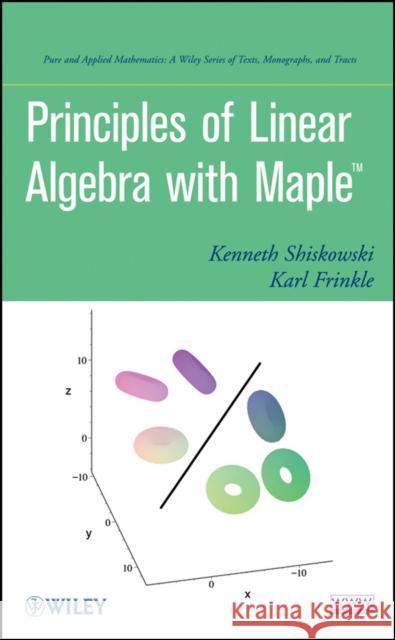
Kenneth Shiskowski; Karl Frinkle
Principles of Linear Algebra With Maple Kenneth M. Shiskowski Karl Frinkle 9780470637593 John Wiley & Sons - książkaWidoczna okładka, to zdjęcie poglądowe, a rzeczywista szata graficzna może różnić się od prezentowanej.

Principles of Linear Algebra With Maple

ISBN-13: 9780470637593 / Angielski / Twarda / 2010 / 616 str.

Kenneth Shiskowski; Karl Frinkle
cena 594,13 zł
(netto: 565,84 VAT:  5%)

Najniższa cena z 30 dni: 589,26 zł
Termin realizacji zamówienia:
ok. 30 dni roboczych
Bez gwarancji dostawy przed świętami

Darmowa dostawa!

An accessible introduction to the theoretical and computational aspects of linear algebra using MapleTM

Many topics in linear algebra can be computationally intensive, and software programs often serve as important tools for understanding challenging concepts and visualizing the geometric aspects of the subject. Principles of Linear Algebra with Maple uniquely addresses the quickly growing intersection between subject theory and numerical computation, providing all of the commands required to solve complex and computationally challenging linear algebra problems using Maple. The authors supply an informal, accessible, and easy-to-follow treatment of key topics often found in a first course in linear algebra. Requiring no prior knowledge of the software, the book begins with an introduction to the commands and programming guidelines for working with Maple. Next, the book explores linear systems of equations and matrices, applications of linear systems and matrices, determinants, inverses, and Cramer's rule. Basic linear algebra topics such as vectors, dot product, cross product, and vector projection are explained, as well as the more advanced topics of rotations in space, rolling a circle along a curve, and the TNB Frame. Subsequent chapters feature coverage of linear transformations from Rn to Rm, the geometry of linear and affine transformations, least squares fits and pseudoinverses, and eigenvalues and eigenvectors. The authors explore several topics that are not often found in introductory linear algebra books, including sensitivity to error and the effects of linear and affine maps on the geometry of objects. The Maple software highlights the topic's visual nature, as the book is complete with numerous graphics in two and three dimensions, animations, symbolic manipulations, numerical computations, and programming. In addition, a related Web site features supplemental material, including Maple code for each chapter's problems, solutions, and color versions of the book's figures. Extensively class-tested to ensure an accessible presentation, Principles of Linear Algebra with Maple is an excellent book for courses on linear algebra at the undergraduate level. It is also an ideal reference for students and professionals who would like to gain a further understanding of the use of Maple to solve linear algebra problems.


Kategorie:
Nauka, Matematyka
Kategorie BISAC:
Mathematics > Algebra - Liniowa
Wydawca:
John Wiley & Sons
Seria wydawnicza:
Pure and Applied Mathematics: A Wiley Series of Texts, Monog
Język:
Angielski
ISBN-13:
9780470637593
Rok wydania:
2010
Numer serii:
000417928
Ilość stron:
616
Waga:
0.99 kg
Wymiary:
23.62 x 15.49 x 3.3
Oprawa:
Twarda
Wolumenów:
01
Dodatkowe informacje:
Bibliografia


Preface.

Conventions and Notations.

1 An Introduction To Maple.

1.1 The Commands .

1.2 Programming.

2 Linear Systems of Equations and Matrices.

2.1 Linear Systems of Equations.

2.2 Augmented Matrix of a Linear System and Row Operations.

2.3 Some Matrix Arithmetic.

3 Gauss–Jordan Elimination and Reduced Row Echelon Form.

3.1 Gauss–Jordan Elimination and rref.

3.2 Elementary Matrices.

3.3 Sensitivity of Solutions to Error in the Linear System.

4 Applications of Linear Systems and Matrices.

4.1 Applications of Linear Systems to Geometry.

4.2 Applications of Linear Systems to Curve Fitting.

4.3 Applications of Linear Systems to Economics.

4.4 Applications of Matrix Multiplication to Geometry.

4.5 An Application of Matrix Multiplication to Economics.

5 Determinants, Inverses and Cramer s Rule.

5.1 Determinants and Inverses from the Adjoint Formula.

5.2 Determinants by Expanding Along Any Row or Column .

5.3 Determinants Found by Triangularizing Matrices.

5.4 LU Factorization.

5.5 Inverses from rref.

5.6 Cramer s Rule.

6 Basic Linear Algebra Topics.

6.1 Vectors.

6.2 Dot Product.

6.3 Cross Product.

6.4 Vector Projection.

7 A Few Advanced Linear Algebra Topics.

7.1 Rotations in Space.

7.2 Rolling a Circle Along a Curve.

7.3 The TNB Frame.

8 Independence, Basis and Dimension for Subspaces of Rn.

8.1 Subspaces of Rn.

8.2 Independent and Dependent Sets of Vectors in Rn.

8.3 Basis and Dimension for Subspaces of Rn.

8.4 Vector Projection onto a Subspace of Rn.

8.5 The Gram–Schmidt Orthonormalization Process.

9 Linear Maps from Rn to Rm.

9.1 Basics About Linear Maps.

9.2 The Kernel and Image Subspaces of a Linear Map.

9.3 Composites of Two Linear maps and Inverses.

9.4 Change of Bases for the Matrix Representation of a Linear Map.

10 The Geometry of Linear and Affine Maps.

10.1 The Effect of a Linear Map on Area and Arclength in Two Dimensions.

10.2 The Decomposition of Linear Maps into Rotations, Reflections and Rescalings in R2.

10.3 The Effect of Linear Maps on Volume, Area and Arclength in R3.

10.4 Rotations, Reflections and Rescalings in Three Dimensions.

10.5 Affine Maps.

11 Least Squares Fits and Pseudoinverses.

11.1 Pseudoinverse to a Non–Square Matrix and Almost Solving an Overdetermined Linear System.

11.2 Fits and Pseudoinverses.

11.3 Least Squares Fits and Pseudoinverses.

12 Eigenvalues and Eigenvectors.

12.1 What Are Eigenvalues and Eigenvectors, and Why Do We Need Them?

12.2 Summary of Definitions and Methods for Computing Eigenvalues and Eigenvectors as well as the Exponential of a Matrix.

12.3 Applications of the Diagonalizability of Square Matrices.

12.4 Solving a Square First Order Linear.

System of Differential Equations . . . . . . . . . . . . . . . . . .

12.5 Basic Facts About Eigenvalues and Eigenvectors, and Diagonalizability.

12.6 The Geometry of the Ellipse Using Eigenvalues and Eigenvectors.

12.7 A Maple Eigen–Procedure.

Bibliography.

Indices.

Keyword Index.

Index of Maple Commands and Packages.

Kenneth Shiskowski, PhD, is Professor of Mathematics at Eastern Michigan University. His areas of research interest include numerical analysis, the history of mathematics, the integration of technology into mathematics, differential geometry, and dynamical systems.

Karl H. Frinkle, PhD, is Associate Professor of Mathematics at Southeastern Oklahoma State University. He has extensive academic experience teaching in the areas of algebra, trigonometry, and calculus. Dr. Frinkle currently focuses his research on Bose–Einstein condensates, nonlinear optics, dynamical systems, and the integration of technology into mathematics.

An accessible introduction to the theoretical and computational aspects of linear algebra using MapleTM

Many topics in linear algebra can be computationally intensive, and software programs often serve as important tools for understanding challenging concepts and visualizing the geometric aspects of the subject. Principles of Linear Algebra with Maple uniquely addresses the quickly growing intersection between subject theory and numerical computation, providing all of the commands required to solve complex and computationally challenging linear algebra problems using Maple. The authors supply an informal, accessible, and easy–to–follow treatment of key topics often found in a first course in linear algebra.

Requiring no prior knowledge of the software, the book begins with an introduction to the commands and programming guidelines for working with Maple. Next, the book explores linear systems of equations and matrices, applications of linear systems and matrices, determinants, inverses, and Cramer′s rule. Basic linear algebra topics such as vectors, dot product, cross product, and vector projection are explained, as well as the more advanced topics of rotations in space, rolling a circle along a curve, and the TNB Frame. Subsequent chapters feature coverage of linear transformations from Rn to Rm, the geometry of linear and affine transformations, least squares fits and pseudoinverses, and eigenvalues and eigenvectors.

The authors explore several topics that are not often found in introductory linear algebra books, including sensitivity to error and the effects of linear and affine maps on the geometry of objects. The Maple software highlights the topic′s visual nature, as the book is complete with numerous graphics in two and three dimensions, animations, symbolic manipulations, numerical computations, and programming. In addition, a related Web site features supplemental material, including Maple code for each chapter′s problems, solutions, and color versions of the book′s figures.

Extensively class–tested to ensure an accessible presentation, Principles of Linear Algebra with Maple is an excellent book for courses on linear algebra at the undergraduate level. It is also an ideal reference for students and professionals who would like to gain a further understanding of the use of Maple to solve linear algebra problems.




Udostępnij

Facebook - konto krainaksiazek.pl


Opinie o Krainaksiazek.pl na Opineo.pl

Partner Mybenefit

Krainaksiazek.pl w programie rzetelna firma Krainaksiaze.pl - płatności przez paypal

Czytaj nas na:

Facebook - krainaksiazek.pl
  • książki na zamówienie
  • granty
  • książka na prezent
  • kontakt
  • pomoc
  • opinie
  • regulamin
  • polityka prywatności

Zobacz:

  • Księgarnia czeska

  • Wydawnictwo Książkowe Klimaty

1997-2025 DolnySlask.com Agencja Internetowa

© 1997-2022 krainaksiazek.pl
     
KONTAKT | REGULAMIN | POLITYKA PRYWATNOŚCI | USTAWIENIA PRYWATNOŚCI
Zobacz: Księgarnia Czeska | Wydawnictwo Książkowe Klimaty | Mapa strony | Lista autorów
KrainaKsiazek.PL - Księgarnia Internetowa

Polityka prywatnosci - link
Krainaksiazek.pl - płatnośc Przelewy24
Przechowalnia Przechowalnia




