• Wyszukiwanie zaawansowane
  • Kategorie
  • Kategorie BISAC
  • Książki na zamówienie
  • Promocje
  • Granty
  • Książka na prezent
  • Opinie
  • Pomoc
  • Załóż konto
  • Zaloguj się

Principles of Inventory Management: When You Are Down to Four, Order More » książka


zaloguj się | załóż konto
Logo Krainaksiazek.pl

koszyk

konto

szukaj
topmenu
Księgarnia internetowa
Szukaj
Książki na zamówienie
Promocje
Granty
Książka na prezent
Moje konto
Pomoc
 
 
Wyszukiwanie zaawansowane
Pusty koszyk
Bezpłatna dostawa dla zamówień powyżej 20 złBezpłatna dostawa dla zamówień powyżej 20 zł

Kategorie główne

• Nauka
 [2946600]
• Literatura piękna
 [1856966]

  więcej...
• Turystyka
 [72221]
• Informatyka
 [151456]
• Komiksy
 [35826]
• Encyklopedie
 [23190]
• Dziecięca
 [619653]
• Hobby
 [140543]
• AudioBooki
 [1577]
• Literatura faktu
 [228355]
• Muzyka CD
 [410]
• Słowniki
 [2874]
• Inne
 [445822]
• Kalendarze
 [1744]
• Podręczniki
 [167141]
• Poradniki
 [482898]
• Religia
 [510455]
• Czasopisma
 [526]
• Sport
 [61590]
• Sztuka
 [243598]
• CD, DVD, Video
 [3423]
• Technologie
 [219201]
• Zdrowie
 [101638]
• Książkowe Klimaty
 [124]
• Zabawki
 [2473]
• Puzzle, gry
 [3898]
• Literatura w języku ukraińskim
 [254]
• Art. papiernicze i szkolne
 [8170]
Kategorie szczegółowe BISAC

Principles of Inventory Management: When You Are Down to Four, Order More

ISBN-13: 9780387244921 / Angielski / Twarda / 2009 / 339 str.
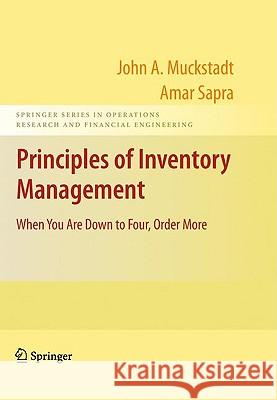
John A. Muckstadt; Amar Sapra
Principles of Inventory Management: When You Are Down to Four, Order More Muckstadt, John A. 9780387244921 Springer - książkaWidoczna okładka, to zdjęcie poglądowe, a rzeczywista szata graficzna może różnić się od prezentowanej.

Principles of Inventory Management: When You Are Down to Four, Order More

ISBN-13: 9780387244921 / Angielski / Twarda / 2009 / 339 str.

John A. Muckstadt; Amar Sapra
cena 201,72 zł
(netto: 192,11 VAT:  5%)

Najniższa cena z 30 dni: 192,74 zł
Termin realizacji zamówienia:
ok. 22 dni roboczych
Bez gwarancji dostawy przed świętami

Darmowa dostawa!

Inventories are prevalent everywhere in the commercial world, whether it be in retail stores, manufacturing facilities, government stockpile material, Federal Reserve banks, or even your own household. This textbook examines basic mathematical techniques used to sufficiently manage inventories by using various computational methods and mathematical models.

The text is presented in a way such that each section can be read independently, and so the order in which the reader approaches the book can be inconsequential. It contains both deterministic and stochastic models along with algorithms that can be employed to find solutions to a variety of inventory control problems.
With exercises at the end of each chapter and a clear, systematic exposition, this textbook will appeal to advanced undergraduate and first-year graduate students in operations research, industrial engineering, and quantitative MBA programs. It also serves as a reference for professionals in both industry and government worlds. The prerequisite courses include introductory optimization methods, probability theory (non-measure theoretic), and stochastic processes.


Kategorie:
Nauka, Ekonomia i biznes
Kategorie BISAC:
Business & Economics > Operations Research
Mathematics > Matematyka stosowana
Mathematics > Programowanie liniowe
Wydawca:
Springer
Seria wydawnicza:
Springer Series in Operations Research and Financial Enginee
Język:
Angielski
ISBN-13:
9780387244921
Rok wydania:
2009
Wydanie:
2010
Numer serii:
000309878
Ilość stron:
339
Waga:
0.81 kg
Wymiary:
25.65 x 18.29 x 3.05
Oprawa:
Twarda
Wolumenów:
01
Dodatkowe informacje:
Bibliografia
Wydanie ilustrowane

From the reviews:

"This book on inventory management is based on a collection of lectures at Cornell University and consists of 10 chapters. ... The book has been written in a form so that sections can be mostly independently read. Each chapter finishes with some exercises. This textbook is particularly suitable for graduate students which are familiar with basic optimization methods, probability theory and stochastic processes. In addition, it can also be used by practitioners as a reference tool." (Frank Werner, Zentralblatt MATH, Vol. 1186, 2010)

1 Inventories Are Everywhere.- 1.1 The Roles of Inventory.- 1.2 Fundamental Questions.- 1.3 Factors Affecting Inventory Policy Decisions.- 1.3.1 System Structure.- 1.3.2 The Items.- 1.3.3 Market Characteristics.- 1.3.4 Lead Times.- 1.3.5 Costs.- 1.4 Measuring Performance.- 2 EOQ Model.- 2.1 Model Development: Economic Order Quantity (EOQ) Model.- 2.1.1 Robustness of the EOQ Model.- 2.1.2 Reorder Point and Reorder Interval.- 2.2 EOQ Model with Backordering Allowed.- 2.2.1 The Optimal Cost.- 2.3 Quantity Discount Model.- 2.3.1 All Units Discount.- 2.3.2 An Algorithm to Determine the Optimal Order Quantity for the All Units Discount Case.- 2.3.3 Incremental Quantity Discounts.- 2.3.4 An Algorithm to Determine the Optimal Order Quantity for the Incremental Quantity Discount Case.- 2.4 Lot Sizing When Constraints Exist.- 2.5 Exercises.- 3 Power-of-Two Policies.- 3.1 Basic Framework.- 3.1.1 Power-of-Two Policies.- 3.1.2 PO2 Policy for a Single-Stage System.- 3.1.2.1 Cost for the Optimal PO2 Policy.- 3.2 Serial Systems.- 3.2.1 Assumptions and Nomenclature.- 3.2.2 A Mathematical Model for Serial Systems.- 3.2.3 Algorithm to Obtain an Optimal Solution to (RP).- 3.3 Multi-Echelon Distribution Systems.- 3.3.1 A Mathematical Model for Distribution Systems.- 3.3.1.1 Relaxed Problem.- 3.3.2 Powers-of-Two Solution.- 3.4 Joint Replenishment Problem (JRP).- 3.4.1 A Mathematical Model for Joint Replenishment Systems.- 3.4.2 Rounding the Solution to the Relaxed Problem.- 3.5 Exercises.- Dynamic Lot Sizing with Deterministic Demand.- 4.1 The Wagner–Whitin (WW) Algorithm.- 4.1.1 Solution Approach.- 4.1.2 Algorithm.- 4.1.3 Shortest-Path Representation of the Dynamic Lot Sizing Problem.- 4.1.4 Technical Appendix for the Wagner–Whitin Algorithm.- 4.2 Wagelmans–Hoesel–Kolen (WHK) Algorithm.- 4.2.1 Model Formulation.- 4.2.2 An Order T logT Algorithm for Solving Problem (4.5).- 4.2.3 Algorithm.- 4.3 Heuristic Methods.- 4.3.1 Silver–Meal Heuristic.- 4.3.2 Least UnitCost Heuristic.- 4.4 A Comment on the Planning Horizon.- 4.5 Exercises.- 5 Single-Period Models.- 5.1 Making Decisions in the Presence of Uncertainty.- 5.2 An Example.- 5.2.1 The Data.- 5.2.2 The Decision Model.- 5.3 Another Example.- 5.4 Multiple Items.- 5.4.1 A General Model.- 5.4.2 Multiple Constraints.- 5.5 Exercises.- 6 Inventory Planning over Multiple Time Periods: Linear-Cost Case.- 6.1 Optimal Policies.- 6.1.1 The Single-Unit, Single-Customer Approach: Single-Location Case.- 6.1.1.1 Notation and Definitions.- 6.1.1.2 Optimality of Base-Stock Policies.- 6.1.1.3 Stochastic Lead Times.- 6.1.1.4 The Serial Systems Case.- 6.1.1.5 Generalized of Demand Model.- 6.1.1.6 Capacity Limitations.- 6.2 Finding Optimal Stock Levels.- 6.2.1 Finite Planning Horizon Analysis.- 6.2.2 Constant, Positive Lead Time Case.- 6.2.3 End-of-Horizon Effects.- 6.2.4 Infinite-Horizon Analysis.- 6.2.5 Lost Sales.- 6.3 Capacity Limited Systems.- 6.3.1 The Shortfall Distribution.- 6.3.1.1 General Properties.- 6.3.2 Discrete Demand Case.- 6.3.3 An Example.- 6.4 A Serial System.- 6.4.1 An Echelon-Based Approach for Managing Inventories in Serial Systems.- 6.4.1.1 A Decision Model.- 6.4.1.2 A Dynamic Programming Formulation of the Decision Problem.- 6.4.1.3 An Algorithm for Computing Optimal Echelon Stock Levels.- 6.4.1.4 Solving the Oil Rig Problem: The Stationary Demand Case.- 6.5 Exercises.- 7 Background Concepts: An Introduction to the (s-1, s) Policy under Poisson Demand.- 7.1 Steady State.- 7.1.1 Backorder Case.- 7.1.2 Lost Sales Case.- 7.2 Performance Measures.- 7.3 Properties of the Performance Measures.- 7.4 Finding Stock Levels in (s-1, s) Policy Managed Systems: Optimization Problem Formulations and Solution Algorithms.- 7.4.1 First Example: Minimize Expected Backorders Subject to an Inventory Investment Constraint.- 7.4.2 Second Example: Maximize Expected System Average Fill Rate Subject to an Inventory Investment Constraint.- 7.5 Exercises.- 8 A Tactical Planning Model f

Inventories are prevalent everywhere in the commercial world, whether it be in retail stores, manufacturing facilities, government stockpile material, Federal Reserve banks, or even your own household.  This textbook examines basic mathematical techniques used  to sufficiently manage inventories by using various computational methods and mathematical models.  Such models discussed include: EOQ model and extensions, power-of-two models, single and multi-period models, probabilistic lot sizing models, multi-echelon stochastic models, Laplace and Normal demand models, exact Poisson model, and many more.

Principles of Inventory Management begins with an introductory chapter in which the basics of inventory systems and mathematical assumptions for all models are grouped together.  The text is presented in a way such that each section can be read independently, and so the order in which the reader approaches the book can be inconsequential.  It contains both deterministic and stochastic models along with algorithms that can be employed to find solutions to a variety of inventory control problems.

Key topics include:

* Economic order quantity (EOQ) model

* Power-of-two policies

* Dynamic lot sizing

* Single and multi-period stochastic models   

* Echelon-based approaches

* Multi-echelon systems

* Single and multi-item models


With exercises at the end of each chapter and a clear, systematic exposition,  this textbook will appeal to advanced undergraduate and first-year graduate students in operations research, industrial engineering, and quantitative MBA programs. It also serves as a reference for professionals in both industry and government worlds.  The prerequisite courses include introductory optimization methods, probability theory (non-measure theoretic), and stochastic processes.




Udostępnij

Facebook - konto krainaksiazek.pl


Opinie o Krainaksiazek.pl na Opineo.pl

Partner Mybenefit

Krainaksiazek.pl w programie rzetelna firma Krainaksiaze.pl - płatności przez paypal

Czytaj nas na:

Facebook - krainaksiazek.pl
  • książki na zamówienie
  • granty
  • książka na prezent
  • kontakt
  • pomoc
  • opinie
  • regulamin
  • polityka prywatności

Zobacz:

  • Księgarnia czeska

  • Wydawnictwo Książkowe Klimaty

1997-2025 DolnySlask.com Agencja Internetowa

© 1997-2022 krainaksiazek.pl
     
KONTAKT | REGULAMIN | POLITYKA PRYWATNOŚCI | USTAWIENIA PRYWATNOŚCI
Zobacz: Księgarnia Czeska | Wydawnictwo Książkowe Klimaty | Mapa strony | Lista autorów
KrainaKsiazek.PL - Księgarnia Internetowa

Polityka prywatnosci - link
Krainaksiazek.pl - płatnośc Przelewy24
Przechowalnia Przechowalnia



