• Wyszukiwanie zaawansowane
  • Kategorie
  • Kategorie BISAC
  • Książki na zamówienie
  • Promocje
  • Granty
  • Książka na prezent
  • Opinie
  • Pomoc
  • Załóż konto
  • Zaloguj się

Preserving Archives » książka


zaloguj się | załóż konto
Logo Krainaksiazek.pl

koszyk

konto

szukaj
topmenu
Księgarnia internetowa
Szukaj
Książki na zamówienie
Promocje
Granty
Książka na prezent
Moje konto
Pomoc
 
 
Wyszukiwanie zaawansowane
Pusty koszyk
Bezpłatna dostawa dla zamówień powyżej 20 złBezpłatna dostawa dla zamówień powyżej 20 zł

Kategorie główne

• Nauka
 [2946600]
• Literatura piękna
 [1856966]

  więcej...
• Turystyka
 [72221]
• Informatyka
 [151456]
• Komiksy
 [35826]
• Encyklopedie
 [23190]
• Dziecięca
 [619653]
• Hobby
 [140543]
• AudioBooki
 [1577]
• Literatura faktu
 [228355]
• Muzyka CD
 [410]
• Słowniki
 [2874]
• Inne
 [445822]
• Kalendarze
 [1744]
• Podręczniki
 [167141]
• Poradniki
 [482898]
• Religia
 [510455]
• Czasopisma
 [526]
• Sport
 [61590]
• Sztuka
 [243598]
• CD, DVD, Video
 [3423]
• Technologie
 [219201]
• Zdrowie
 [101638]
• Książkowe Klimaty
 [124]
• Zabawki
 [2473]
• Puzzle, gry
 [3898]
• Literatura w języku ukraińskim
 [254]
• Art. papiernicze i szkolne
 [8170]
Kategorie szczegółowe BISAC

Preserving Archives

ISBN-13: 9781856048231 / Angielski / Miękka / 2013 / 336 str.
Helen Forde;Jonathan Rhys-Lewis
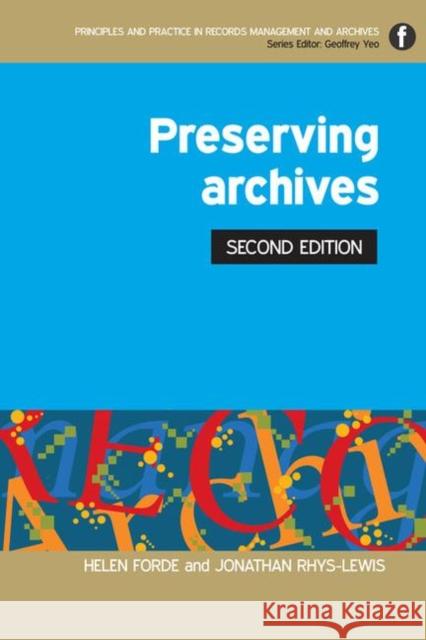
Preserving Archives Helen Forde Jonathan Rhys-Lewis  9781856048231 Facet Publishing - książkaWidoczna okładka, to zdjęcie poglądowe, a rzeczywista szata graficzna może różnić się od prezentowanej.

Preserving Archives

ISBN-13: 9781856048231 / Angielski / Miękka / 2013 / 336 str.

Helen Forde;Jonathan Rhys-Lewis
cena 358,68 zł
(netto: 341,60 VAT:  5%)

Najniższa cena z 30 dni: 327,43 zł
Termin realizacji zamówienia:
ok. 30 dni roboczych
Bez gwarancji dostawy przed świętami

Darmowa dostawa!

A brand new and fully updated edition of this seminal work on archival preservation. Access to archival material - the documentary heritage of people all over the world that gives them their identity and ensures their rights - is dependent on the survival of fragile materials: paper, parchment, photographic materials, audiovisual materials and, most recently, magnetic and optical formats. The primary importance of such survival is widely acknowledged but sometimes overlooked in a rush to provide ever better means of access. But without the basic material, no services can be offered. Preservation is the heart of archival activity. Archivists in all types of organizations face questions of how to plan a preservation strategy in less than perfect circumstances, or deal with a sudden emergency. This book considers the causes of threats to the basic material, outlines the preservation options available and offers flexible solutions applicable in a variety of situations. It offers a wide range of case studies and examples from international specialists. This revised edition also includes a new chapter on the management and training of volunteers, reflecting a key concern for many archival institutions. This is a vital handbook for professional archivists, but also for the many librarians, curators and enthusiasts, trained and untrained, in museums, local studies centres and voluntary societies in need of good clear advice


Kategorie:
Nauka, Językoznawstwo
Kategorie BISAC:
Language Arts & Disciplines > Library & Information Science - Archives & Special Libraries
Wydawca:
Facet Publishing
Język:
Angielski
ISBN-13:
9781856048231
Rok wydania:
2013
Wydanie:
Revised
Numer serii:
000503947
Ilość stron:
336
Oprawa:
Miękka
Wolumenów:
01

Introduction to the series - Geoffrey Yeo
1. Introducing archive preservation

  • Introduction
  • How has the relationship between conservation and preservation developed?
  • Definitions
  • Summary
  • Notes

2. Understanding archival materials and their characteristics

  • Introduction
  • Paper
  • Parchment
  • Inks: from carbon ink to laser printing
  • Photographic materials
  • Analogue audiovisual materials: wax cylinders, shellac and vinyl discs and film
  • Optical materials: CDs and DVDs
  • Magnetic materials: tape, hard disks and floppy disks
  • Minidiscs
  • Portable digital storage
  • Summary
  • Notes and references

3. Managing digital preservation

  • Introduction
  • Why is digital preservation management important?
  • Why is digital preservation difficult?
  • Costs of digital preservation
  • What should be preserved?
  • Who should be involved?
  • What is the starting point?
  • What happens next?
  • Summary
  • Notes and references

4. Archive buildings and their characteristics

  • Introduction
  • How has the concept of archive buildings developed?
  • How did archive buildings develop in the UK?
  • What other ideas have developed for archive buildings?
  • What should be considered before building or adapting an existing building to house an archive?
  • What needs to be explained?
  • Location
  • How should the architect be briefed?
  • What are the problems with adapted buildings or historic buildings?
  • Summary
  • Notes and references

5. Safeguarding the building and its contents

  • Introduction
  • Security
  • Fire prevention, detection and suppression
  • Water detection
  • Environmental issues
  • Summary
  • Notes and references

6. Managing archival storage

  • Introduction
  • Why do environmental conditions matter?
  • What needs to be controlled?
  • Mould: why is it such a threat?
  • Measuring and monitoring temperature and humidity
  • Measuring and monitoring pollution levels
  • Special arrangements
  • How can comparative costs be assessed?
  • Shelving, racking and plan chest specifications
  • What kind of equipment is needed?
  • Possible future developments
  • Summary
  • Notes and references

7. Managing risks and avoiding disaster

  • Introduction
  • Why undertake an ‘operation-hope-not’?
  • Definitions
  • Who is responsible for disaster planning?
  • What should be saved first?
  • Development of a disaster control plan: where to start?
  • Prevention
  • Preparation
  • Reaction
  • Recovery
  • Evaluation
  • Summary
  • Notes and references

8. Creating and using surrogates

  • Introduction
  • Copying archive material
  • What copying techniques are available?
  • What problems arise?
  • Developing a preservation copying policy: why do it?
  • How can the copies themselves be preserved?
  • Selecting correct copying methods
  • Preparation of material
  • Copying of material in-house
  • Use of outside agencies
  • Summary
  • Notes and references

9. Moving the records

  • Introduction
  • What are the risks?
  • Planning the project
  • Briefing a suitable removal firm
  • Minimum removal equipment specifications
  • Preparing for the move
  • The move itself
  • And afterwards...
  • Summary
  • Notes and references

10. Exhibiting archives

  • Introduction
  • How can the overall risk be minimized?
  • Managing the care of documents in exhibitions
  • Planning and preparing for an exhibition
  • During the exhibition
  • And afterwards...
  • Summary
  • Notes and references

11. Handling the records

  • Introduction
  • The problem
  • Improving the quality of care: how can it be achieved?
  • Where and how can good practice be demonstrated to readers?
  • How can staff be best trained?
  • Summary
  • Notes

12. Managing a pest control programme

  • Introduction
  • What are the common pests?
  • What damage do pests do to archival materials?
  • Where are they likely to be active?
  • What are the signs of an infestation?
  • How can they be prevented from getting into the collections?
  • Why are previous eradication measures no longer used?
  • Why is integrated pest management (IPM) now adopted as a strategy?
  • How can IPM be introduced?
  • Setting traps
  • Dealing with an infestation
  • Ongoing management
  • Summary
  • Notes and references

13. Training and the use of volunteers

  • Introduction
  • What options for preservation training are available?
  • What areas of preservation should be covered?
  • The use of volunteers
  • What are the key challenges of using volunteers?
  • Using volunteers for preservation activities
  • The importance of documentation
  • Volunteers and the interface with conservation
  • Summary
  • Notes and references

14. Putting preservation into practice

  • Introduction
  • Choices and options
  • Who is responsible?
  • What is a preservation policy?
  • What about strategies?
  • Costs, funding and options
  • How is a programme planned and put into action?
  • And the results?
  • Notes and references

Appendices

  1. The National Archives Conditions for Loans policy
  2. A conservation workshop
  3. Compiling a Preservation Policy; an advisory template
  4. UCL Library Services: Volunteer Agreement
  5. Benchmarking entries: MLA

Bibliography
British and international standards relating to archive preservation


Udostępnij

Facebook - konto krainaksiazek.pl


Opinie o Krainaksiazek.pl na Opineo.pl

Partner Mybenefit

Krainaksiazek.pl w programie rzetelna firma Krainaksiaze.pl - płatności przez paypal

Czytaj nas na:

Facebook - krainaksiazek.pl
  • książki na zamówienie
  • granty
  • książka na prezent
  • kontakt
  • pomoc
  • opinie
  • regulamin
  • polityka prywatności

Zobacz:

  • Księgarnia czeska

  • Wydawnictwo Książkowe Klimaty

1997-2025 DolnySlask.com Agencja Internetowa

© 1997-2022 krainaksiazek.pl
     
KONTAKT | REGULAMIN | POLITYKA PRYWATNOŚCI | USTAWIENIA PRYWATNOŚCI
Zobacz: Księgarnia Czeska | Wydawnictwo Książkowe Klimaty | Mapa strony | Lista autorów
KrainaKsiazek.PL - Księgarnia Internetowa

Polityka prywatnosci - link
Krainaksiazek.pl - płatnośc Przelewy24
Przechowalnia Przechowalnia






