• Wyszukiwanie zaawansowane
  • Kategorie
  • Kategorie BISAC
  • Książki na zamówienie
  • Promocje
  • Granty
  • Książka na prezent
  • Opinie
  • Pomoc
  • Załóż konto
  • Zaloguj się

Prescribing Hemodialysis: A Guide to Urea Modeling » książka


zaloguj się | załóż konto
Logo Krainaksiazek.pl

koszyk

konto

szukaj
topmenu
Księgarnia internetowa
Szukaj
Książki na zamówienie
Promocje
Granty
Książka na prezent
Moje konto
Pomoc
 
 
Wyszukiwanie zaawansowane
Pusty koszyk
Bezpłatna dostawa dla zamówień powyżej 20 złBezpłatna dostawa dla zamówień powyżej 20 zł

Kategorie główne

• Nauka
 [2946600]
• Literatura piękna
 [1856966]

  więcej...
• Turystyka
 [72221]
• Informatyka
 [151456]
• Komiksy
 [35826]
• Encyklopedie
 [23190]
• Dziecięca
 [619653]
• Hobby
 [140543]
• AudioBooki
 [1577]
• Literatura faktu
 [228355]
• Muzyka CD
 [410]
• Słowniki
 [2874]
• Inne
 [445822]
• Kalendarze
 [1744]
• Podręczniki
 [167141]
• Poradniki
 [482898]
• Religia
 [510455]
• Czasopisma
 [526]
• Sport
 [61590]
• Sztuka
 [243598]
• CD, DVD, Video
 [3423]
• Technologie
 [219201]
• Zdrowie
 [101638]
• Książkowe Klimaty
 [124]
• Zabawki
 [2473]
• Puzzle, gry
 [3898]
• Literatura w języku ukraińskim
 [254]
• Art. papiernicze i szkolne
 [8170]
Kategorie szczegółowe BISAC

Prescribing Hemodialysis: A Guide to Urea Modeling

ISBN-13: 9781461288114 / Angielski / Miękka / 2011 / 292 str.
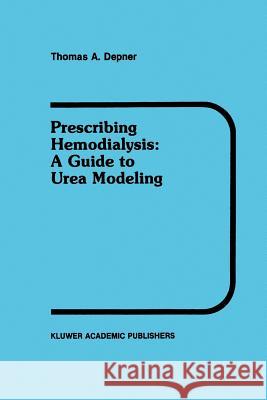
T. a. Depner
Prescribing Hemodialysis: A Guide to Urea Modeling Depner, T. a. 9781461288114 Springer - książkaWidoczna okładka, to zdjęcie poglądowe, a rzeczywista szata graficzna może różnić się od prezentowanej.

Prescribing Hemodialysis: A Guide to Urea Modeling

ISBN-13: 9781461288114 / Angielski / Miękka / 2011 / 292 str.

T. a. Depner
cena 806,99 zł
(netto: 768,56 VAT:  5%)

Najniższa cena z 30 dni: 771,08 zł
Termin realizacji zamówienia:
ok. 22 dni roboczych
Bez gwarancji dostawy przed świętami

Darmowa dostawa!
inne wydania

What regulation shall we have for the operation? Shall a man transfuse he knows not what. to correct he knows not what. God knows how (l)? Dr. Henry Stubbs Royal College of Physicians circa 1670 If dialysis therapy were a new phannaceutical product being evaluated by the FDA now, it might not be approved for marketing. The recommended dose, its potential toxicity, the side effects of under-or over-dialysis as well as its efficacy have been the subject of very few studies. The high mortality rate associated with the treatment may raise a few eyebrows. That it is a life-saving modality of treatment is undoubtedly true for more than 100,000 patients in the United States and for more than a million patients world wide. Because dialysis has extended the lives of many people by a variable period of time, most nephrologists have "rested on their laurels" and did not vigorously pursue studies to optimize these treatments. But facts have a way of intruding in all our lives and the facts are that the overall mortality rate of dialysis patients in the United States is rising and stands close to 25% per year and is closer to 33% per year for patients between the ages of 65 and 74 (2). These mortality figures are considerably higher for age-adjusted dialysis populations in Europe and particu larly in Japan, and certainly for the age-adjusted nonnal population."


Kategorie:
Nauka, Medycyna
Kategorie BISAC:
Medical > Nefrologia
Gardening > General
Medical > Diseases
Wydawca:
Springer
Seria wydawnicza:
Developments in Nephrology
Język:
Angielski
ISBN-13:
9781461288114
Rok wydania:
2011
Wydanie:
1991
Numer serii:
000089857
Ilość stron:
292
Waga:
0.45 kg
Wymiary:
23.39 x 15.6 x 1.7
Oprawa:
Miękka
Wolumenów:
01
Dodatkowe informacje:
Wydanie ilustrowane

1. Uremic Toxins & Dialysis.- The uremic syndrome.- Role of protein nitrogen metabolism.- Clinical measurement of uremia.- Effect of dialysis on the uremic syndrome.- Proposed uremic toxins.- Alternatives to the single-toxin theory.- Protein and tissue binding of proposed uremic toxins.- Toxic contributions of dialysis itself.- Where urea fits into the toxin theories.- 2. Urea Metabolism: Clinical Chemistry of Urea.- Excretion of nitrogenous waste products: comparative physiology.- Biochemistry of urea.- Inborn errors of urea metabolism: urea cycle enzymopathies.- Urea transport.- Nitrogen recycling.- Methods of urea measurement.- The toxicity of urea.- 3. Urea Modeling: Introduction.- Definition of modeling.- Evolution of urea modeling.- Why urea instead of other solutes?.- Quantifying hemodialysis therapy.- Quality assurance programs and urea modeling.- Urea modeling development and techniques.- What is the purpose of urea modeling?.- Urea modeling for high-flux, short-duration dialysis.- What clinical data are provided by urea modeling?.- Significance of the urea distribution volume (V).- Significance of the urea nitrogen generation rate (G).- Components of the dialysis prescription.- Measures of prescription effectiveness.- 4. Single-Compartment Model.- Models for hemodialysis urea kinetics.- Overview of kinetic analysis.- Laws of diffusion.- First-order kinetics: clearance, rate constant, half-life, and exponential decline.- The single-compartment model.- Constant-volume model, three BUN measurements.- Evaluation of the constant-volume model.- Variable-volume model, three BUN measurements.- Source code for the variable-volume model, three BUN values.- Two-BUN method, variable volume.- Comparison of the two-BUN method with the three-BUN method.- Source code for the variable-volume model, two BUN values.- 5. Multicompartment Models.- Urea compartments in normal humans.- Limitations of the single-compartment model.- Description of the two-compartment model.- Site of urea generation.- Postdialysis rebound in urea concentration.- Two-compartment modeling techniques.- Solutions to equations for the two-compartment model.- Graphic description of the two-compartment model.- High-flux dialysis and two compartments.- Solutes with low mass transfer coefficients.- Measuring the intercompartment mass transfer area coefficient.- A comparison of one-compartment with two-compartment models.- The direct quantification method.- Impact of pool number on calculated variables.- Determinants of postdialysis urea rebound.- Two-compartment model with variable ECF volume.- Two-compartment model with variable ECF and ICF volume.- The magnitude of intracellular swelling.- Additional compartments.- Recommendations regarding modeling with one versus two compartments.- Blood sampling techniques and precautions.- 6. A Practical Solution: Ureakin.- Value of the computer program.- Description of the program.- Theoretical basis for the program.- Conventions and assumptions.- Files and file extensions used by UREAKIN.- Options available from the main menu.- Refinements to UREAKIN.- 7. Refinements and Application of Urea Modeling.- Measuring blood urea concentrations.- Compensation for blood and plasma water content.- Dialyzer urea clearance.- Effect of fluid balance on kinetic measurements.- Recirculation of dialyzer venous blood.- Residual (native kidney) urea clearance: its significance.- Simplified methods for urea modeling.- 8. Measuring Dialysis: How Much is Enough?.- Historical methods.- Kt/V: A yardstick for dialysis therapy.- Measuring dialysis outcome.- The adequacy of dialysis.- Comparing dialysis outcome with the prescription.- 9. Examples of Urea Modeling.- Case 1: Expected results in an average adult patient.- Case 2: A case with no residual function and no weight gain between dialyses; the effect of changing Kd..- Case 3: The patient with significant residual renal function (Kr).- Case 4: Effects of habitually large weight gains between dialyses.- Case 5: The patient with high protein intake.- Case 6: The patient with low protein intake.- Case 7: The patient treated with high-flux dialysis.- Case 8: The patient whose dialyzer clearance (Kd) varies from the expected clearance.- Case 9: Small patients and the pediatric patient.- 10. The Future.- Dialysis versus other treatments for end-stage renal failure.- Outcome parameters for high-flux dialysis.- More complex models.- Modeling other solutes.- Better markers for uremia.- Improved blood flow monitoring.- Dialysate modeling.- Real-time monitoring of urea kinetics.- Urea modeling from the total-care perspective.- Appendicies.- Appendix A. Source code for a single-compartment, variable-volume model: three-BUN method.- Appendix B. Source code for a single-compartment, variable-volume model: two-BUN method.- Appendix C. Source code for a two-compartment, fixed-volume model.- Appendix D. Numerical solution for a two-compartment, variable-ECV model.- Appendix E. Description of a two-compartment, osmotic model with variable ECV and ICV.- Appendix F. Interpreting the results of urea modeling.- Appendix G. Useful equations.- Appendix H. Examples of data collection forms.- Appendix I. Examples of modeling reports.


Udostępnij

Facebook - konto krainaksiazek.pl


Opinie o Krainaksiazek.pl na Opineo.pl

Partner Mybenefit

Krainaksiazek.pl w programie rzetelna firma Krainaksiaze.pl - płatności przez paypal

Czytaj nas na:

Facebook - krainaksiazek.pl
  • książki na zamówienie
  • granty
  • książka na prezent
  • kontakt
  • pomoc
  • opinie
  • regulamin
  • polityka prywatności

Zobacz:

  • Księgarnia czeska

  • Wydawnictwo Książkowe Klimaty

1997-2025 DolnySlask.com Agencja Internetowa

© 1997-2022 krainaksiazek.pl
     
KONTAKT | REGULAMIN | POLITYKA PRYWATNOŚCI | USTAWIENIA PRYWATNOŚCI
Zobacz: Księgarnia Czeska | Wydawnictwo Książkowe Klimaty | Mapa strony | Lista autorów
KrainaKsiazek.PL - Księgarnia Internetowa

Polityka prywatnosci - link
Krainaksiazek.pl - płatnośc Przelewy24
Przechowalnia Przechowalnia






