• Wyszukiwanie zaawansowane
  • Kategorie
  • Kategorie BISAC
  • Książki na zamówienie
  • Promocje
  • Granty
  • Książka na prezent
  • Opinie
  • Pomoc
  • Załóż konto
  • Zaloguj się

Practical Organic Chemistry: A Student Handbook of Techniques » książka


zaloguj się | załóż konto
Logo Krainaksiazek.pl

koszyk

konto

szukaj
topmenu
Księgarnia internetowa
Szukaj
Książki na zamówienie
Promocje
Granty
Książka na prezent
Moje konto
Pomoc
 
 
Wyszukiwanie zaawansowane
Pusty koszyk
Bezpłatna dostawa dla zamówień powyżej 20 złBezpłatna dostawa dla zamówień powyżej 20 zł

Kategorie główne

• Nauka
 [2946912]
• Literatura piękna
 [1852311]

  więcej...
• Turystyka
 [71421]
• Informatyka
 [150889]
• Komiksy
 [35717]
• Encyklopedie
 [23177]
• Dziecięca
 [617324]
• Hobby
 [138808]
• AudioBooki
 [1671]
• Literatura faktu
 [228371]
• Muzyka CD
 [400]
• Słowniki
 [2841]
• Inne
 [445428]
• Kalendarze
 [1545]
• Podręczniki
 [166819]
• Poradniki
 [480180]
• Religia
 [510412]
• Czasopisma
 [525]
• Sport
 [61271]
• Sztuka
 [242929]
• CD, DVD, Video
 [3371]
• Technologie
 [219258]
• Zdrowie
 [100961]
• Książkowe Klimaty
 [124]
• Zabawki
 [2341]
• Puzzle, gry
 [3766]
• Literatura w języku ukraińskim
 [255]
• Art. papiernicze i szkolne
 [7810]
Kategorie szczegółowe BISAC

Practical Organic Chemistry: A Student Handbook of Techniques

ISBN-13: 9780412282300 / Angielski / Miękka / 1989 / 200 str.
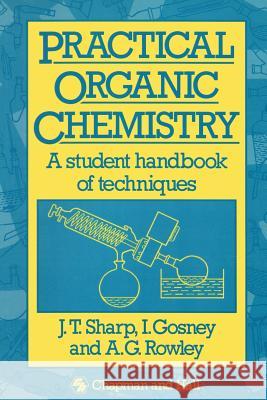
J.T. Sharp;I. Gosney;A.G. Rowley
Practical Organic Chemistry: A Student Handbook of Techniques Sharp, J. T. 9780412282300 Chapman and Hall - książkaWidoczna okładka, to zdjęcie poglądowe, a rzeczywista szata graficzna może różnić się od prezentowanej.

Practical Organic Chemistry: A Student Handbook of Techniques

ISBN-13: 9780412282300 / Angielski / Miękka / 1989 / 200 str.

J.T. Sharp;I. Gosney;A.G. Rowley
cena 220,86
(netto: 210,34 VAT:  5%)

Najniższa cena z 30 dni: 192,74
Termin realizacji zamówienia:
ok. 22 dni roboczych
Dostawa w 2026 r.

Darmowa dostawa!

One of the very best things about organic chemistry is actually doing experimental work at the beneh. This applies not only at the profes- sionallevel but also from the earliest stages of apprenticeship to the craft as a student. The fascination sterns from the nature of the sub- ject itself, with its vast array of different types of reaction and its al- most infinite variety of different chemical compounds. Each reaction and each new compound pose their own particular problems to chal- lenge the skill and ingenuity of the chemist, whether working in a first-year teaching la bora tory or at the frontiers of research. This book is intended to provide basic guidance in the essential experimental techniques used in a typical undergraduate course. It gives concise coverage of the range of practical skills required, from first-year level when students may have no previous experience, up to final-year level when students are usually involved in more complex and dem an ding experimental work in supervised research projects. Our objective was to produce a handbook of techniques that could be used with a variety of practical courses throughout a student's whole period of study. Those who run practical courses generally have strong feelings about what particular experiments or exercises are appropriate for their own students, and it is rare that a book of experiments suitable for one department is acceptable to another.


Kategorie:
Nauka, Biologia i przyroda
Kategorie BISAC:
Science > Chemia - Organiczna
Wydawca:
Chapman and Hall
Język:
Angielski
ISBN-13:
9780412282300
Rok wydania:
1989
Ilość stron:
200
Waga:
0.31 kg
Wymiary:
23.34 x 15.7 x 1.27
Oprawa:
Miękka
Wolumenów:
01

1 Introduction.- 1.1 The range of experimental techniques.- 1.2 Good laboratory practice.- 1.3 Safety in the laboratory.- 1.3.1 Chemical hazards.- 1.3.2 Fire hazard.- 1.3.3 Vacuum and pressure work.- 1.4 Keeping records.- 1.4.1 Recording experimental data.- 1.4.2 Final reports.- 1.5 Samples and spectra.- 2 Carrying out reactions.- 2.1 Basic techniques.- 2.1.1 Apparatus.- 2.1.2 Addition of reactants.- 2.1.3 Stirring reaction mixtures.- 2.1.4 Temperature control.- 2.1.5 Reactions under anhydrous conditions and inert atmospheres.- 2.2 Special techniques.- 2.2.1 The use of air-and water-sensitive reagents.- 2.2.2 Reactions in liquid ammonia.- 2.2.3 Catalytic hydrogenation.- 2.2.4 Photochemistry.- 2.2.5 Flash vacuum pyrolysis.- 3 Isolation and purification of reaction products.- 3.1 Primary work-up procedures.- 3.1.1 General considerations.- 3.1.2 Removal of solvent by rotary evaporator.- 3.1.3 Extraction procedures.- 3.1.4 Drying organic solutions.- 3.1.5 Separation of the target product(s).- 3.2 Crystallization.- 3.2.1 General principles.- 3.2.2 Melting point as a criterion of purity.- 3.2.3 Methods of crystallization.- 3.2.4 Choosing the crystallization solvent.- 3.2.5 Special topics.- 3.3 Melting point.- 3.3.1 General principles.- 3.3.2 Determination of melting point.- 3.3.3 Other methods.- 3.4 Distillation.- 3.4.1 General considerations.- 3.4.2 Simple distillation.- 3.4.3 Fractional distillation.- 3.4.4 Small-scale distillation.- 3.4.5 Molecular distillation.- 3.4.6 Steam distillation.- 3.4.7 Sublimation of solids.- 3.4.8 Appendices.- 4 Separation of organic mixtures by chromatography.- 4.1 Analytical methods.- 4.1.1 Thin-layer chromatography.- General description.- TLC plates and adsorbents.- Application of the sample.- Running (developing) the chromatogram.- Examining the chromatogram.- The use of TLC for qualitative analysis.- Choosing the developing solvent.- 4.1.2 Gas-liquid chromatography.- General description.- The instrument.- Injecting the sample.- Running the chromatogram.- Identification by GLC.- Quantitative analysis.- Recording GLC data.- Selection of the stationary phase and other operating parameters.- Setting up the instrument, some general points.- 4.1.3 High-performance liquid chromatography.- General description.- Equipment.- Operation of the equipment.- Qualitative and quantitative analysis.- Retention and resolution — basics.- Optimizing the separation.- Selection of the chromatographic mode.- Liquid — solid (adsorption) chromatography (LSC).- Liquid — liquid chromatography (LLC) on bonded phases.- 4.2 Preparative methods.- 4.2.1 Preparative thin-layer chromatography.- 4.2.2 Column chromatography.- General description.- Choosing the method.- Flash chromatography.- Dry-column flash chromatography.- Medium-pressure liquid chromatography.- Gravity-elution chromatography.- 4.3 Appendices.- 4.3.1 General principles of chromatographic separation.- 4.3.2 Control of adsorbent activity.- 4.3.3 Preparation of TLC plates.- Preparation of samples for spectroscopy.- 5.1 Infra-red.- 5.2 Nuclear magnetic resonance.- 5.3 Mass spectrometry.- 5.4 Ultraviolet.- Finding chemical information.- 6.1 Physical properties.- 6.2 Spectroscopic properties.- 6.3 Beilstein’s Handbuch.- 6.4 Chemical Abstracts.


Udostępnij

Facebook - konto krainaksiazek.pl


Opinie o Krainaksiazek.pl na Opineo.pl

Partner Mybenefit

Krainaksiazek.pl w programie rzetelna firma Krainaksiaze.pl - płatności przez paypal

Czytaj nas na:

Facebook - krainaksiazek.pl
  • książki na zamówienie
  • granty
  • książka na prezent
  • kontakt
  • pomoc
  • opinie
  • regulamin
  • polityka prywatności

Zobacz:

  • Księgarnia czeska

  • Wydawnictwo Książkowe Klimaty

1997-2025 DolnySlask.com Agencja Internetowa

© 1997-2022 krainaksiazek.pl
     
KONTAKT | REGULAMIN | POLITYKA PRYWATNOŚCI | USTAWIENIA PRYWATNOŚCI
Zobacz: Księgarnia Czeska | Wydawnictwo Książkowe Klimaty | Mapa strony | Lista autorów
KrainaKsiazek.PL - Księgarnia Internetowa

Polityka prywatnosci - link
Krainaksiazek.pl - płatnośc Przelewy24
Przechowalnia Przechowalnia





