• Wyszukiwanie zaawansowane
  • Kategorie
  • Kategorie BISAC
  • Książki na zamówienie
  • Promocje
  • Granty
  • Książka na prezent
  • Opinie
  • Pomoc
  • Załóż konto
  • Zaloguj się

Practical Business Analytics Using R and Python: Solve Business Problems Using a Data-Driven Approach » książka


zaloguj się | załóż konto
Logo Krainaksiazek.pl

koszyk

konto

szukaj
topmenu
Księgarnia internetowa
Szukaj
Książki na zamówienie
Promocje
Granty
Książka na prezent
Moje konto
Pomoc
 
 
Wyszukiwanie zaawansowane
Pusty koszyk
Bezpłatna dostawa dla zamówień powyżej 20 złBezpłatna dostawa dla zamówień powyżej 20 zł

Kategorie główne

• Nauka
 [2949965]
• Literatura piękna
 [1857847]

  więcej...
• Turystyka
 [70818]
• Informatyka
 [151303]
• Komiksy
 [35733]
• Encyklopedie
 [23180]
• Dziecięca
 [617748]
• Hobby
 [139972]
• AudioBooki
 [1650]
• Literatura faktu
 [228361]
• Muzyka CD
 [398]
• Słowniki
 [2862]
• Inne
 [444732]
• Kalendarze
 [1620]
• Podręczniki
 [167233]
• Poradniki
 [482388]
• Religia
 [509867]
• Czasopisma
 [533]
• Sport
 [61361]
• Sztuka
 [243125]
• CD, DVD, Video
 [3451]
• Technologie
 [219309]
• Zdrowie
 [101347]
• Książkowe Klimaty
 [123]
• Zabawki
 [2362]
• Puzzle, gry
 [3791]
• Literatura w języku ukraińskim
 [253]
• Art. papiernicze i szkolne
 [7933]
Kategorie szczegółowe BISAC

Practical Business Analytics Using R and Python: Solve Business Problems Using a Data-Driven Approach

ISBN-13: 9781484287538 / Angielski / Miękka / 2023 / 700 str.
Umesh R. Hodeghatta; Umesha Nayak
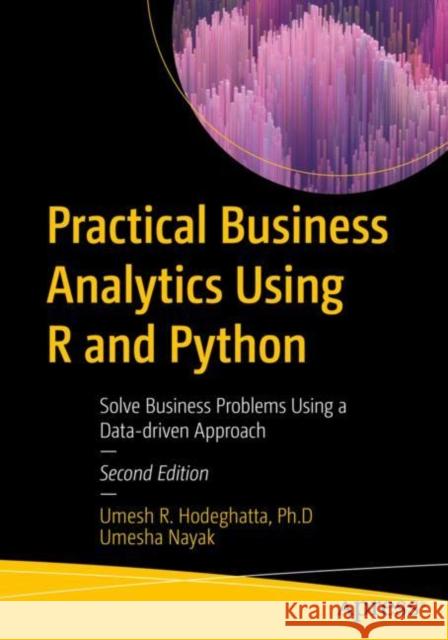
Practical Business Analytics Using R and Python: Solve Business Problems Using a Data-Driven Approach Hodeghatta, Umesh R. 9781484287538 Apress - książkaWidoczna okładka, to zdjęcie poglądowe, a rzeczywista szata graficzna może różnić się od prezentowanej.

Practical Business Analytics Using R and Python: Solve Business Problems Using a Data-Driven Approach

ISBN-13: 9781484287538 / Angielski / Miękka / 2023 / 700 str.

Umesh R. Hodeghatta; Umesha Nayak
cena 230,54 zł
(netto: 219,56 VAT:  5%)

Najniższa cena z 30 dni: 229,28 zł
Termin realizacji zamówienia:
ok. 16-18 dni roboczych
Bez gwarancji dostawy przed świętami

Darmowa dostawa!

This book illustrates how data can be useful in solving business problems. It explores various analytics techniques for using data to discover hidden patterns and relationships, predict future outcomes, optimize efficiency and improve the performance of organizations. You’ll learn how to analyze data by applying concepts of statistics, probability theory, and linear algebra. In this new edition, both R and Python are used to demonstrate these analyses.Practical Business Analytics Using R and Pythonalso features new chapters covering databases, SQL, Neural networks, Text Analytics, and Natural Language Processing.Part one begins with an introduction to analytics, the foundations required to perform data analytics, and explains different analytics terms and concepts such as databases and SQL, basic statistics, probability theory, and data exploration. Part two introduces predictive models using statistical machine learning and discusses concepts like regression, classification, and neural networks. Part three covers two of the most popular unsupervised learning techniques, clustering and association mining, as well as text mining and natural language processing (NLP). The book concludes with an overview of big data analytics, R and Python essentials for analytics including libraries such as pandas and NumPy.Upon completing this book, you will understand how to improve business outcomes by leveraging R and Python for data analytics.What You Will LearnMaster the mathematical foundations required for business analyticsUnderstand various analytics models and data mining techniques such as regression, supervised machine learning algorithms for modeling, unsupervised modeling techniques, and how to choose the correct algorithm for analysis in any given taskUse R and Python to develop descriptive models, predictive models, and optimize modelsInterpret and recommend actions based on analytical model outcomesWho This Book Is ForSoftware professionals and developers, managers, and executives who want to understand and learn the fundamentals of analytics using R and Python.

This book illustrates how data can be useful in solving business problems. It explores various analytics techniques for using data to discover hidden patterns and relationships, predict future outcomes, optimize efficiency and improve the performance of organizations. You’ll learn how to analyze data by applying concepts of statistics, probability theory, and linear algebra. In this new edition, both R and Python are used to demonstrate these analyses. Practical Business Analytics Using R and Python also features new chapters covering databases, SQL, Neural networks, Text Analytics, and Natural Language Processing.Part one begins with an introduction to analytics, the foundations required to perform data analytics, and explains different analytics terms and concepts such as databases and SQL, basic statistics, probability theory, and data exploration. Part two introduces predictive models using statistical machine learning and discusses concepts like regression, classification, and neural networks. Part three covers two of the most popular unsupervised learning techniques, clustering and association mining, as well as text mining and natural language processing (NLP). The book concludes with an overview of big data analytics, R and Python essentials for analytics including libraries such as pandas and NumPy.Upon completing this book, you will understand how to improve business outcomes by leveraging R and Python for data analytics.What You Will Learn

  • Master the mathematical foundations required for business analytics
  • Understand various analytics models and data mining techniques such as regression, supervised machine learning algorithms for modeling, unsupervised modeling techniques, and how to choose the correct algorithm for analysis in any given task
  • Use R and Python to develop descriptive models, predictive models, and optimize models
  • Interpret and recommend actions based on analytical model outcomes
Who This Book Is ForSoftware professionals and developers, managers, and executives who want to understand and learn the fundamentals of analytics using R and Python.

Kategorie:
Informatyka, Bazy danych
Kategorie BISAC:
Computers > Information Theory
Computers > Artificial Intelligence - General
Computers > Languages - Python
Wydawca:
Apress
Język:
Angielski
ISBN-13:
9781484287538
Rok wydania:
2023
Dostępne języki:
Ilość stron:
700
Oprawa:
Miękka
Dodatkowe informacje:
Wydanie ilustrowane

Section 1: Introduction to Analytics
In this section, we discuss the necessary foundations required to perform data analytics. We discuss different analytics terms, basics statistics and probability theory, descriptive statistics including various plots, and various measures for evaluating your predictive models. 
Chapter 1: Business Analytics Revolution

Chapter 2: Foundations of Business Analytics

Chapter 3: Structured Query Language (SQL) Analytics

Chapter 4: Business Analytics Process
 
Chapter 5: Exploratory Data Analysis (EDA)

Chapter 6: Evaluating Analytics Model Performance

Section II: Supervised Learning and Predictive Analytics
In this section, we introduce statistical learning models and machine learning models. We present various regression analysis and classification analysis. We also discuss logistic regression and end our discussion by introducing Neural Network and gradient descent algorithms. 
Chapter 7: Simple Linear Regressions

Chapter 8: Multiple Linear Regressions

Chapter 9: Classification

Chapter 10: Neural Networks

Chapter 11: Logistic Regression

Section III: Time series models
In this section, we introduce optimization models and Time series analysis. In time series, we discuss different forecasting models, and in optimization models, we introduce both linear and non-linear optimization models.
Chapter 12: Time Series – Forecasting

Section IV: Unsupervised model and Text Mining
In this section, we discuss two popular unsupervised models - cluster analysis and relationship data mining techniques. Finally, we end this section by introducing text mining and NLP and briefly introducing big data. 
Chapter 13: Cluster Analysis

Chapter 14: Relationship Data Mining

Chapter 15: Mining Text and Text Analytics
 
Chapter 16: Big Data and Big Data Analytics

Section V: Business Analytics Tools
This is the last part. In this section we 
This section summarizes what we have learned in the earlier section by working on some case studies. We work on practical cases using public datasets using both ‘R’ and ‘Python’.
Chapter 17: R programming for Analytics

Chapter 18: Python Programming for Analytics


Dr. Umesh Hodeghatta Rao is an engineer, a scientist, and an educator. He is currently a faculty member at Northeastern University, MA, USA, specializing in data analytics, AI, machine learning, deep learning, natural language processing (NLP), and cyber security.  He has more than 25 years of work experience in technical and senior management positions at AT&T Bell Laboratories, Cisco Systems, McAfee, and Wipro. He was also a faculty member at Kent State University, Kent, Ohio, USA and Xavier Institute of Management, Bhubaneswar, India. He has his master’s degree in Electrical and Computer Engineering (ECE) from Oklahoma State University, USA and a Ph.D. from the Indian Institute of Technology (IIT), Kharagpur. His research interest is applying AI Machine Learning to strengthen an organization’s information security based on his expertise on Information Security and Machine Learning. As a Chief Data Scientist, he is helping business leaders to make informed decisions and recommendations linked to the organization's strategy and financial goals, reflecting an awareness of external dynamics based on a data-driven approach.

He has published many journal articles in international journals and conference proceedings.  In addition, he has authored books titled "Business Analytics Using R: A Practical Approach" and “The InfoSec Handbook: An Introduction to Information Security” published by Springer Apress, USA. Furthermore, Dr. Hodeghatta has contributed his services to many professional organizations and regulatory bodies. He was an Executive Committee member of IEEE Computer Society (India); Academic advisory member for the Information and Security Audit Association (ISACA), USA; IT advisor for the government of India; Technical Advisory Member of the International Neural Network Society (INNS) India; Advisory member of Task Force on Business Intelligence & Knowledge Management; He is listed in Who’s Who in the World in the year 2012, 2013, 2014, 2015 and 2016. He is also a senior member of the IEEE, USA. 


Umesha Nayak is a director and principal consultant of MUSA Software Engineering Pvt. Ltd. which focuses on systems/process/management consulting.  He has 33 years experience, of which 12 years are in providing consulting to IT / manufacturing and other organizations from across the globe. He is a Master of Science in Software Systems; Master of Arts in Economics; CAIIB; Certified Information Systems Auditor (CISA), and Certified Risk and Information Systems Control (CRISC) professional from ISACA, US; PGDFM; Certified Ethical Hacker from EC Council; Certified Lead Auditor for many of the standards; Certified Coach among others.  He has worked extensively in banking, software development, product design and development, project management, program management, information technology audits, information application audits, quality assurance, coaching, product reliability, human resource management, and consultancy.  He was Vice President and Corporate Executive Council member at Polaris Software Lab, Chennai prior to his current assignment.  He has also held various roles like Head of Quality, Head of SEPG and Head of Strategic Practice Unit – Risks & Treasury at Polaris Software Lab.  He started his journey with computers in 1981 with ICL mainframes and continued further with minis and PCs.  He was one of the founding members of the information systems auditing in the banking industry in India.  He has effectively guided many organizations through successful ISO 9001/ISO 27001/CMMI and other certifications and process/product improvements. He has co-authored the open access book The InfoSec Handbook: An Introduction to Information Security, published by Apress.

This book illustrates how data can be useful in solving business problems. It explores various analytics techniques for using data to discover hidden patterns and relationships, predict future outcomes, optimize efficiency and improve the performance of organizations. You’ll learn how to analyze data by applying concepts of statistics, probability theory, and linear algebra. In this new edition, both R and Python are used to demonstrate these analyses. Practical Business Analytics Using R and Python also features new chapters covering databases, SQL, Neural networks, Text Analytics, and Natural Language Processing.


Part one begins with an introduction to analytics, the foundations required to perform data analytics, and explains different analytics terms and concepts such as databases and SQL, basic statistics, probability theory, and data exploration. Part two introduces predictive models using statistical machine learning and discusses concepts like regression, classification, and neural networks. Part three covers two of the most popular unsupervised learning techniques, clustering and association mining, as well as text mining and natural language processing (NLP). The book concludes with an overview of big data analytics, R and Python essentials for analytics including libraries such as pandas and NumPy. 

Upon completing this book, you will understand how to improve business outcomes by leveraging R and Python for data analytics.

You will:

  • Master the mathematical foundations required for business analytics
  • Understand various analytics models and data mining techniques such as regression, supervised machine learning algorithms for modeling, unsupervised modeling techniques, and how to choose the correct algorithm for analysis in any given task
  • Use R and Python to develop descriptive models, predictive models, and optimize models
  • Interpret and recommend actions based on analytical model outcomes

Nayak, Umesha Umesha Nayak is a director and principal consultan... więcej >


Udostępnij

Facebook - konto krainaksiazek.pl


Opinie o Krainaksiazek.pl na Opineo.pl

Partner Mybenefit

Krainaksiazek.pl w programie rzetelna firma Krainaksiaze.pl - płatności przez paypal

Czytaj nas na:

Facebook - krainaksiazek.pl
  • książki na zamówienie
  • granty
  • książka na prezent
  • kontakt
  • pomoc
  • opinie
  • regulamin
  • polityka prywatności

Zobacz:

  • Księgarnia czeska

  • Wydawnictwo Książkowe Klimaty

1997-2025 DolnySlask.com Agencja Internetowa

© 1997-2022 krainaksiazek.pl
     
KONTAKT | REGULAMIN | POLITYKA PRYWATNOŚCI | USTAWIENIA PRYWATNOŚCI
Zobacz: Księgarnia Czeska | Wydawnictwo Książkowe Klimaty | Mapa strony | Lista autorów
KrainaKsiazek.PL - Księgarnia Internetowa

Polityka prywatnosci - link
Krainaksiazek.pl - płatnośc Przelewy24
Przechowalnia Przechowalnia





