• Wyszukiwanie zaawansowane
  • Kategorie
  • Kategorie BISAC
  • Książki na zamówienie
  • Promocje
  • Granty
  • Książka na prezent
  • Opinie
  • Pomoc
  • Załóż konto
  • Zaloguj się

Power and Communication Cables: Theory and Applications » książka


zaloguj się | załóż konto
Logo Krainaksiazek.pl

koszyk

konto

szukaj
topmenu
Księgarnia internetowa
Szukaj
Książki na zamówienie
Promocje
Granty
Książka na prezent
Moje konto
Pomoc
 
 
Wyszukiwanie zaawansowane
Pusty koszyk
Bezpłatna dostawa dla zamówień powyżej 20 złBezpłatna dostawa dla zamówień powyżej 20 zł

Kategorie główne

• Nauka
 [2949965]
• Literatura piękna
 [1857847]

  więcej...
• Turystyka
 [70818]
• Informatyka
 [151303]
• Komiksy
 [35733]
• Encyklopedie
 [23180]
• Dziecięca
 [617748]
• Hobby
 [139972]
• AudioBooki
 [1650]
• Literatura faktu
 [228361]
• Muzyka CD
 [398]
• Słowniki
 [2862]
• Inne
 [444732]
• Kalendarze
 [1620]
• Podręczniki
 [167233]
• Poradniki
 [482388]
• Religia
 [509867]
• Czasopisma
 [533]
• Sport
 [61361]
• Sztuka
 [243125]
• CD, DVD, Video
 [3451]
• Technologie
 [219309]
• Zdrowie
 [101347]
• Książkowe Klimaty
 [123]
• Zabawki
 [2362]
• Puzzle, gry
 [3791]
• Literatura w języku ukraińskim
 [253]
• Art. papiernicze i szkolne
 [7933]
Kategorie szczegółowe BISAC

Power and Communication Cables: Theory and Applications

ISBN-13: 9780780311961 / Angielski / Twarda / 2003 / 880 str.
R. Bartnikas; K. D. Srivastava; Ray Bartnikas
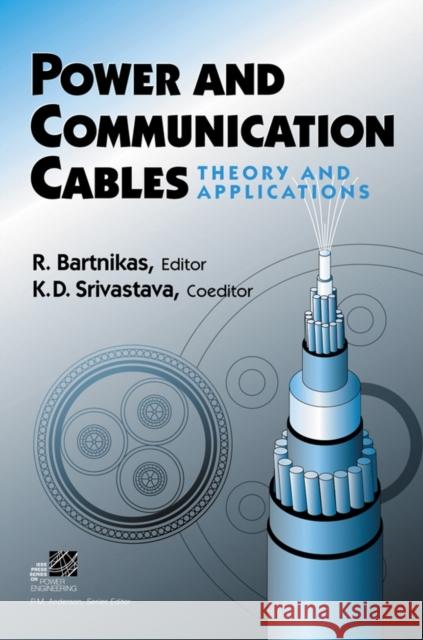
Power and Communication Cables: Theory and Applications Bartnikas, Ray 9780780311961 IEEE Computer Society Press - książkaWidoczna okładka, to zdjęcie poglądowe, a rzeczywista szata graficzna może różnić się od prezentowanej.

Power and Communication Cables: Theory and Applications

ISBN-13: 9780780311961 / Angielski / Twarda / 2003 / 880 str.

R. Bartnikas; K. D. Srivastava; Ray Bartnikas
cena 975,30 zł
(netto: 928,86 VAT:  5%)

Najniższa cena z 30 dni: 965,33 zł
Termin realizacji zamówienia:
ok. 30 dni roboczych
Bez gwarancji dostawy przed świętami

Darmowa dostawa!

Power and communication cables are frequently installed adjacent to each other, and hybrid cables that contain both power conductors and communication lines are increasingly popular. Power and Communication Cables is a convenient, single-source volume written for utility maintenance engineers, cable production and design engineers, and students to expand their knowledge of both types of cables in the power and communications fields. With contributions from leaders in the field, this book presents a detailed treatment of solid-liquid, polymeric, compressed gas, and cryogenic cables used in power transmission and distribution. In the area of communication, the contributors address the use of metallic conductor multipair and coaxial cables, as well as optical fiber cables.

Power and Communication Cables provides in-depth discussion of the design, manufacture, testing, installation, and operation of power and communication cables. You will find essential information on the properties of materials and learn how they influence cable characteristics. Moreover, this interdisciplinary reference provides theoretical and practical insights into various aspects of cable engineering in both power and communication systems.


Kategorie:
Technologie
Kategorie BISAC:
Technology & Engineering > Electrical
Technology & Engineering > Telecommunications
Wydawca:
IEEE Computer Society Press
Seria wydawnicza:
IEEE Press Series on Power Engineering
Język:
Angielski
ISBN-13:
9780780311961
Rok wydania:
2003
Ilość stron:
880
Waga:
1.67 kg
Wymiary:
26.24 x 18.75 x 5.41
Oprawa:
Twarda
Wolumenów:
01
Dodatkowe informacje:
Bibliografia
Glosariusz/słownik
Wydanie ilustrowane

PREFACE.

ACKNOWLEDGMENTS.

CHAPTER 1: CABLES: A CHRONOLOGICAL PERSPECTIVE (R. Bartnikas).

1.1 Preliminary Remarks.

1.2 Power Cables.

1.3 Communication Cables.

CHAPTER 2: CHARACTERISTICS OF CABLE MATERIALS (R. Bartnikas).

2.1 Introduction.

2.2 Metallic Conductors.

2.3 Conductor and Insulation Semiconducting Shields.

2.4 Insulation.

2.5 Materials for Protective Coverings.

2.6 Armoring Materials.

2.7 Coverings for Corrosion Protection.

2.8 Conclusion.

2.9 Glossary of Cable Materials Technology.

CHAPTER 3: DESIGN AND MANUFACTURE OF EXTRUDED SOLID–DIELECTRIC POWER DISTRIBUTION CABLES (H. D. Campbell and L J. Hiivala).

3.1 Introduction.

3.2 Design Fundamentals.

3.3 Design Considerations.

3.4 Design Objectives.

3.5 Solid–Dielectric Insulation Techniques.

3.6 Related Tests.

CHAPTER 4: EXTRUDED SOLID–DIELECTRIC POWER TRANSMISSION CABLES (L J. Hiivala).

4.1 Introduction.

4.2 Design and Construction.

4.3 Manufacturing Methods.

4.4 Testing.

4.5 Accessories.

4.6 Concluding Remarks.

CHAPTER 5: DESIGN AND MANUFACTURE OF OIL–IMPREGNATED PAPER INSULATED POWER DISTRIBUTION CABLES (W. K. Rybczynski).

5.1 Brief History of Development.

5.2 Elements of Solid–Type Oil–Paper Cable Design.

5.3 Cable Manufacture.

5.4 Tests.

5.5 Electrical Characteristics.

5.6 Conclusion.

CHAPTER 6: LOW–PRESSURE OIL–FILLED POWER TRANSMISSION CABLES (W. K. Rybczynski).

6.1 Introduction.

6.2 Elements of Oil–Filled Cable Design.

6.3 Cable Manufacture.

6.4 Tests.

6.5 Electrical Characteristics.

6.6 Principles of Oil Feeding.

6.7 Notes on Sheath Bonding.

6.8 Limitations of LPOF Cables.

6.9 Self–Contained High–Pressure Oil–Filled Cables.

6.10 Self Contained Oil–Filled Cables for dc Application.

CHAPTER 7: HIGH–PRESSURE OIL–FILLED PIPE–TYPE POWER TRANSMISSION CABLES (W. K. Rybczynski).

7.1 Introduction.

7.2 Principles of Operation.

7.3 Elements of Cable Design.

7.4 Cable Manufacture.

7.5 Tests.

7.6 Electrical Characteristics.

7.7 Principles of Oil Feeding.

7.8 Cathodic Protection.

7.9 Limitations of HPOFPT Cables.

7.10 Development of HPOFPT Cable for Higher Voltages in the United States.

7.11 Gas–Type Cables.

7.12 Gas Compression EHV Cables.

7.13 Concluding Remarks.

CHAPTER 8: VOLTAGE BREAKDOWN AND OTHER ELECTRICAL TESTS ON POWER CABLES (H. D. Campbell).

8.1 Introduction.

8.2 Alternating–Current Overvoltage Test.

8.3 Direct–Current Overvoltage Test.

8.4 Voltage Testing of Production Lengths.

8.5 Tests on Specimens.

8.6 Impulse Tests.

CHAPTER 9: DISSIPATION FACTOR, PARTIAL–DISCHARGE, AND ELECTRICAL AGING TESTS ON POWER CABLES (R. Bartnikas).

9.1 Introduction.

9.2 Dissipation Factor of a Cable.

9.3 Bridge Techniques for the Measurement of tan δ.

9.4 Partial–Discharge Characteristics.

9.5 Partial–Discharge Measurements.

9.6 Partial–Discharge Site Location.

9.7 Discharge Pulse Pattern Studies.

9.8 Electrical Aging Mechanisms.

9.9 Accelerated Electrical Aging Tests.

CHAPTER 10: FIELD TESTS AND ACCESSORIES FOR POLYMERIC POWER DISTRIBUTION CABLES (H. H. Campbell and W. T. Starr).

10.1 Introduction.

10.2 Alternating–Current Overvoltage Test.

10.3 Dissipation Factor (Power Factor) Test.

10.4 Insulation Resistance Test.

10.5 Partial–Discharge Test.

10.6 Direct–Current Overvoltage Test.

10.7 Direct–Current Test Procedures.

10.8 Interpretation of Test Results.

10.9 Question of Test Levels.

10.10 Direct Stress versus Alternating Stress Considerations.

10.11 Practical Test Levels.

10.12 Joints and Terminations.

10.13 Some Current Practices.

CHAPTER 11: POWER CABLE SYSTEMS (G. Ludasi).

11.1 Introduction.

11.2 Comparison of Overhead Lines and Cables.

11.3 Radial Power Systems.

11.4 Looped Systems.

11.5 Current–Carrying Capacity: Rating Equations.

11.6 Calculation of Losses.

11.7 Thermal Resistance of Cables.

11.8 Cyclic Loading.

11.9 Short–Term Overloading.

11.10 Fault Currents.

11.11 Cable System Economics.

11.12 Choice of System Voltage.

11.13 Cable Selection and Installation Methods.

11.14 Cable Pulling.

11.15 Choice of Cable Route and Manhole Location.

CHAPTER 12: CRYOGENIC AND COMPRESSED GAS INSULATED POWER CABLES (K. D. Srivastava).

12.1 Introduction.

12.2 Compressed Gas Insulated Transmission Line System.

12.3 Cryoresistive Cables.

12.4 Superconductive Cables.

12.5 Economic Considerations.

CHAPTER 13: UNDERWATER POWER CABLES (R. T. Traut).

13.1 Introduction.

13.2 Underwater Power Cable Design.

13.3 Power Transmission Requirements.

13.4 Armor and External Protection Design.

13.5 Underwater Power Cable Manufacture.

13.6 Cable Transport.

13.7 Underwater Power Cable Installation.

CHAPTER 14: HIGH–VOLTAGE DIRECT–CURRENT CABLES (C. Doench and K. D. Srivastava).

14.1 Introduction.

14.2 Electrical Behavior of DC Cables.

14.3 Transient Electric Stresses on HVDC Cables.

14.4 Design of HVDC Cables.

14.5 Selection of Materials.

14.6 Direct–Current Cable Accessories.

14.7 Testing of DC Cables.

14.8 Emerging Trends in HVDC Cable Technology.

CHAPTER 15: TELEPHONE CABLES (R. Bartnikas).

15.1 Historical Background.

15.2 Transmission Parameters of Copper Conductor Telephone Cables.

15.3 Digital Transmission.

15.4 Characteristics of Metallic Conductor Telephone Cables.

15.4.1 Twisted–Wire Multipair Cables.

15.5 Electrical Characteristics of Coaxial Cables.

15.6 Metallic Conductor Telephone Cable Design and Manufacture.

15.7 Coaxial Cable Design and Construction.

15.8 Video Pair Cable Design and Construction.

15.9 Optical Fiber Telephone Cables.

CHAPTER 16: UNDERSEA COAXIAL COMMUNICATION CABLES (R. T. Traut).

16.1 Introduction.

16.2 Undersea Cable Telecommunications.

16.3 Undersea Coaxial Cable Design.

CHAPTER 17: TERRESTRIAL AND UNDERWATER OPTICAL FIBER CABLES (W. F. Wright).

17.1 Introduction.

17.2 Historical Perspective.

17.3 Optical Fiber Characteristics.

17.4 Introduction to Fiber–Optic Cables.

17.5 Introduction to Undersea Fiber–Optic Communication Systems.

17.6 Concluding Remarks.

AUTHOR INDEX.

SUBJECT INDEX.

ABOUT THE EDITORS.

R. Bartnikas has been with the Institut de Recherche d′Hydro–Québec since 1968, where he has held positions as scientific director of the Materials Science Department and then Distinguished Senior Scientist. Prior to 1968, he was associated with the Cable Division and R&D Laboratories of Northern Electric (now Northern Telecom). He is an adjunct professor in the Department of Electrical and Computer Engineering at the University of Waterloo and in the Department of Engineering Physics and Materials at École Polytechnique (Université de Montréal); he is a visiting professor at the University of Rome at La Sapienza.
Dr. Bartnikas is the editor of the ASTM monograph/book series Engineering Dielectrics and has coedited two books entitled Elements of Cable Engineering and Power Cable Engineering. Since 1968 he has been an active member of the IEEE Insulated Conductors Committee. Dr. Bartnikas is a Fellow of ASTM, the IEEE, the Institute of Physics, (U.K), the Royal Society of Canada (Academy of Science), and the Canadian Academy of Engineering.

K.D. Srivastava is emeritus professor in the Department of Electrical and Computer Engineering at the University of British Columbia, Vancouver, Canada, where he was head of the department and then a vice president. He was chairman of the Electrical Engineering Department at the University of Waterloo. Prior to moving to Canada, Professor Srivastava was a senior research engineer at Brush Electric Co. Ltd., Loughborough and a principal scientific officer at Rutherford High Energy Laboratory, Harwell, both in England.
Professor Srivastava has coedited two books on electric cables with Dr. Bartnikas: Elements of Cable Engineering and Power Cable Engineering. He has published over 150 technical reports and papers. Professor Srivastava is a Fellow of the IEEE, a Fellow of the IEE (U.K.), and a Fellow of the RSA (U.K.).

Power and communication cables are frequently installed adjacent to each other, and hybrid cables that contain both power conductors and communication lines are increasingly popular. Power and Communication Cables is a convenient, single–source volume written for utility maintenance engineers, cable production and design engineers, and students to expand their knowledge of both types of cables in the power and communications fields. With contributions from leaders in the field, this book presents a detailed treatment of solid–liquid, polymeric, compressed gas, and cryogenic cables used in power transmission and distribution. In the area of communication, the contributors address the use of metallic conductor multipair and coaxial cables, as well as optical fiber cables.

Power and Communication Cables provides in–depth discussion of the design, manufacture, testing, installation, and operation of power and communication cables. You will find essential information on the properties of materials and learn how they influence cable characteristics. Moreover, this interdisciplinary reference provides theoretical and practical insights into various aspects of cable engineering in both power and communication systems.




Udostępnij

Facebook - konto krainaksiazek.pl


Opinie o Krainaksiazek.pl na Opineo.pl

Partner Mybenefit

Krainaksiazek.pl w programie rzetelna firma Krainaksiaze.pl - płatności przez paypal

Czytaj nas na:

Facebook - krainaksiazek.pl
  • książki na zamówienie
  • granty
  • książka na prezent
  • kontakt
  • pomoc
  • opinie
  • regulamin
  • polityka prywatności

Zobacz:

  • Księgarnia czeska

  • Wydawnictwo Książkowe Klimaty

1997-2025 DolnySlask.com Agencja Internetowa

© 1997-2022 krainaksiazek.pl
     
KONTAKT | REGULAMIN | POLITYKA PRYWATNOŚCI | USTAWIENIA PRYWATNOŚCI
Zobacz: Księgarnia Czeska | Wydawnictwo Książkowe Klimaty | Mapa strony | Lista autorów
KrainaKsiazek.PL - Księgarnia Internetowa

Polityka prywatnosci - link
Krainaksiazek.pl - płatnośc Przelewy24
Przechowalnia Przechowalnia



