• Wyszukiwanie zaawansowane
  • Kategorie
  • Kategorie BISAC
  • Książki na zamówienie
  • Promocje
  • Granty
  • Książka na prezent
  • Opinie
  • Pomoc
  • Załóż konto
  • Zaloguj się

Power Electronics: Thyristor Controlled Power for Electric Motors » książka


zaloguj się | załóż konto
Logo Krainaksiazek.pl

koszyk

konto

szukaj
topmenu
Księgarnia internetowa
Szukaj
Książki na zamówienie
Promocje
Granty
Książka na prezent
Moje konto
Pomoc
 
 
Wyszukiwanie zaawansowane
Pusty koszyk
Bezpłatna dostawa dla zamówień powyżej 20 złBezpłatna dostawa dla zamówień powyżej 20 zł

Kategorie główne

• Nauka
 [2944077]
• Literatura piękna
 [1814251]

  więcej...
• Turystyka
 [70679]
• Informatyka
 [151074]
• Komiksy
 [35590]
• Encyklopedie
 [23169]
• Dziecięca
 [611005]
• Hobby
 [136031]
• AudioBooki
 [1718]
• Literatura faktu
 [225599]
• Muzyka CD
 [379]
• Słowniki
 [2916]
• Inne
 [443741]
• Kalendarze
 [1187]
• Podręczniki
 [166463]
• Poradniki
 [469211]
• Religia
 [506887]
• Czasopisma
 [481]
• Sport
 [61343]
• Sztuka
 [242115]
• CD, DVD, Video
 [3348]
• Technologie
 [219293]
• Zdrowie
 [98602]
• Książkowe Klimaty
 [124]
• Zabawki
 [2385]
• Puzzle, gry
 [3504]
• Literatura w języku ukraińskim
 [260]
• Art. papiernicze i szkolne
 [7151]
Kategorie szczegółowe BISAC

Power Electronics: Thyristor Controlled Power for Electric Motors

ISBN-13: 9780412141607 / Angielski / Miękka / 1975 / 223 str.
Raymond Ramshaw
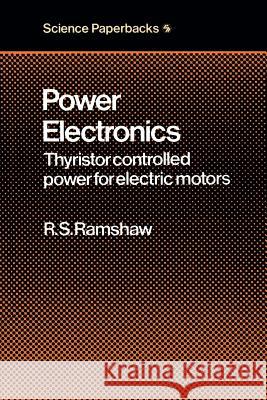
Power Electronics: Thyristor Controlled Power for Electric Motors Ramshaw, Raymond S. 9780412141607 Chapman & Hall - książkaWidoczna okładka, to zdjęcie poglądowe, a rzeczywista szata graficzna może różnić się od prezentowanej.

Power Electronics: Thyristor Controlled Power for Electric Motors

ISBN-13: 9780412141607 / Angielski / Miękka / 1975 / 223 str.

Raymond Ramshaw
cena 201,24
(netto: 191,66 VAT:  5%)

Najniższa cena z 30 dni: 192,74
Termin realizacji zamówienia:
ok. 22 dni roboczych.

Darmowa dostawa!

The following pages are meant for those who wish to use thyristors. The details of the physics of semiconductor materials or the design of thyristors themselves are unnecessary here but a general description of the device may help to avoid pitfalls during electric circuit design. Thyristor is the internationally recognized name for a particular semi- conductor device. The name is derived from the Greek, the first part meaning switch and the second part an association with the transistor family. It has a trade name, viz. SCR (silicon controlled rectifier) and it got this name principally because it is a silicon device and it is used as a rectifier which can be controlled. As a controlled switch it forms a group together with the electromagnetic relay, the thyratron and the mercury arc rectifier. The advantages and disadvantages of the thyristor become apparent in the process of describing the device and its range of application. However, the present general interest, development and use of the thyristor, indicates that for many cases its many advantages make it superior to other devices. Control of rotating electric machines is a major interest of the author so that in this book the applications of the thyristor are towards this end. Thyristors are used so much in connection with the control of machines that it is worthwhile to go into some details of both the electric drive to be controlled and the possible thyristor control units.


Kategorie:
Nauka
Kategorie BISAC:
Technology & Engineering > Mechanical
Science > General
Non-Classifiable > Non-Classifiable
Wydawca:
Chapman & Hall
Język:
Angielski
ISBN-13:
9780412141607
Rok wydania:
1975
Wydanie:
1973
Ilość stron:
223
Waga:
0.33 kg
Wymiary:
23.39 x 15.6 x 1.27
Oprawa:
Miękka
Wolumenów:
01
Dodatkowe informacje:
Bibliografia

1. Power Electronics and Rotating Electric Drives.- 1.1. Introduction.- 1.2. Power Electronics.- 1.2.1. The Thyristor.- 1.3. Rotating Electric Drives.- 1.3.1. The Direct Current Drive.- 1.3.2. The Alternating Current Drive.- 1.3.3. Choice of Drive and Control System.- References and Bibliography.- 2. The Thyristor.- 2.1. Introduction.- 2.2. Semiconductors.- 2.2.1. The Diode.- 2.2.2. The Transistor.- (a) Cut-off.- (b) Linear region.- (c) Saturation.- 2.2.3. The Thyristor.- (a) The diode model of the thyristor.- (b) The two transistor model of the thyristor.- 2.3. Thyristor Characteristics.- 2.3.1. The Thyristor Reverse Biased.- 2.3.2. The Thyristor Forward Biased and Blocking.- 2.3.3. The Thyristor Forward Biased and Conducting.- (a) Light turn-on.- (b) Gate turn-on.- (c) Breakover voltage turn-on.- (d) dv/dt turn-on.- 2.4. Thyristor Turn-Off.- 2.4.1. Ways of Turn-off.- (a) Natural commutation.- (b) Reverse bias turn-off.- (c) Gate turn-off.- 2.4.2 Thyristor Turn-off Time.- 2.5. Thyristor Ratings.- 2.5.7. Voltage Ratings.- 2.5.2. Current Rating.- 2.5.5. Power Rating.- (a) Load current forward conduction loss.- (b) Forward leakage power loss.- (c) Reverse leakage power loss and turn-off loss.- (d) Gate power loss.- (e) Turn-on loss.- 2.5.4. Intermittent Ratings.- 2.6. Thyristor Manufacture.- 2.7. Thyristors in Circuitsx.- 2.7.1. Thyristors in Series.- 2.7.2. Thyristors in Parallel.- 2.7.3. Circuits to Turn on Thyrsitors.- (a) Direct current firing signals.- (b) Pulse firing signals.- (c) Alternating curren t firing signals.- 2.7.4. Circuits to Turn-off Thyristors.- (a) Self commutation by resonance.- (b) Auxiliary resonant turn-off.- (c) Parallel capacitance turn-off.- (d) Series capacitance turn-off.- 2.8. Thyristor Protection Circuits.- 2.8.1. Overvoltage.- 2.5.2. Overcurrent.- 2.5.5. Voltage Surges.- 2.9. Relative Merits of Thyristors.- 2.10. The Bidirectional Triode Thyristor (Triac).- 2.11. Summary.- Worked Examples.- References and Bibliography.- Problems.- 3. Induction Motor Control.- 3.1. Introduction.- 3.2. Induction Motor Starting.- 3.2.1. Thyristor Starting.- 3.3. Induction Motor Speed Control.- 3.3.1. Thyristor Systems for Speed Control.- (a) The alternating current switch.- Worked example.- (b) Inverters.- (i) Inverter classification.- (ii) A C1 inverter for a single-phase induction motor.- Analysis of a C1 inverter with resistive load.- (iii) A class 4 inverter for a three-phase induction motor.- (c) Inverter commutation.- (i) The McMurray inverter.- Worked example.- (ii) The McMurray-Bedford inverter.- (iii) Auxiliary commutating supply.- (d) Voltage proportional to frequency.- (i) Variable ratio transformer.- (ii) Variable voltage converter.- (iii) Inverter voltage control.- (e) Harmonic elimination.- (i) Multiple pulse width control.- (ii) Selected harmonic reduction.- (iii) Harmonic neutralization by wave synthesis.- (f) Appraisal of thyristor three-phase.- (g) Inverters in the induction motor rotor circuit.- References.- Problems.- 4. Direct Current Motor Control.- 4.1. Introduction.- 4.2. Starting Direct Current Motors.- 4.2.1. Thyristors and the Resistance Starter.- 4.2.2. Thyristor Starting without Resistance.- 4.3. Speed Control of Direct Current Motors.- 4.3.1. Thyristor Speed Control.- 4.3.2. Thyristor Controlled Rectifier Converters.- (a) Single-phase half-wave converter.- (b) Single-phase full-wave converter.- Worked example.- (c) Three-phase controlled converters.- (d) Armature and field control.- Worked example.- (e) Converter voltage ripple.- 4.3.3. Thyristor Voltage Choppers.- (a) The Morgan chopper.- (b) The Jones chopper.- (c) The oscillation chopper.- (i) Charging analysis.- (ii) Commutation analysis.- 4.4. Position Control by Direct Current Motors.- 4.4.1. Thyristor Position Control.- (a) Design study of a discontinuous servomechanism for position control using thyristors.- (i) Power circuit.- (ii) Control circuit.- Worked example.- 4.4.2. Alternative circuits.- References and Bibliography.- Problems.- 5. Synchronous Motor Control.- 5.1. Introduction.- 5.2. Synchronous Motor Starting.- 5.2.1. An Inverter for Starting.- 5.3. Speed Control.- 5.3.1. A Speed Control Problem.- (a) A thyristor stepping motor.- (b) A cycloconverter for low speeds.- 5.4. Synchronous Motor Excitation.- 5.4.1. Thyristor Automatic Excitation Control.- (a) Brushless excitation protection during starting.- 5.5. A Synchronous or a Direct Current Motor?.- References and Bibliography.- Appendices.- I. Logic Circuitry for Inverter Control.- II. Logic Circuitry for Bidirectional Converter.- III. Logic Circuitry for On-Off Servo.- References.- Additional Problems for Chapters One, Two, Three and Four.


Udostępnij

Facebook - konto krainaksiazek.pl


Opinie o Krainaksiazek.pl na Opineo.pl

Partner Mybenefit

Krainaksiazek.pl w programie rzetelna firma Krainaksiaze.pl - płatności przez paypal

Czytaj nas na:

Facebook - krainaksiazek.pl
  • książki na zamówienie
  • granty
  • książka na prezent
  • kontakt
  • pomoc
  • opinie
  • regulamin
  • polityka prywatności

Zobacz:

  • Księgarnia czeska

  • Wydawnictwo Książkowe Klimaty

1997-2026 DolnySlask.com Agencja Internetowa

© 1997-2022 krainaksiazek.pl
     
KONTAKT | REGULAMIN | POLITYKA PRYWATNOŚCI | USTAWIENIA PRYWATNOŚCI
Zobacz: Księgarnia Czeska | Wydawnictwo Książkowe Klimaty | Mapa strony | Lista autorów
KrainaKsiazek.PL - Księgarnia Internetowa

Polityka prywatnosci - link
Krainaksiazek.pl - płatnośc Przelewy24
Przechowalnia Przechowalnia






