• Wyszukiwanie zaawansowane
  • Kategorie
  • Kategorie BISAC
  • Książki na zamówienie
  • Promocje
  • Granty
  • Książka na prezent
  • Opinie
  • Pomoc
  • Załóż konto
  • Zaloguj się

Poroelasticity » książka


zaloguj się | załóż konto
Logo Krainaksiazek.pl

koszyk

konto

szukaj
topmenu
Księgarnia internetowa
Szukaj
Książki na zamówienie
Promocje
Granty
Książka na prezent
Moje konto
Pomoc
 
 
Wyszukiwanie zaawansowane
Pusty koszyk
Bezpłatna dostawa dla zamówień powyżej 20 złBezpłatna dostawa dla zamówień powyżej 20 zł

Kategorie główne

• Nauka
 [2949965]
• Literatura piękna
 [1857847]

  więcej...
• Turystyka
 [70818]
• Informatyka
 [151303]
• Komiksy
 [35733]
• Encyklopedie
 [23180]
• Dziecięca
 [617748]
• Hobby
 [139972]
• AudioBooki
 [1650]
• Literatura faktu
 [228361]
• Muzyka CD
 [398]
• Słowniki
 [2862]
• Inne
 [444732]
• Kalendarze
 [1620]
• Podręczniki
 [167233]
• Poradniki
 [482388]
• Religia
 [509867]
• Czasopisma
 [533]
• Sport
 [61361]
• Sztuka
 [243125]
• CD, DVD, Video
 [3451]
• Technologie
 [219309]
• Zdrowie
 [101347]
• Książkowe Klimaty
 [123]
• Zabawki
 [2362]
• Puzzle, gry
 [3791]
• Literatura w języku ukraińskim
 [253]
• Art. papiernicze i szkolne
 [7933]
Kategorie szczegółowe BISAC

Poroelasticity

ISBN-13: 9783319797519 / Angielski / Miękka / 2018 / 877 str.
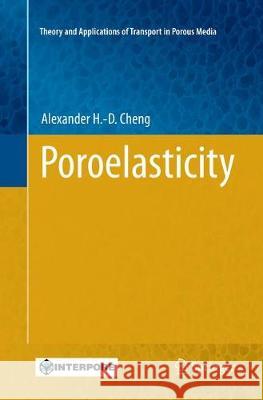
Alexander H.-D. Cheng
Poroelasticity Cheng, Alexander H.-D. 9783319797519 Springer - książkaWidoczna okładka, to zdjęcie poglądowe, a rzeczywista szata graficzna może różnić się od prezentowanej.

Poroelasticity

ISBN-13: 9783319797519 / Angielski / Miękka / 2018 / 877 str.

Alexander H.-D. Cheng
cena 1331,56 zł
(netto: 1268,15 VAT:  5%)

Najniższa cena z 30 dni: 1156,64 zł
Termin realizacji zamówienia:
ok. 22 dni roboczych
Bez gwarancji dostawy przed świętami

Darmowa dostawa!

This book treats the mechanics of porous materials infiltrated with a fluid (poromechanics), focussing on its linear theory (poroelasticity). Porous materials from inanimate bodies such as sand, soil and rock, living bodies such as plant tissue, animal flesh, or man-made materials can look very different due to their different origins, but as readers will see, the underlying physical principles governing their mechanical behaviors can be the same, making this work relevant not only to engineers but also to scientists across other scientific disciplines.Readers will find discussions of physical phenomena including soil consolidation, land subsidence, slope stability, borehole failure, hydraulic fracturing, water wave and seabed interaction, earthquake aftershock, fluid injection induced seismicity and heat induced pore pressure spalling as well as discussions of seismoelectric and seismoelectromagnetic effects. The work also explores the biomechanics of cartilage, bone and blood vessels.Chapters present theory using an intuitive, phenomenological approach at the bulk continuum level, and a thermodynamics-based variational energy approach at the micromechanical level. The physical mechanisms covered extend from the quasi-static theory of poroelasticity to poroelastodynamics, poroviscoelasticity, porothermoelasticity, and porochemoelasticity. Closed form analytical solutions are derived in details. This book provides an excellent introduction to linear poroelasticity and is especially relevant to those involved in civil engineering, petroleum and reservoir engineering, rock mechanics, hydrology, geophysics, and biomechanics.


Kategorie:
Technologie
Kategorie BISAC:
Technology & Engineering > Mechanical
Science > Earth Sciences - Meteorology & Climatology
Technology & Engineering > Materials Science - General
Wydawca:
Springer
Seria wydawnicza:
Theory and Applications of Transport in Porous Media
Język:
Angielski
ISBN-13:
9783319797519
Rok wydania:
2018
Wydanie:
Softcover Repri
Ilość stron:
877
Oprawa:
Miękka
Wolumenów:
01

1 Introduction

1.1 Porous Material
1.2 Physical Mechanism
1.3 Poroelastic Phenomena

2. Constitutive Equation
2.1 Physical versus Phenomenological Approach
2.2 Stress and Strain of Porous Medium
2.3 Poroelastic Constitutive Equation
2.4 Bulk Material Constant

3. Micromechanics
3.1 Micromechanical Analysis
3.2 Ideal Porous Medium
3.3 Effective Modulus
3.4 Nonlinear Model
3.5 Laboratory Test
3.6 Table of Poroelastic Constants

4. Variational Energy Formulation
4.1 Internal and external stress and strain
4.2 Thermodynamic Principles
4.3 Variational Formulation
4.4 Constitutive Equation
4.5 Intrinsic Material Constant
4.6 Link with Phenomological Model
4.7 Deviation from Ideal Porous Medium
4.8 Limiting Material Properties
4.9 Material Stability and Energy Diagram
4.10 Semilinear Model 4.11. Laboratory Measurement of Intrinsic Constant

5. Anisotropy
5.1 Anisotropic Constitutive Equation
5.2 Material Symmetry
5.3 Micromechanics
5.4 Ideal Porous Medium
5.5 Example

6. Governing Equation
6.1 Darcy's Law
6.2 Other Physical Laws
6.3 Governing Equation
6.4 Degenerated Governing Equation
6.5 Boundary Value Problem
6.6 Field Equation

7. Analytical Solution<7.1 Review of Early Work
7.2 Uniaxial Strain
7.3 One-dimensional Consolidation Problem
7.4 Plane Strain
7.5 Generalized Plane Strain
7.6 Bending of Plate
7.7 Mandel Problem
7.8 Water Wave over Seabed
7.9 Spherical Symmetry
7.10 Cryer Problem
7.11 Spherical Cavity
7.12 Axial Symmetry
7.13 Cylinder Problem
7.14 Borehole Problem
7.15 Borehole and Cylinder Application Problems
7.16 Moving Load on Half Plane
7.17 Plane Strain Half Space and Layered Problem
7.18 Axial Symmetry Half Space Problem

8. Fundamental Solution and Integral Equation
8.1 Reciprocal Theorem
8.2 Somigliana Integral Equation
8.3 Fredholm Integral Equation
8.4 Stress Discontinuity Method
8.5 Displacement Discontinuity Method
8.6 Dislocation Method
8.7 Galerkin Integral Equation
8.8 Fundamental Solution
8.9 Poroelasticity Fundamental Solution
8.10 Fluid Source
8.11 Fluid Dipole
8.12 Fluid Dilatation
8.13 Fluid Force
8.14 Fluid dodecapole
8.15 Total Force
8.16 Solid Quadrupole and Hexapole
8.17 Solid Center of Dilatation
8.18 Displacement Discontinuity
8.19 Edge Dislocation
8.20 Fundamental Solution Relation Based on Reciprocity

9. Poroelastodynamics
9.1 Dynamic Equilibrium Equation
9.2 Dynamic Permeability
9.3 Governing Equation
9.4 Wave Propagation
9.5 Phase Velocity and Attenuation
9.6 One-Dimensional Wave Problem
9.7 Thermoelasticity Analogy
9.8 Poroelastodynamics Fundamental Solution
9.9 Integral Equation Representation
9.10 Plane Wave Reflection and Refraction

10. Poroviscoelasticity
10.1 Viscoelasticity
10.2 Poroviscoelasticity
10.3 Borehole Problem
10.4 Cylinder Problem
10.5 Poroviscoelastodynamics

11. Porothermoelasticity
11.1 Constitutive Equation
11.2 Balance Law
11.3 Nonequilibrium Thermodynamics and Transport Law
11.4 Governing Equation
11.5 Uniaxial Strain
11.6 Heating off a Half Space
11.7 Axial Symmetry
11.8 Borehole Problem
11.9 Cylinder Problem
11.10 Spherical Symmetry
11.11 Cavity Problem
11.12 Sphere Problem
11.13 Porothermoelasticity Fundamental Solution

12. Porochemoelasticity
12.1 Electrochemical Effect
12.2 Micromechanical Analysis
12.3 Constitutive Equation
12.4 Balance and Transport Law
12.5 Governing Equation
12.6 Uniaxial Strain Problem
12.7 Axial Symmetry Problem
12.8 Spherical Symmetry Problem Appendices

Index

This book treats the mechanics of porous materials infiltrated with a fluid (poromechanics), focussing on its linear theory (poroelasticity). Porous materials from inanimate bodies such as sand, soil and rock, living bodies such as plant tissue, animal flesh, or man-made materials can look very different due to their different origins, but as readers will see, the underlying physical principles governing their mechanical behaviors can be the same, making this work relevant not only to engineers but also to scientists across other scientific disciplines. 

Readers will find discussions of physical phenomena including soil consolidation, land subsidence, slope stability, borehole failure, hydraulic fracturing, water wave and seabed interaction, earthquake aftershock, fluid injection induced seismicity and heat induced pore pressure spalling as well as discussions of seismoelectric and seismoelectromagnetic effects. The work also explores the biomechanics of cartilage, bone and blood vessels.

Chapters present theory using an intuitive, phenomenological approach at the bulk continuum level, and a thermodynamics-based variational energy approach at the micromechanical level. The physical mechanisms covered extend from the quasi-static theory of poroelasticity to poroelastodynamics, poroviscoelasticity, porothermoelasticity, and porochemoelasticity. Closed form analytical solutions are derived in details.   

This book provides an excellent introduction to linear poroelasticity and is especially relevant to those involved in civil engineering, petroleum and reservoir engineering, rock mechanics, hydrology, geophysics, and biomechanics.




Udostępnij

Facebook - konto krainaksiazek.pl


Opinie o Krainaksiazek.pl na Opineo.pl

Partner Mybenefit

Krainaksiazek.pl w programie rzetelna firma Krainaksiaze.pl - płatności przez paypal

Czytaj nas na:

Facebook - krainaksiazek.pl
  • książki na zamówienie
  • granty
  • książka na prezent
  • kontakt
  • pomoc
  • opinie
  • regulamin
  • polityka prywatności

Zobacz:

  • Księgarnia czeska

  • Wydawnictwo Książkowe Klimaty

1997-2025 DolnySlask.com Agencja Internetowa

© 1997-2022 krainaksiazek.pl
     
KONTAKT | REGULAMIN | POLITYKA PRYWATNOŚCI | USTAWIENIA PRYWATNOŚCI
Zobacz: Księgarnia Czeska | Wydawnictwo Książkowe Klimaty | Mapa strony | Lista autorów
KrainaKsiazek.PL - Księgarnia Internetowa

Polityka prywatnosci - link
Krainaksiazek.pl - płatnośc Przelewy24
Przechowalnia Przechowalnia



