• Wyszukiwanie zaawansowane
  • Kategorie
  • Kategorie BISAC
  • Książki na zamówienie
  • Promocje
  • Granty
  • Książka na prezent
  • Opinie
  • Pomoc
  • Załóż konto
  • Zaloguj się

Political Economy of Development and Business » książka

zaloguj się | załóż konto
Logo Krainaksiazek.pl

koszyk

konto

szukaj
topmenu
Księgarnia internetowa
Szukaj
Książki na zamówienie
Promocje
Granty
Książka na prezent
Moje konto
Pomoc
 
 
Wyszukiwanie zaawansowane
Pusty koszyk
Bezpłatna dostawa dla zamówień powyżej 20 złBezpłatna dostawa dla zamówień powyżej 20 zł

Kategorie główne

• Nauka
 [2949965]
• Literatura piękna
 [1857847]

  więcej...
• Turystyka
 [70818]
• Informatyka
 [151303]
• Komiksy
 [35733]
• Encyklopedie
 [23180]
• Dziecięca
 [617748]
• Hobby
 [139972]
• AudioBooki
 [1650]
• Literatura faktu
 [228361]
• Muzyka CD
 [398]
• Słowniki
 [2862]
• Inne
 [444732]
• Kalendarze
 [1620]
• Podręczniki
 [167233]
• Poradniki
 [482388]
• Religia
 [509867]
• Czasopisma
 [533]
• Sport
 [61361]
• Sztuka
 [243125]
• CD, DVD, Video
 [3451]
• Technologie
 [219309]
• Zdrowie
 [101347]
• Książkowe Klimaty
 [123]
• Zabawki
 [2362]
• Puzzle, gry
 [3791]
• Literatura w języku ukraińskim
 [253]
• Art. papiernicze i szkolne
 [7933]
Kategorie szczegółowe BISAC

Political Economy of Development and Business

ISBN-13: 9783031110955 / Angielski / Miękka / 2023
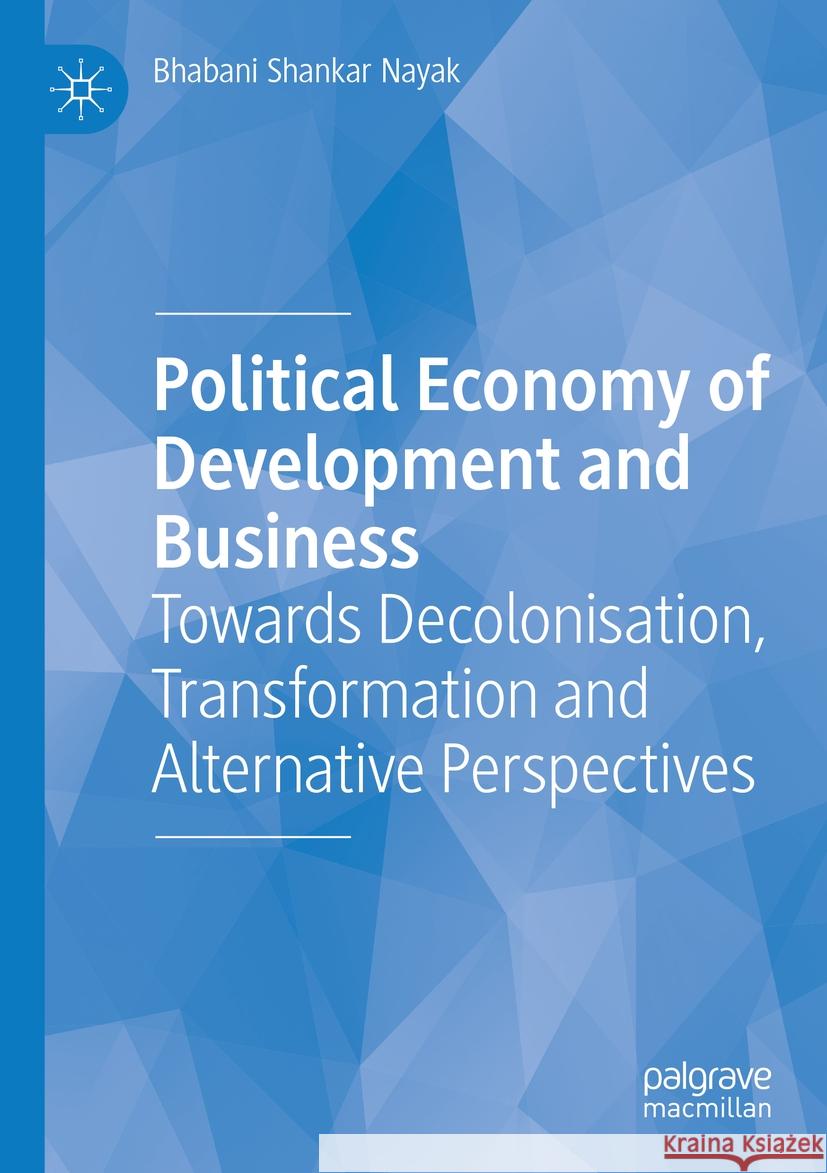
Bhabani Shankar Nayak
Political Economy of Development and Business Bhabani Shankar Nayak 9783031110955 Springer International Publishing - książkaWidoczna okładka, to zdjęcie poglądowe, a rzeczywista szata graficzna może różnić się od prezentowanej.

Political Economy of Development and Business

ISBN-13: 9783031110955 / Angielski / Miękka / 2023

Bhabani Shankar Nayak
cena 403,47 zł
(netto: 384,26 VAT:  5%)

Najniższa cena z 30 dni: 385,52 zł
Termin realizacji zamówienia:
ok. 22 dni roboczych
Bez gwarancji dostawy przed świętami

Darmowa dostawa!
inne wydania

This book presents an alternative, critical perspective on the political economy of development and business. The everyday issues experienced by those on the margins are examined to highlight the Eurocentric bias at the centre of development theory, public policy, and business practices. Ruling class projects within these areas are critically evaluated in order to present a vision of development that recognises pluralistic traditions and people’s everyday experiences. Eurocentric liberal myopia and its praxis are outlined in development theory, public policy, and business practices. Particular focus is given to tribal planning, needs based development, public private partnerships, modes of capital accumulation, conscious capitalism, and creative business education.
This book stands in defense of critical inquiry and pluriversal knowledge against the monolithic knowledge traditions and use of ruling class projects in development, public policy, and business ethics. It aims to explore new forms of economic transformation that are inclusive and worker led. It will be relevant to students and researchers interested in the political economy, development economics, and international business.


Kategorie:
Nauka, Ekonomia i biznes
Kategorie BISAC:
Political Science > Ekonomia polityczna
Business & Economics > Development - General
Business & Economics > International - General
Wydawca:
Springer International Publishing
Język:
Angielski
ISBN-13:
9783031110955
Rok wydania:
2023
Waga:
0.34 kg
Wymiary:
21.0 x 14.8
Oprawa:
Miękka
Dodatkowe informacje:
Wydanie ilustrowane

Political Economy of Development and Business 

Dedication         

Acknowledgements        

Preface 

Chapter-1  

Colonial World of Postcolonial Historians and the Neoliberal Reinvention of Tribal Identity in India    

Abstract             

Introduction      

Neoliberalism and Identity          

The Idea of Identity        

Identity as a reflection of one’s own self 

Land, Environment and Identity Formations        

Tribal Cosmology and Their Ideas on Identity       

Tribal Identity in Post-Colonial India        

Hinduisation, Territorialisation and the Changing Notion of Tribal Identity in India     

Growth of NGOs and their impact on social development and identity formation          

The Politics of Cooption and Dominance 

Globalization and Tribal Identity: Territorialization of Labour and the Deterritorialization of Capital     

Market Expansion, Crisis and the Disintegration of the Communal Identity              

Sustaining the Exclusiveness for Inequality and Exploitation of Tribals      

Conclusion         

Chapter-2           

Myth of Modernization and Development in Orissa         

Abstract              

Introduction      

A Brief History of Mining and Industrialization in Orissa  

Myth of Modernization, Industrialisation and Development in Orissa       

Silenced Drums and Unquiet Woods       

Conclusion         

Chapter-3           

Interrogating Social Capital and Denials of Development in the Planning for Tribal Development in India        

Abstract              

Introduction      

Development as a concept          

Development Versus Planning for Tribal Development in India   

Seven Decades of Indian Planning and Tribal Development           

Interrogating Social Capital, Voluntary Action for Tribal Development      

Conclusion         

Chapter-4           

Capitalism and Transition of 'Needs’ Based Development to ‘Desired’ based Development    

Abstract              

Introduction      

The idea of individuality and society among tribals in India           

Market, Individual and Society   

Locating Transitions in the Development Planning for Tribals in India       

Revisiting of Freudian Ideas in the Tribal Development Policies in India    

Conclusion         

Chapter-5 

Impossible Theorem and Possibilities of Development Studies     

Abstract              

Introduction      

Pathways of Development Studies           

Failures of Development Studies and Impossibility Theorem        

The Question of Survival              

Alternatives within Development Studies as a discipline  

Conclusion         

Chapter-6           

Reification and Praxis of Public Private Partnerships in History     

Abstract              

Introduction      

History of Public Private Partnerships (PPPs) in Economic Development Planning             

Theoretical Trends of Public Private Partnerships (PPPs) 

Conclusion         

Chapter-7           

Challenges of cultural relativism and the future of feminist universalism 

Abstract              

Introduction      

Nature of Feminism, Universalism, and Cultural Relativism           

Contradictions Between Feminism and Cultural Relativism           

Universalism – Claims of Essentialism?   

Feminism and Cultural Relativism - Similarities    

Future Challenges and Alternatives         

Conclusion         

Chapter-8 

Bhagavad Gita and Hindu Modes of Capitalist Accumulation in India         

Abstract              

Introduction      

Canonisation of Gita as National Scripture            

Hindu Religion and Capitalism in India    

Theoretical Context from Social Structures of Accumulation to Religious Structures of Accumulation        

Bhagavad Gita and Hindu Modes of Accumulation in India            

Karma and Dharma (duty) led Regimes, Modes, and Structures of Accumulation    

Domestication of labour and the spiritual economy of Bhakti (devotion) 

Artha (wealth) and Gyana/Vidya (knowledge)     

Moksa (deliverance or salvation) or Nirvana as the Theological Promise of Capitalism          

Conclusion         

Chapter-9     

Bhagavad Gita in the making of conscious capitalism       

Abstract              

Introduction      

Religion, capitalism and consciousness   

Hindu religious consciousness, Bhagavad Gita and capitalism       

Conclusion         

Chapter-10    

Eurocentric conceptualisation of risk in international business     

Abstract              

Introduction      

Theoretical and conceptual trends to locate ‘risk’             

Conclusion         

Chapter-11        

Decolonising business ethics from Eurocentric philosophy and advancing radical perspectives on pluriversal African business ethics             

Abstract              

Introduction      

Why to advance business ethics in Africa?            

Eurocentric Foundation of Business Ethics            

Models and Praxis of Eurocentric Business Ethics in Africa            

Decolonisation of Business Ethics and Advancing Pluriversal African Business Ethics    

Conclusion         

Chapter-12

Subjective and Objective Limits of Creative Business Education   

Abstract              

Introduction      

Debates around Interdisciplinarity          

‘Creativity’, ‘Labour’ and ‘Capital’ in Creative Business Education curriculum              

Interdisciplinary Limits of creative business education     200Conclusion         

Chapter-13 

Post-pandemic transformations: How and why COVID-19 requires International Business to rethink its praxis           

Abstract              

Introduction      

The Covid-19 and International Business 

International business and visions for a post Covid world              

Re-configuring social foundations of international business and market   

Customer to citizens as shareholders of international business    

Towards post-pandemic transformations in international business           

Conclusions       

Chapter-14

Follies of State and Capitalism during the Covid-19 Crisis 

Abstract              

Introduction      

Globalisation and Pandemic of Capitalist Crises  

COVID-19, Fallacies of ‘Failed State’ Thesis, and Future of Developmental and Capitalist States 

End of economic globalisation and rise of surveillance capitalism 

Towards the forward march of workers led alternative globalisation        

Conclusion         

Bibliography      

Prof. Bhabani Shankar Nayak is a political economist and works as Professor of Business Management and Programme Director of Strategic Business and Management at the University for the Creative Arts, UK. His research interests consist of closely interrelated and mutually guiding programmes surrounding political economy of religion, business, and capitalism, along with faith and globalisation, and economic policies. He is the author of Disenchanted India and Beyond: Musings on the Lockdown Alternatives (2020), China: The Bankable State (2021), Hindu Fundamentalism and the Spirit of Global Capitalism in India (2018) and Nationalising Crisis: The Political Economy of Public Policy in India (2007).

This book presents an alternative, critical perspective on the political economy of development and business. The everyday issues experienced by those on the margins are examined to highlight the Eurocentric bias at the centre of development theory, public policy, and business practices. Ruling class projects within these areas are critically evaluated in order to present a vision of development that recognises pluralistic traditions and people’s everyday experiences. Eurocentric liberal myopia and its praxis are outlined in development theory, public policy, and business practices. Particular focus is given to tribal planning, needs based development, public private partnerships, modes of capital accumulation, conscious capitalism, and creative business education.

This book stands in defense of critical inquiry and pluriversal knowledge against the monolithic knowledge traditions and use of ruling class projects in development, public policy, and business ethics. It aims to explore new forms of economic transformation that are inclusive and worker led. It will be relevant to students and researchers interested in the political economy, development economics, and international business.

Prof. Bhabani Shankar Nayak is a political economist and works as Professor of Business Management and Programme Director of Strategic Business and Management at the University for the Creative Arts, UK. His research interests consist of closely interrelated and mutually guiding programmes surrounding political economy of religion, business, and capitalism, along with faith and globalisation, and economic policies. He is the author of Disenchanted India and Beyond: Musings on the Lockdown Alternatives (2020), China: The Bankable State (2021),Hindu Fundamentalism and the Spirit of Global Capitalism in India (2018) and Nationalising Crisis: The Political Economy of Public Policy in India (2007).


Udostępnij

Facebook - konto krainaksiazek.pl


Opinie o Krainaksiazek.pl na Opineo.pl

Partner Mybenefit

Krainaksiazek.pl w programie rzetelna firma Krainaksiaze.pl - płatności przez paypal

Czytaj nas na:

Facebook - krainaksiazek.pl
  • książki na zamówienie
  • granty
  • książka na prezent
  • kontakt
  • pomoc
  • opinie
  • regulamin
  • polityka prywatności

Zobacz:

  • Księgarnia czeska

  • Wydawnictwo Książkowe Klimaty

1997-2025 DolnySlask.com Agencja Internetowa

© 1997-2022 krainaksiazek.pl
     
KONTAKT | REGULAMIN | POLITYKA PRYWATNOŚCI | USTAWIENIA PRYWATNOŚCI
Zobacz: Księgarnia Czeska | Wydawnictwo Książkowe Klimaty | Mapa strony | Lista autorów
KrainaKsiazek.PL - Księgarnia Internetowa

Polityka prywatnosci - link
Krainaksiazek.pl - płatnośc Przelewy24
Przechowalnia Przechowalnia




