• Wyszukiwanie zaawansowane
  • Kategorie
  • Kategorie BISAC
  • Książki na zamówienie
  • Promocje
  • Granty
  • Książka na prezent
  • Opinie
  • Pomoc
  • Załóż konto
  • Zaloguj się

Plant DNA Infectious Agents » książka


zaloguj się | załóż konto
Logo Krainaksiazek.pl

koszyk

konto

szukaj
topmenu
Księgarnia internetowa
Szukaj
Książki na zamówienie
Promocje
Granty
Książka na prezent
Moje konto
Pomoc
 
 
Wyszukiwanie zaawansowane
Pusty koszyk
Bezpłatna dostawa dla zamówień powyżej 20 złBezpłatna dostawa dla zamówień powyżej 20 zł

Kategorie główne

• Nauka
 [2946912]
• Literatura piękna
 [1852311]

  więcej...
• Turystyka
 [71421]
• Informatyka
 [150889]
• Komiksy
 [35717]
• Encyklopedie
 [23177]
• Dziecięca
 [617324]
• Hobby
 [138808]
• AudioBooki
 [1671]
• Literatura faktu
 [228371]
• Muzyka CD
 [400]
• Słowniki
 [2841]
• Inne
 [445428]
• Kalendarze
 [1545]
• Podręczniki
 [166819]
• Poradniki
 [480180]
• Religia
 [510412]
• Czasopisma
 [525]
• Sport
 [61271]
• Sztuka
 [242929]
• CD, DVD, Video
 [3371]
• Technologie
 [219258]
• Zdrowie
 [100961]
• Książkowe Klimaty
 [124]
• Zabawki
 [2341]
• Puzzle, gry
 [3766]
• Literatura w języku ukraińskim
 [255]
• Art. papiernicze i szkolne
 [7810]
Kategorie szczegółowe BISAC

Plant DNA Infectious Agents

ISBN-13: 9783709174586 / Angielski / Miękka / 2011 / 348 str.
Thomas Hohn; Josef Schell
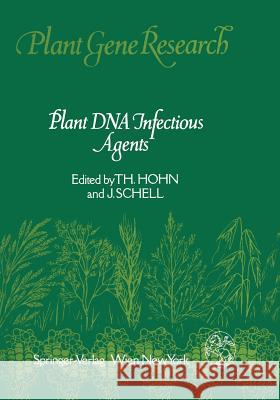
Plant DNA Infectious Agents Thomas Hohn Josef Schell 9783709174586 Springer - książkaWidoczna okładka, to zdjęcie poglądowe, a rzeczywista szata graficzna może różnić się od prezentowanej.

Plant DNA Infectious Agents

ISBN-13: 9783709174586 / Angielski / Miękka / 2011 / 348 str.

Thomas Hohn; Josef Schell
cena 402,53
(netto: 383,36 VAT:  5%)

Najniższa cena z 30 dni: 385,52
Termin realizacji zamówienia:
ok. 22 dni roboczych
Bez gwarancji dostawy przed świętami

Darmowa dostawa!

There has been recent rapid progress in the transformation of plants with foreign DNA, making use either of the natural routes of genetic invasion that viruses and bacteria have developed, or of chemical, mechanical and electrical tricks to make plant protoplast membranes permeable to nucleic acids. Genes integrated into plant virus genomes can be carried systemi- cally from the initial site of infection into the rest of the plant. Genes placed between the borders of Agrobacterium tumefaciens T-DNA can be transferred into single cells or plant tissue, which then divides to produce wound calli, or as in the case of an Agrobacterium rhizogenes infection, grow out into new roots. Calli and roots can be grown into whole plants. If virus genomes are placed between the T-DNA borders, a very effective infectious route, termed "agroinfection," is established. Once inside a pro- toplast, DNA finds its way into the nucleus where it can finally integrate into the resident chromosome and be expressed. Whether it can also find its way into chloroplasts is not yet clear, but at least translation products can be targeted into this organelle. Regeneration of whole organisms from single cells is a special feature of plants and offers a unique tool to study genes in a multicellular organism. In addition, as in animal cells, transcription and translation of trans- forming genes can be studied in plant cells during "transient expression."


Kategorie:
Nauka, Biologia i przyroda
Kategorie BISAC:
Science > Biologia molekularna
Science > Cytologia
Science > Botanika
Wydawca:
Springer
Seria wydawnicza:
Plant Gene Research
Język:
Angielski
ISBN-13:
9783709174586
Rok wydania:
2011
Wydanie:
Softcover Repri
Numer serii:
000036284
Ilość stron:
348
Waga:
0.70 kg
Wymiary:
25.4 x 17.8
Oprawa:
Miękka
Wolumenów:
01

1 The Molecular Biology of Cauliflower Mosaic Virus and Its Application as Plant Gene Vector.- I. Introduction.- II. The Biology of Cauliflower Mosaic Virus.- A. The Virus Particle.- B. The DNA of CaMV.- C. The Genetic Organisation of the CaMV.- 1. The Genes of CaMV.- 2. Transcripts of CaMV.- D. The Replication of CaMV.- E. Structural Homologies Between CaMV and Retroid Elements.- III. The Development of CaMV into a Plant Gene Vector.- A. Mutants of CaMV.- 1. Mutations in ORF II.- 2. Mutations in Other Regions of the CaMV Genome.- B. Translational Polarity.- C. Transducing Cauliflower Mosaic Virus Variants.- D. Defective Complementing Mutants of CaMV.- IV. Elements of CaMV as Tools in Plant Genetic Engineering.- V. Vector Based on Other Plant Viruses.- VI. Conclusion and Outlook.- VII. References.- 2 The Structure, Expression, Functions and Possible Exploitation of Geminivirus Genomes.- I. Introduction.- II. Genome Organisation.- A. Coding Regions.- B. Non-coding Regions.- III. Gene Expression.- IV. Gene Functions.- V. The Potential of Geminiviruses as Gene Vectors.- VI. References.- 3 cDNA Cloning of Plant RNA Viruses and Viroids.- I. General Introduction.- II. Construction of Full-Length cDNA Clones.- A. Introduction.- B. Synthesis of Double-Stranded cDNA.- C. Cloning Strategies.- D. Cloning in Transcription Vectors.- III. DNA Copies as Tools to Study the Molecular Biology of Plant RNA Viruses.- A. Introduction.- B. Infectivity of cDNA Clones.- i) Infectivity of DNA Copies.- ii) Infectivity of in vitro Transcripts from DNA Copies.- C. RNA Replication.- D. RNA Recombination.- E. Genetic Organisation and Gene Expression.- IV. Viroids and Satellites.- A. Introduction.- B. Molecular Cloning of Viroids.- C. Application of cDNA Clones.- i) Viroids.- ii) Satellite Viruses.- V. Diagnosis of Plant Diseases Using DNA Copies of Plant Viruses and Viroids.- A. Introduction.- B. Spot Hybridisation.- VI. Conclusions and Future Aspects.- VII. References.- 4 Agroinfection.- I. Introduction.- II. Potential Applications of Agroinfection.- A. Agrobacterium as an Organism for the Experimental Storage and Transmission of Plant Viruses.- 1. Storage and Safety.- 2. Efficiency and Flexibility.- 3. Release of Viral Genomes from the T-DNA.- 4. Analysis of T-DNA Transfer.- B. Transformation of Plant Cells with Viral Genetic Information.- 1. Transient Expression.- 2. Expression of Viral Genes in Host and Non-Host Plants.- 3. Transgenic Plants Containing Oligomers of Viral Genomes or Genome Components.- i) Complementation Between Different Components of a Multi-Component System.- ii) Analysis of in vitro Produced Mutant Viral Strains.- iii) Development of Proviral Vectors.- 4. Super-Infection of Plants Transgenic for Viral Sequences.- i) Cross-Protection.- ii) Complementation of Defective Viral Genes with Integrated Wild-Type-Genes; Development of Complementation Vectors.- III. Perspectives.- IV. References.- 5 The Mechanism of T-DNA Transfer from Agrobacterium tumefaciens to the Plant Cell.- I. General Introduction.- A. Scope of the Review.- B. Crown Gall Disease.- C. Molecular Basis of Neoplastic Transformation.- a) The Ti Plasmid and Its Organisation.- b) Functional Organisation of the T-DNA.- II. Early Events of Transformation.- A. Virulence Functions.- a) Chromosomal Virulence Region.- b) Organisation of the Virulence Region.- c) Regulation of vir Region Expression.- d) Nature of the Inducer.- B. T-DNA-Transfer.- a) The 25-bp Terminal Sequence.- b) Overdrive.- c) Analysis of the T-DNA/Plant DNA Junctions.- d) T-DNA Localisation and Structure Within the Plant Genome.- III. T-DNA Processing.- A. The Search of Processing Intermediates.- a) Genetic Assays.- b) Physical Assays.- c) Summary and Discussion.- B. Proteins Involved in T-DNA Processing.- a) Vir D Locus.- b) Vir C Locus.- c) Vir E Locus.- d) Vir F Locus.- IV. Conclusions.- V. References.- 6 Molecular Analysis of Root Induction by Agrobacterium rhizogenes.- I. Introduction.- II. Taxonomy.- III. Ri Plasmid Structure.- IV. Ri T-DNA Organization.- V. T-DNA of Ri Transformed Plants.- VI. Endogenous T-DNA of Plants.- VII. Conclusions and Further Speculations.- VIII. References.- 7 Pathways to Plant Genetic Manipulation Employing Agrobacterium.- I. Introduction.- II. Biology of Agrobacterium tumefaciens Ti Plasmid.- III. Strategies for Inserting Genes into T-DNA.- A. Homogenotization.- B. Cointegrating Intermediate Vectors.- C. Binary Vectors.- D. Disarming the T-DNA.- E. Specific Examples.- 1. Use of pMON200: A Cointegrating Vector.- 2. Use of pMON505: A Binary Vector.- F. Border Sequences and Binary Vector T-DNA Structure.- IV. Practical Catalogue.- A. Survey of Binary Vectors.- B. Selectable Markers.- C. Expression Cassette Vectors.- V. Getting Genes into Plants.- VI. Novel Applications of Ti Transformation.- A. Gene Isolation by Complementation or Direct Selection.- B. T-DNA as a Transposon for Mutation and Promoter Probe.- VII. Prospects.- VIII. References.- 8 Plant Transposable Elements: Unique Structures for Gene Tagging and Gene Cloning.- I. Introduction.- II. Isolation and Characterization of a Transposable Element.- A. Recognition of a Transposable Element.- B. Genes Suitable for the Isolation of Transposable Elements.- C. Transposon Tagging of a Gene in Zea mays.- D. Genetical Analysis of the Tagged Mutants.- E. Frequency of Mutation.- III. Transposable Elements as Molecular Probes for Gene Isolation.- A. General Aspects.- B. Isolation of Mutants Induced by Autonomous Elements (Ac and En [Spm]).- C. Isolation of Clones Carrying Receptor Elements.- D. Identification of Gene-Specific Sequences.- IV. Conclusions.- V. References.- 9 Direct Gene Transfer to Plants.- I. Direct Gene Transfer.- A. Introduction.- B. A Representative Experiment.- C. Protocol and Transformation Frequency.- D. Electroporation.- E. No Hostrange Limitations.- F. Foreign Gene Mendelian Inheritance.- G. Stability of the Foreign Gene.- H. Instability of the Foreign Gene.- I. Molecular Proof for Transformation.- J. Gene Localization by in situ Hybridization.- K. Arrangement of Foreign DNA in the Host Genome.- L. Co-Transformation with Non-Selectable Genes.- M. Gene Transfer from Total Genomic DNA.- N. Limitations for Direct Gene Transfer.- II. Other Vectorless Gene Transfer Systems.- A. Liposome Fusion.- B. Spheroplast Fusion.- C. Microinjection.- III. Direct Gene Transfer in Theoretical and Applied Genetics.- A. Gene Isolation.- B. Gene Identification.- C. Replication.- D. Gene Replacement.- E. Gene Regulation.- F. Stability and Instability.- G. Gene Transfer to Chloroplasts and Mitochondria.- H. Gene Transfer into Cereals.- I. Gene Transfer into Potentially Totipotent Cells.- J. Gene Transfer Without Pre Cloning in Bacteria.- K. Gene Transfer into Organelles.- L. Tagging of Chromosomes.- M. Modulation of Expression.- N. Conclusions.- IV. References.- 10 Microinjection: An Experimental Tool for Studying and Modifying Plant Cells.- I. Introduction.- II. Recipient Cell Systems.- A. Cell Types.- B. Protoplasts.- C. Cell Culture Conditions.- III. Resolution of Intracellular Compartments.- A. Microscopy.- B. Fluorescent Stains.- IV. Microinjection Methodology.- A. Micromanipulation Techniques.- B. Equipment.- V. Genetic Transformation.- VI. Other Applications.- VII. Concluding Remarks.- VIII. References.- 11 Transformation of Chlamydomonas Reinhardtii.- I. Introduction.- II. Nuclear Transformation.- A. Selection.- i) ARG7 Locus.- ii) Resistance to Kanamycin.- iii) Other Selective Markers.- B. ARS Sequences of C. reinhardtii.- C. ARC Sequences.- D. Natural Plasmids.- E. Is Agrobacterium tumefaciens a Possible Transformation Vector for C. reinhardtii?.- III. Prospects of Chloroplast Transformation in C. reinhardtii.- IV. Conclusions.- V. References.- 12 Induction of Expression in and Stable Transformation of an Algal Cell by Nuclear Microinjection with Naked DNA.- I. Introduction.- II. Acetabularia.- III. Techniques.- IV. Expression of Genomic RNA.- V. Expression of Genomic DNA.- VI. Expression of Genes and Gene Constructions.- VII. Regulation of Expression.- VIII. Transformation.- IX. Genetics.- X. Discussion.- XI. References.- 13 Transient Expression of DNA in Plant Cells.- I. Overview of Transient Assay Applications.- II. Transient Assays in Plant Cells.- III. Transient Expression after Electroporation-Mediated Gene Transfer.- IV. Discussion.- V. References.- 14 Plastid Transformation: A Progress Report.- I. Introduction.- II. Construction of Vectors for the Transformation of Plastids.- III. General Conclusions.- IV. References.- 15 Targeting Nuclear Gene Products into Chloroplasts.- I. Introduction.- II. Binding of Precursors to the Outer Membrane of the Chloroplast.- III. Translocation of Polypeptides Across the Envelope Membranes.- IV. Processing of Precursors to the Nature Polypeptide.- V. The Transit Peptide Itself can Mediate Import of Foreign Polpeptides.- VI. Structural Analysis of Chloroplast Transit Peptides.- VII. Experimental Analysis of Transit Peptides.- VIII. Future Prospects.- IX. References.

Hohn, Thomas Thomas Hohn, B.A., wurde 1964 in Detmold geboren. ... więcej >


Udostępnij

Facebook - konto krainaksiazek.pl


Opinie o Krainaksiazek.pl na Opineo.pl

Partner Mybenefit

Krainaksiazek.pl w programie rzetelna firma Krainaksiaze.pl - płatności przez paypal

Czytaj nas na:

Facebook - krainaksiazek.pl
  • książki na zamówienie
  • granty
  • książka na prezent
  • kontakt
  • pomoc
  • opinie
  • regulamin
  • polityka prywatności

Zobacz:

  • Księgarnia czeska

  • Wydawnictwo Książkowe Klimaty

1997-2025 DolnySlask.com Agencja Internetowa

© 1997-2022 krainaksiazek.pl
     
KONTAKT | REGULAMIN | POLITYKA PRYWATNOŚCI | USTAWIENIA PRYWATNOŚCI
Zobacz: Księgarnia Czeska | Wydawnictwo Książkowe Klimaty | Mapa strony | Lista autorów
KrainaKsiazek.PL - Księgarnia Internetowa

Polityka prywatnosci - link
Krainaksiazek.pl - płatnośc Przelewy24
Przechowalnia Przechowalnia





