• Wyszukiwanie zaawansowane
  • Kategorie
  • Kategorie BISAC
  • Książki na zamówienie
  • Promocje
  • Granty
  • Książka na prezent
  • Opinie
  • Pomoc
  • Załóż konto
  • Zaloguj się

Planetary Nebulae: A Study of Late Stages of Stellar Evolution » książka


zaloguj się | załóż konto
Logo Krainaksiazek.pl

koszyk

konto

szukaj
topmenu
Księgarnia internetowa
Szukaj
Książki na zamówienie
Promocje
Granty
Książka na prezent
Moje konto
Pomoc
 
 
Wyszukiwanie zaawansowane
Pusty koszyk
Bezpłatna dostawa dla zamówień powyżej 20 złBezpłatna dostawa dla zamówień powyżej 20 zł

Kategorie główne

• Nauka
 [2949965]
• Literatura piękna
 [1857847]

  więcej...
• Turystyka
 [70818]
• Informatyka
 [151303]
• Komiksy
 [35733]
• Encyklopedie
 [23180]
• Dziecięca
 [617748]
• Hobby
 [139972]
• AudioBooki
 [1650]
• Literatura faktu
 [228361]
• Muzyka CD
 [398]
• Słowniki
 [2862]
• Inne
 [444732]
• Kalendarze
 [1620]
• Podręczniki
 [167233]
• Poradniki
 [482388]
• Religia
 [509867]
• Czasopisma
 [533]
• Sport
 [61361]
• Sztuka
 [243125]
• CD, DVD, Video
 [3451]
• Technologie
 [219309]
• Zdrowie
 [101347]
• Książkowe Klimaty
 [123]
• Zabawki
 [2362]
• Puzzle, gry
 [3791]
• Literatura w języku ukraińskim
 [253]
• Art. papiernicze i szkolne
 [7933]
Kategorie szczegółowe BISAC

Planetary Nebulae: A Study of Late Stages of Stellar Evolution

ISBN-13: 9789400972353 / Angielski / Miękka / 2011 / 326 str.
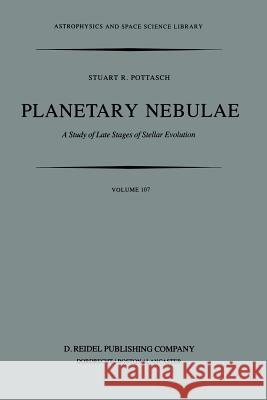
Stuart R. Pottasch
Planetary Nebulae: A Study of Late Stages of Stellar Evolution Pottasch, Stuart R. 9789400972353 Springer - książkaWidoczna okładka, to zdjęcie poglądowe, a rzeczywista szata graficzna może różnić się od prezentowanej.

Planetary Nebulae: A Study of Late Stages of Stellar Evolution

ISBN-13: 9789400972353 / Angielski / Miękka / 2011 / 326 str.

Stuart R. Pottasch
cena 605,23 zł
(netto: 576,41 VAT:  5%)

Najniższa cena z 30 dni: 578,30 zł
Termin realizacji zamówienia:
ok. 22 dni roboczych
Bez gwarancji dostawy przed świętami

Darmowa dostawa!

The purpose of this book is to give a detailed description of the planetary nebulae including the relevant astronomical observations and their interpretation. Considerable attention is given to the evolution of these objects as well as to their physical characteristics. I t is hoped that the book be useful to both advanced research workers and to students with some background in astronomy. In this regard, the book should serve as a text as well as a reference work. The many tables included are expected to be useful for both purposes. The references are generally not included in the text except for historical purposes in an effort to improve readability. References are given at the end of each chapter together with sufficient text to describe their content. No attempt has been made to make the list of references complete; on the contrary it has generally been limited to the most recent literature on the subject which in turn refers to earlier research. Again, exceptions have been made for references of historical interest.


Kategorie:
Nauka, Fizyka
Kategorie BISAC:
Science > Astronomia, przestrzeń i czas
Wydawca:
Springer
Seria wydawnicza:
Astrophysics and Space Science Library (Paperback)
Język:
Angielski
ISBN-13:
9789400972353
Rok wydania:
2011
Wydanie:
Softcover Repri
Numer serii:
000036061
Ilość stron:
326
Waga:
0.48 kg
Wymiary:
23.39 x 15.6 x 1.8
Oprawa:
Miękka
Wolumenów:
01

I: History, Morphology and Evolution.- A Historical Review.- II: Distribution of Planetary Nebulae in the Galaxy.- A. Methods of discovering planetary nebulae.- B. Distribution in galactic coordinates.- B.1. Galactic longitude distribution.- B.2. Galactic latitude distribution.- C. Radial velocities of the nebulae.- D. Extragalactic planetary nebulae.- D.1. Discovery of extragalactic planetary nebulae.- D.2. Distribution of extragalactic planetary nebulae.- D.3. Luminosity function of planetary nebulae.- III: Interpretation of Emission Lines and Nebular Abundances.- A. Recombination lines.- A.1. Hydrogen line formation in the low density limit.- A.2. Hydrogen line formation at finite densities.- A.3. Ionization by diffuse Lyman continuum photons.- A.4. Self-absorption in the hydrogen spectrum.- A.5. Helium.- B. Collisionally excited lines.- C. Line formation in heavier elements by other processes.- C.1. Dielectronic recombination.- C.2. Other recombination processes.- C.3. OIII Bowen resonance-fluorescence.- D. Nebular models.- E. Abundances in planetary nebulae.- E.1. Helium.- E.2. Oxygen.- E.3. Nitrogen.- E.4. Carbon.- E.5. Neon, Argon and Sulfur.- E.6. Abundance variations with galactic latitude.- E.7. Variation of nebular abundance with position in the nebula.- IV: Nebular Continuum Emission.- A.Sources of continuum emission.- A.1. Hydrogen free-bound and free-free emission.- A.2. Helium continuum emission.- A.3. Hydrogen two-quantum emission.- A.4. Helium two-quantum emission.- B. Comparison of theory with observations.- C. Separation of continuum radiation from the nebula and the exciting star.- C.1. The visual continuum.- C.2. The ultraviolet continuum.- D. Radio continuum radiation.- D.1. Constant density nebula.- D.2. Nebulae with varying density.- E. Comparison of radio continuum with hydrogen line emission.- V: Distance to the Nebulae.- A. Extinction.- B. Distances to individual nebulae.- C. Mass of the nebula.- C.1. Nearby nebulae.- C.2. Galactic center nebulae.- C.3. Discussion of the nebular mass variation.- D. Statistical methods for determining distances.- D.1. ‘Shklovskii’ method.- D.2. Modified ‘Shklovskii’ method.- D.3. Proper motions.- E. Absolute nebular flux.- F. The space density of nearby nebulae and their distribution with height above the galactic plane.- VI: Morphology, Expansion and Mass Loss.- A. Morphology: measurements.- B. Nebular expansion.- C. Morphology: models and classification.- D. Morphology: ‘halo’ structures.- E. Morphology: four individual cases.- F. Mass loss from the central star: ultraviolet lines.- G. Other evidence for mass loss: visual lines.- VII: The Temperature of the Central Stars.- A. The line spectra.- B. The continuous spectrum of the central star.- C. Model atmospheres.- D. ‘Zanstra’ temperatures.- D.1. The Zanstra hydrogen temperature.- D.2. The Zanstra ionized helium temperature.- D.3. Discussion of nebulae consisting of hydrogen and helium.- D.4. Resultant temperatures and discussion.- E. ‘Stoy’ temperatures.- F. Temperatures derived from nebular ionization equilibrium.- VIII: Infrared and Millimeter Radiation.- A. Infrared continuous emission.- B. Interpretation as dust emission.- C. Energy input to the dust.- D. Consequences for the central star temperature determination.- E. Broad and narrow infrared emission features.- F. Molecular hydrogen.- G. Carbon monoxide emission.- IX: Evolution of the Central Star.- A. Observational evidence.- A.1. The H-R diagram.- A.2. White dwarfs.- B. Theoretical models.- B.1. Review of the early evolution.- B.2. Uncertainty in early evolution.- B.3. Enrichment of helium, nitrogen and carbon.- B.4. Evolution after nebular formation.- C. Comparison of theory and observation.- C.1. The H-R diagram and central star mass.- C.2. The ages of the nebulae and the position of the star on the H-R diagram.- C.3. Changes in chemical composition in the atmosphere.- X: Evolution from Red Giant to Planetary Nebula.- A. The cool giants.- B. The Mira variables.- B.1. Light curves, periods, absolute magnitudes and mass loss.- B.2. Spatial distribution, kinematics and local space density of Miras.- B.3. Mass loss.- B.4. Mass of Mira variables and pulsation theory.- C. The OH/IR masers.- C.1. OH maser emission.- C.2. Observed OH emission.- C.3. Detection and kinematics of OH/IR maser sources.- C.4. The birthrate of OH/IR stars.- C.5. The missing link?.- D. Protoplanetary nebulae and symbiotic stars.- D.1. V 1016 Cygni and HM Sge.- D.2. CRL 618.- D.3. CW Leo.- D.4. Far infrared radiation from protoplanetary nebulae.- E. FG Sge and its nebula.- F. Discussion of the evolution.- XI: Influence of Planetary Nebulae on the Interstellar Medium.- A. The mass input.- B. The dust input.- C. Kinetic energy input.- D. Element abundance changes.- E. The far-ultraviolet radiation field.- E.1. Absorption of radiation in the interstellar medium.- E.2. Radiation of optically thin planetary nebulae and hot white dwarfs.- E.3. Comparison with O stars.- Appendix I: Positions and other Information of the Brightest Planetary Nebulae and Their Central Stars.- Appendix II: Infrared Continuum Flux from Planetary Nebulae.- Author Index.- Index of Individual Objects.


Udostępnij

Facebook - konto krainaksiazek.pl


Opinie o Krainaksiazek.pl na Opineo.pl

Partner Mybenefit

Krainaksiazek.pl w programie rzetelna firma Krainaksiaze.pl - płatności przez paypal

Czytaj nas na:

Facebook - krainaksiazek.pl
  • książki na zamówienie
  • granty
  • książka na prezent
  • kontakt
  • pomoc
  • opinie
  • regulamin
  • polityka prywatności

Zobacz:

  • Księgarnia czeska

  • Wydawnictwo Książkowe Klimaty

1997-2025 DolnySlask.com Agencja Internetowa

© 1997-2022 krainaksiazek.pl
     
KONTAKT | REGULAMIN | POLITYKA PRYWATNOŚCI | USTAWIENIA PRYWATNOŚCI
Zobacz: Księgarnia Czeska | Wydawnictwo Książkowe Klimaty | Mapa strony | Lista autorów
KrainaKsiazek.PL - Księgarnia Internetowa

Polityka prywatnosci - link
Krainaksiazek.pl - płatnośc Przelewy24
Przechowalnia Przechowalnia






