• Wyszukiwanie zaawansowane
  • Kategorie
  • Kategorie BISAC
  • Książki na zamówienie
  • Promocje
  • Granty
  • Książka na prezent
  • Opinie
  • Pomoc
  • Załóż konto
  • Zaloguj się

Physics of the Galaxy and Interstellar Matter » książka


zaloguj się | załóż konto
Logo Krainaksiazek.pl

koszyk

konto

szukaj
topmenu
Księgarnia internetowa
Szukaj
Książki na zamówienie
Promocje
Granty
Książka na prezent
Moje konto
Pomoc
 
 
Wyszukiwanie zaawansowane
Pusty koszyk
Bezpłatna dostawa dla zamówień powyżej 20 złBezpłatna dostawa dla zamówień powyżej 20 zł

Kategorie główne

• Nauka
 [2946912]
• Literatura piękna
 [1852311]

  więcej...
• Turystyka
 [71421]
• Informatyka
 [150889]
• Komiksy
 [35717]
• Encyklopedie
 [23177]
• Dziecięca
 [617324]
• Hobby
 [138808]
• AudioBooki
 [1671]
• Literatura faktu
 [228371]
• Muzyka CD
 [400]
• Słowniki
 [2841]
• Inne
 [445428]
• Kalendarze
 [1545]
• Podręczniki
 [166819]
• Poradniki
 [480180]
• Religia
 [510412]
• Czasopisma
 [525]
• Sport
 [61271]
• Sztuka
 [242929]
• CD, DVD, Video
 [3371]
• Technologie
 [219258]
• Zdrowie
 [100961]
• Książkowe Klimaty
 [124]
• Zabawki
 [2341]
• Puzzle, gry
 [3766]
• Literatura w języku ukraińskim
 [255]
• Art. papiernicze i szkolne
 [7810]
Kategorie szczegółowe BISAC

Physics of the Galaxy and Interstellar Matter

ISBN-13: 9783540173151 / Angielski / Miękka / 1988 / 492 str.
Helmut Scheffler;Hans Elsasser;Arthur H. Armstrong
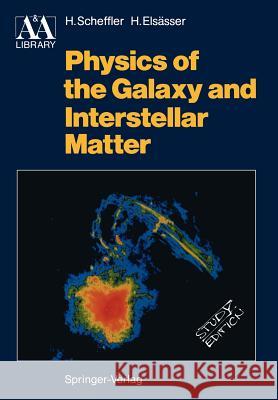
Physics of the Galaxy and Interstellar Matter Helmut Scheffler, Hans Elsässer, Arthur H. Armstrong 9783540173151 Springer-Verlag Berlin and Heidelberg GmbH &  - książkaWidoczna okładka, to zdjęcie poglądowe, a rzeczywista szata graficzna może różnić się od prezentowanej.

Physics of the Galaxy and Interstellar Matter

ISBN-13: 9783540173151 / Angielski / Miękka / 1988 / 492 str.

Helmut Scheffler;Hans Elsasser;Arthur H. Armstrong
cena 201,72
(netto: 192,11 VAT:  5%)

Najniższa cena z 30 dni: 192,74
Termin realizacji zamówienia:
ok. 22 dni roboczych
Bez gwarancji dostawy przed świętami

Darmowa dostawa!

The present book is a translation of the original German edition (published in 1982) with some minor corrections and improvements. The guide to sup- plementary and advanced literature given in the Appendix, however, has been brought up to date. This book is addressed primarily to students taking astronomy as a prin- cipal or subsidiary subject, and to scientists of related fields, but amateur as- tronomers should also be able to profit from it. For most chapters an elementary knowledge of mathematics and physics will be sufficient, however, Chaps. 5 and 6 impose somewhat greater requirements. In addition the reader should already be acquainted with the basic concepts of stellar physics as treated in introduc- tory books, including the spectral types, the system of stellar magnitudes and colours, absolute magnitudes and luminosities, the Herlzsprung-Russell dia- gram and its interpretation. A modem textbook should use SI units. On the other hand, the use of the cgs system is still the prevailing custom in astrophysics - together with the special units of astronomy: length is quoted in parsecs pc], mass in solar masses M0] and time in years a]. We have therefore compromised and employed both cgs and SI units in this book, whichever was the appropriate choice in each instance. A table for conversion of cgs units into SI units and vice versa is given in the Appendix.


Kategorie:
Nauka, Fizyka
Kategorie BISAC:
Science > Astronomia, przestrzeń i czas
Science > Astrofizyka
Wydawca:
Springer-Verlag Berlin and Heidelberg GmbH &
Seria wydawnicza:
Astronomy and Astrophysics Library
Język:
Angielski
ISBN-13:
9783540173151
Rok wydania:
1988
Dostępne języki:
Angielski
Wydanie:
1988
Numer serii:
000030573
Ilość stron:
492
Waga:
0.87 kg
Wymiary:
24.424.4 x 17.0
Oprawa:
Miękka
Wolumenów:
01

1. Introductory Survey.- 1.1 The Stellar System.- 1.2 Interstellar Matter.- 1.3 Dynamics and Evolution.- 2. Positions, Motions and Distances of the Stars — Concepts and Methods.- 2.1 Positions and Motions.- 2.1.1 Astronomical Coordinate Systems.- 2.1.2 Temporal Changes of the Star Coordinates.- 2.1.3 Space Velocities and Solar Motion.- 2.1.4 The Fundamental Astronomical Coordinate System.- 2.1.5 Extra-Galactically Based Reference System, Radioastrometry.- 2.2 Distances.- 2.2.1 Primary Methods.- 2.2.2 Secondary Methods.- 3. Structure and Kinematics of the Stellar System.- 3.1 Apparent Distribution of the Stars.- 3.1.1 General Star Counts, Integrated Starlight.- 3.1.2 Apparent Distribution of the Individual Star Types.- 3.1.3 Distribution of the Surface Brightness of the Milky Way in the Visible and in the Infrared.- 3.2 The Local Galactic Star Field.- 3.2.1 Methods of Stellar Statistics.- 3.2.2 Luminosity Function and Spatial Distribution of the Stars.- 3.2.3 Motions of the Stars in the Solar Vicinity.- 3.3 Large Scale Distribution of the Stars.- 3.3.1 OB Stars, Young Open Star Clusters and OB Associations.- 3.3.2 Globular Clusters, RR Lyrae Stars and Cepheids.- 3.3.3 Stars in the Galactic Halo.- 3.3.4 Surface Brightness of the Milky Way and Galactic Structure, Stellar Emission of the Central Region.- 3.4 Large Scale Motion of the Stars.- 3.4.1 Shear, Rotation and Dilatation of the Velocity Field.- 3.4.2 Rotation of the Galactic Disc.- 3.4.3 Objects of the Galactic Halo.- 3.5 General Summary, Stellar Populations.- 3.5.1 Sub-Systems.- 3.5.2 Stellar Populations and Evolution of the Galaxy.- 4. Interstellar Phenomena.- 4.1 The Generally Distributed Medium.- 4.1.1 Interstellar Extinction.- 4.1.2 Interstellar Polarisation.- 4.1.3 Reflection Nebulae and Diffuse Galactic Light.- 4.1.4 Interstellar Absorption Lines in Stellar Spectra.- 4.1.5 The 21 cm Radio Line of the Interstellar Hydrogen.- 4.1.6 Line Emission of Interstellar CO Molecules.- 4.1.7 Continuous Radio Emission.- 4.1.8 Faraday Rotation in the Interstellar Magnetic Field and Dispersion of the Radiation of Discrete Radio Sources.- 4.1.9 Interstellar Radiation Field, X- and Gamma Rays, Cosmic Particle Radiation.- 4.2 Interstellar Clouds.- 4.2.1 Diffuse Emission Nebulae: Optical Phenomena.- 4.2.2 Continuous Radio Emission from H II Regions.- 4.2.3 Radio Recombination Lines of H II Regions.- 4.2.4 Infrared Emission from H II Regions.- 4.2.5 Dark Clouds: Optical Data.- 4.2.6 Dark Clouds of High Extinction and IR Sources.- 4.2.7 Molecular Clouds.- 4.2.8 Maser Point Sources.- 4.2.9 Interstellar Clouds and Star Formation.- 5. Physics of the Interstellar Matter.- 5.1 Radiation in the Interstellar Gas.- 5.1.1 Radiation Transport.- 5.1.2 Line Emission and Absorption Under Interstellar Conditions.- 5.1.3 Continuous Emission and Absorption.- 5.2 State of the Interstellar Gas.- 5.2.1 Ionisation.- 5.2.2 Formation and Dissociation of Interstellar Molecules.- 5.2.3 Heat Balance and Kinetic Temperature of the Gas.- 5.2.4 State of Molecular Clouds and H II Regions.- 5.2.5 Elemental Abundances in the Interstellar Gas.- 5.3 The Interstellar Dust Grains.- 5.3.1 Optics of Small Solid Particles.- 5.3.2 Nature of the Interstellar Dust Grains.- 5.3.3 Interactions with the Radiation Field, the Gas and the Magnetic Field.- 5.4 Distribution and Motion of the Interstellar Matter.- 5.4.1 Local Distribution and Cloud Structure of the Dust.- 5.4.2 Density and Cloud Structure of the Neutral Hydrogen in the Solar Neighbourhood.- 5.4.3 The Neutral Hydrogen on the Large Scale.- 5.4.4 Large Scale Distribution of H II Regions and Molecular Clouds.- 5.4.5 Gaseous Galactic Halo.- 6. Dynamics of the Galaxy.- 6.1 Stellar Dynamics.- 6.1.1 Posing of the Problem, Fundamental Equations.- 6.1.2 Close Stellar Encounters, Relaxation.- 6.1.3 Stellar Dynamics Taking Account of Encounters.- 6.1.4 Collisionless Dynamics of the Galactic Stellar System.- 6.1.5 The Mass Distribution in the Galaxy.- 6.2 Gravitational Theory of the Spiral Structure.- 6.2.1 Statement of the Problem and General Review.- 6.2.2 Spiral-Form Density Waves.- 6.3 Dynamics of the Interstellar Gas.- 6.3.1 Posing of the Problem and Fundamentals.- 6.3.2 Dynamical Equilibrium of the Gas.- 6.3.3 Shock Fronts in the Interstellar Gas.- 6.3.4 Condensation of the Gas and Galactic Evolution.- A. Fundamental Formulae for the Transformation of Astronomical Coordinates.- B. Energy States and Transitions of Molecules.- C. Charts for the Graphical Determination of Approximate Galactic Coordinates.- D. Excitation and Ionisation in the Thermo dynamical Equilibrium.- Astronomical and Physical Constants.- Latin Names of Constellations.- References.- Supplementary and Advanced Literature.- Sources of Tables.- Sources of Figures.


Udostępnij

Facebook - konto krainaksiazek.pl


Opinie o Krainaksiazek.pl na Opineo.pl

Partner Mybenefit

Krainaksiazek.pl w programie rzetelna firma Krainaksiaze.pl - płatności przez paypal

Czytaj nas na:

Facebook - krainaksiazek.pl
  • książki na zamówienie
  • granty
  • książka na prezent
  • kontakt
  • pomoc
  • opinie
  • regulamin
  • polityka prywatności

Zobacz:

  • Księgarnia czeska

  • Wydawnictwo Książkowe Klimaty

1997-2025 DolnySlask.com Agencja Internetowa

© 1997-2022 krainaksiazek.pl
     
KONTAKT | REGULAMIN | POLITYKA PRYWATNOŚCI | USTAWIENIA PRYWATNOŚCI
Zobacz: Księgarnia Czeska | Wydawnictwo Książkowe Klimaty | Mapa strony | Lista autorów
KrainaKsiazek.PL - Księgarnia Internetowa

Polityka prywatnosci - link
Krainaksiazek.pl - płatnośc Przelewy24
Przechowalnia Przechowalnia





