• Wyszukiwanie zaawansowane
  • Kategorie
  • Kategorie BISAC
  • Książki na zamówienie
  • Promocje
  • Granty
  • Książka na prezent
  • Opinie
  • Pomoc
  • Załóż konto
  • Zaloguj się

Physics of Photonic Devices » książka


zaloguj się | załóż konto
Logo Krainaksiazek.pl

koszyk

konto

szukaj
topmenu
Księgarnia internetowa
Szukaj
Książki na zamówienie
Promocje
Granty
Książka na prezent
Moje konto
Pomoc
 
 
Wyszukiwanie zaawansowane
Pusty koszyk
Bezpłatna dostawa dla zamówień powyżej 20 złBezpłatna dostawa dla zamówień powyżej 20 zł

Kategorie główne

• Nauka
 [2952079]
• Literatura piękna
 [1850969]

  więcej...
• Turystyka
 [71058]
• Informatyka
 [151066]
• Komiksy
 [35579]
• Encyklopedie
 [23181]
• Dziecięca
 [620496]
• Hobby
 [139036]
• AudioBooki
 [1646]
• Literatura faktu
 [228729]
• Muzyka CD
 [379]
• Słowniki
 [2932]
• Inne
 [445708]
• Kalendarze
 [1409]
• Podręczniki
 [164793]
• Poradniki
 [480107]
• Religia
 [510956]
• Czasopisma
 [511]
• Sport
 [61267]
• Sztuka
 [243299]
• CD, DVD, Video
 [3411]
• Technologie
 [219640]
• Zdrowie
 [100984]
• Książkowe Klimaty
 [124]
• Zabawki
 [2281]
• Puzzle, gry
 [3363]
• Literatura w języku ukraińskim
 [258]
• Art. papiernicze i szkolne
 [8020]
Kategorie szczegółowe BISAC

Physics of Photonic Devices

ISBN-13: 9780470293195 / Angielski / Twarda / 2009 / 840 str.
Shun Lien Chuang
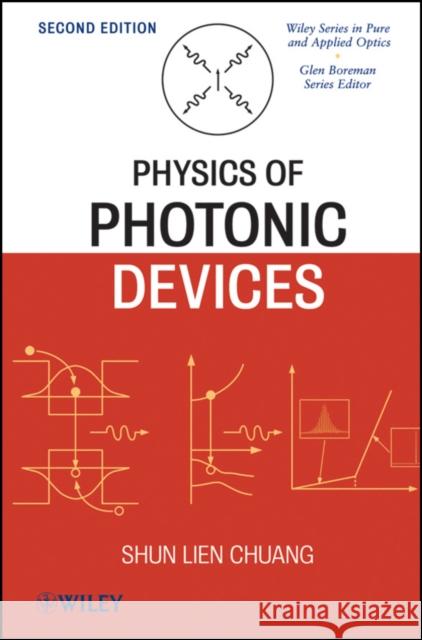
Physics of Photonic Devices Shun Lien Chuang 9780470293195 John Wiley & Sons - książkaWidoczna okładka, to zdjęcie poglądowe, a rzeczywista szata graficzna może różnić się od prezentowanej.

Physics of Photonic Devices

ISBN-13: 9780470293195 / Angielski / Twarda / 2009 / 840 str.

Shun Lien Chuang
cena 775,06
(netto: 738,15 VAT:  5%)

Najniższa cena z 30 dni: 767,13
Termin realizacji zamówienia:
ok. 30 dni roboczych
Dostawa w 2026 r.

Darmowa dostawa!

The most up-to-date book available on the physics of photonic devices This new edition of Physics of Photonic Devices incorporates significant advancements in the field of photonics that have occurred since publication of the first edition (Physics of Optoelectronic Devices). New topics covered include a brief history of the invention of semiconductor lasers, the Lorentz dipole method and metal plasmas, matrix optics, surface plasma waveguides, optical ring resonators, integrated electroabsorption modulator-lasers, and solar cells. It also introduces exciting new fields of research such as: surface plasmonics and micro-ring resonators; the theory of optical gain and absorption in quantum dots and quantum wires and their applications in semiconductor lasers; and novel microcavity and photonic crystal lasers, quantum-cascade lasers, and GaN blue-green lasers within the context of advanced semiconductor lasers. Physics of Photonic Devices, Second Edition presents novel information that is not yet available in book form elsewhere. Many problem sets have been updated, the answers to which are available in an all-new Solutions Manual for instructors. Comprehensive, timely, and practical, Physics of Photonic Devices is an invaluable textbook for advanced undergraduate and graduate courses in photonics and an indispensable tool for researchers working in this rapidly growing field.


Kategorie:
Technologie
Kategorie BISAC:
Technology & Engineering > Electronics - General
Technology & Engineering > Lasers & Photonics
Wydawca:
John Wiley & Sons
Język:
Angielski
ISBN-13:
9780470293195
Rok wydania:
2009
Numer serii:
000211295
Ilość stron:
840
Waga:
1.19 kg
Wymiary:
23.62 x 15.49 x 4.32
Oprawa:
Twarda
Wolumenów:
01
Dodatkowe informacje:
Bibliografia
Wydanie ilustrowane

Chapter 1: Introduction.

1.1 Basic Concepts of Semiconductor Bonding and Band Diagrams.

1.2 The Invention of Semiconductor Lasers.

1.3 The Field of Optoelectronics.

1.4 Overview of the book.

Problems.

References.

Bibliography.

PART I: FUNDAMENTALS.

Chapter 2: Basic Semiconductor Electronics.

2.1 Maxwell’s Equations and Boundary Conditions.

2.2 Semiconductor Electronics Equations.

2.3 Generation and Recombination in Semiconductors.

2.4 Examples and Applications to Optoelectronic Devices.

2.5 Semiconductor p–N and n–P Heterojunctions.

2.6 Semiconductor n–N Heterojunctions and Metal–Semiconductor Junctions.

Problems.

References.

Chapter 3: Basic Quantum Mechanics.

3.1 Schrödinger Equation.

3.2 The Square Well.

3.3 The Harmonic Oscillator.

3.4 The Hydrogen Atom and Excitons in 2D and 3D.

3.5 Time–Independent Perturbation Theory.

3.6 Time–Dependent Perturbation Theory .

Appendix 3A. Löwdin’s Renormalization Method.

Problems.

References.

Chapter 4: Theory of Electronic Band Structures in Semiconductors.

4.1 The Bloch Theorem and the k•p Method for Simple Bands.

4.2 Kane′s Model for Band Structure––The k•p Method with the Spin–Orbit Interaction.

4.3 Luttinger–Kohn’s Model––The k•p Method for Degenerate Bands.

4.4 The Effective Mass Theory for a Single Band and Degenerate Bands.

4.5 Strain Effects on Band Structures.

4.6 Electronic States in an Arbitrary One–Dimensional Potential.

4.7 Kronig–Penny Model for a Superlattice.

4.8 Band Structures of Semiconductor Quantum Wells.

4.9 Band Structures of Strained Semiconductor Quantum Wells.

Problems.

References.

PART II: PROPAGATION OF LIGHT.

Chapter 5: Electromagnetics and Light Propagation.

5.1 Time–Harmonic Fields and Duality Principle.

5.2 Poynting′s Theorem and Reciprocity Relations.

5.3 Plane Wave Solutions for Maxwell’s Equations in Homogeneous Media.

5.4 Light Propagation in Isotropic Media.

5.5 Wave Propagation in Lossy Medium–Lorentz Oscillator Model and Metal Plasma.

5.6 Plane Wave Reflection from a Surface.

5.7 Matrix Optics.

5.8 Propagation Matrix Approach for Plane Wave Reflection from a Multilayered Medium.

5.9 Wave Propagation in Periodic Media.

Appendix 5A Kramers–Kronig Relations.

Problems.

References.

Chapter 6: Light Propagation in Anisotropic Media and Radiation.

6.1 Light Propagation in Uniaxial Media.

6.2 Wave Propagation in Gyrotropic Media– Magnetooptic Effects.

6.3 General Solutions to Maxwell′s Equations and Gauge Transformations.

6.4 Radiation and the Far–Field Pattern.

Problems.

References.

Chapter 7: Optical Waveguide Theory.

7.1 Symmetric Dielectric Slab Waveguides.

7.2 Asymmetric Dielectric Slab Waveguides.

7.3 Rectangular Dielectric Waveguides.

7.4 Ray Optics Approach to Waveguide Problems.

7.5 The Effective Index Method.

7.6 Wave Guidance in a Lossy or Gain Medium.

7.7 Surface Plasmon Waveguide.

Problems.

References.

Chapter 8: Coupled Mode Theory.

8.1 Waveguide Couplers.

8.2 Coupled Optical Waveguides.

8.3 Applications of Optical Waveguide Couplers.

8.4 Optical Ring Resonators and Add–Drop Filters.

8.5 Distributed Feedback Structures.

Appendix 8A Coupling Coefficients for Parallel Waveguides.

Appendix 8B Improved Coupled–Mode Theory.

Problems.

References.

PART III: GENERATION OF LIGHT.

Chapter 9: Optical Processes in Semiconductors.

9.1 Optical Transitions Using the Fermi’s Golden Rule.

9.2 Spontaneous and Stimulation Emissions.

9.3 Interband Absorption and Gain of Bulk Semiconductors.

9.4 Interband Absorption and Gain in a Quantum Well.

9.5 Interband Momentum Matrix Elements of Bulk and Quantum–Well Semiconductors.

9.6 Quantum Dots and Quantum Wires.

9.7 Intersubband Absorption.

9.8 Gain Spectrum in a Quantum–Well Laser with Valence–Band–Mixing Effects.

Appendix 9A Coordinate Transformation of the Basis Functions and the Momentum Matrix Elements.

Problems.

References.

Chapter 10: Fundamentals of Semiconductor Lasers.

10.1 Double Heterojunction Semiconductor Lasers.

10.2 Gain–Guided and Index–Guided Semiconductor Lasers.

10.3 Quantum–Well Lasers.

10.4 Strained Quantum–Well Lasers.

10.5 Strained Quantum–Dot Lasers.

Problems.

References.

Chapter 11: Advanced Semiconductor Lasers.

11.1 Distributed Feedback Lasers.

11.2 Vertical–Cavity Surface Emitting Lasers.

11.3 Microcavity and Photonics Crystal Lasers .

11.4 Quantum–Cascade Lasers.

11.5 GaN–based Blue–Green Lasers and LEDs.

11.6 Coupled Laser Arrays.

Appendix 11A. Hamiltonin for Strained Wurtzite Crystals.

Appendix 11B. Band–edge Optical Matrix Elements.

Problems.

References.

PART IV: MODULATION OF LIGHT.

Chapter 12: Direct Modulation of Semiconductor Lasers.

12.1 Rate Equations and Linear Gain Analysis.

12.2 High–Speed Modulation Response with Nonlinear Gain Saturation .

12.3 Transport Effects on Modulation of Quantum–Well Lasers: Electrical vs. Optical Modulation.

12.4 Semiconductor Laser Spectral Linewidth and the Linewidth Enhancement Factor.

12.5 Relative Intensity Noise (RIN) Spectrum.

Problems.

References.

Chapter 13: Electrooptic and Acoustooptic Modulators.

13.1 Electrooptic Effects and Amplitude Modulators.

13.2 Phase Modulators.

13.3 Electrooptic Effects in Waveguide Devices.

13.4 Scattering of Light by Sound: Raman–Nath and Bragg Diffractions.

13.5 Coupled–Mode Analysis for Bragg Acoustooptic Wave Couplers.

Problems.

References.

Chapter 14: Electroabsorption Modulators.

14.1 General Formulation for Optical Absorption due to an Electron–Hole Pair.

14.2 Franz–Keldysh Effect––Photon–Assisted Tunneling.

14.3 Exciton Effect.

14.4 Quantum Confined Stark Effect (QCSE).

14.5 Electroabsorption Modulator.

14.6 Integrated Electroabsorption Modulator–Laser (EML).

14.7 Self–Electrooptic Effect Devices (SEEDs).

Appendix 14A. Two–Particle Wave Function and the Effective Mass Equation.

Appendix 14B. Solution of the Electron–Hole Effective–Mass Equation with Exciton Effects.

Problems.

References.

PART V: DETECTION OF LIGHT AND SOLAR CELLS.

Chapter 15: Photodetectors and Solar Cells.

15.1 Photoconductors.

15.2 p–n Junction Photodiodes.

15.3 p–i–n Photodiodes.

15.4 Avalanche Photodiodes.

15.5 Intersubband Quantum–Well Photodetectors.

15.6 Solar Cells.

Problems.

References.

Appendices.

A. Semiconductor Heterojunction Band Lineups in the Model–Solid Theory.

B. Optical Constants of GaAs and InP.

C. Electronic Properties of Si, Ge, and Binary, Ternary, and Quarternary Compounds.

D. Parameters for GaN, InN, and AlN and Ternary InGaN, AlGaN, and AlGaN Compounds.

Index.

Shun Lien Chuang, PhD, is the MacClinchie Distinguished Professor in the Department of Electrical and Computer Engineering at the University of Illinois, Urbana–Champaign. His research centers on semiconductor optoelectronic and nanophotonic devices. He is a Fellow of the American Physical Society, IEEE, and the Optical Society of America. He received the Engineering Excellence Award from the OSA, the Distinguished Lecturer Award and the William Streifer Scientific Achievement Award from the IEEE Lasers and Electro–Optics Society, and the Humboldt Research Award for Senior U.S. Scientists from the Alexander von Humboldt Foundation.

The most up–to–date book available on the physics of photonic devices

This new edition of Physics of Photonic Devices incorporates significant advancements in the field of photonics that have occurred since publication of the first edition (Physics of Optoelectronic Devices). New topics covered include a brief history of the invention of semiconductor lasers, the Lorentz dipole method and metal plasmas, matrix optics, surface plasma waveguides, optical ring resonators, integrated electroabsorption modulator–lasers, and solar cells. It also introduces exciting new fields of research such as: surface plasmonics and micro–ring resonators; the theory of optical gain and absorption in quantum dots and quantum wires and their applications in semiconductor lasers; and novel microcavity and photonic crystal lasers, quantum–cascade lasers, and GaN blue–green lasers within the context of advanced semiconductor lasers.

Physics of Photonic Devices, Second Edition presents novel information that is not yet available in book form elsewhere. Many problem sets have been updated, the answers to which are available in an all–new Solutions Manual for instructors. Comprehensive, timely, and practical, Physics of Photonic Devices is an invaluable textbook for advanced undergraduate and graduate courses in photonics and an indispensable tool for researchers working in this rapidly growing field.




Udostępnij

Facebook - konto krainaksiazek.pl


Opinie o Krainaksiazek.pl na Opineo.pl

Partner Mybenefit

Krainaksiazek.pl w programie rzetelna firma Krainaksiaze.pl - płatności przez paypal

Czytaj nas na:

Facebook - krainaksiazek.pl
  • książki na zamówienie
  • granty
  • książka na prezent
  • kontakt
  • pomoc
  • opinie
  • regulamin
  • polityka prywatności

Zobacz:

  • Księgarnia czeska

  • Wydawnictwo Książkowe Klimaty

1997-2025 DolnySlask.com Agencja Internetowa

© 1997-2022 krainaksiazek.pl
     
KONTAKT | REGULAMIN | POLITYKA PRYWATNOŚCI | USTAWIENIA PRYWATNOŚCI
Zobacz: Księgarnia Czeska | Wydawnictwo Książkowe Klimaty | Mapa strony | Lista autorów
KrainaKsiazek.PL - Księgarnia Internetowa

Polityka prywatnosci - link
Krainaksiazek.pl - płatnośc Przelewy24
Przechowalnia Przechowalnia




