• Wyszukiwanie zaawansowane
  • Kategorie
  • Kategorie BISAC
  • Książki na zamówienie
  • Promocje
  • Granty
  • Książka na prezent
  • Opinie
  • Pomoc
  • Załóż konto
  • Zaloguj się

Phonological Development » książka

zaloguj się | załóż konto
Logo Krainaksiazek.pl

koszyk

konto

szukaj
topmenu
Księgarnia internetowa
Szukaj
Książki na zamówienie
Promocje
Granty
Książka na prezent
Moje konto
Pomoc
 
 
Wyszukiwanie zaawansowane
Pusty koszyk
Bezpłatna dostawa dla zamówień powyżej 20 złBezpłatna dostawa dla zamówień powyżej 20 zł

Kategorie główne

• Nauka
 [2946912]
• Literatura piękna
 [1852311]

  więcej...
• Turystyka
 [71421]
• Informatyka
 [150889]
• Komiksy
 [35717]
• Encyklopedie
 [23177]
• Dziecięca
 [617324]
• Hobby
 [138808]
• AudioBooki
 [1671]
• Literatura faktu
 [228371]
• Muzyka CD
 [400]
• Słowniki
 [2841]
• Inne
 [445428]
• Kalendarze
 [1545]
• Podręczniki
 [166819]
• Poradniki
 [480180]
• Religia
 [510412]
• Czasopisma
 [525]
• Sport
 [61271]
• Sztuka
 [242929]
• CD, DVD, Video
 [3371]
• Technologie
 [219258]
• Zdrowie
 [100961]
• Książkowe Klimaty
 [124]
• Zabawki
 [2341]
• Puzzle, gry
 [3766]
• Literatura w języku ukraińskim
 [255]
• Art. papiernicze i szkolne
 [7810]
Kategorie szczegółowe BISAC

Phonological Development

ISBN-13: 9781118342800 / Angielski / Miękka / 2014 / 448 str.
Marilyn May Vihman
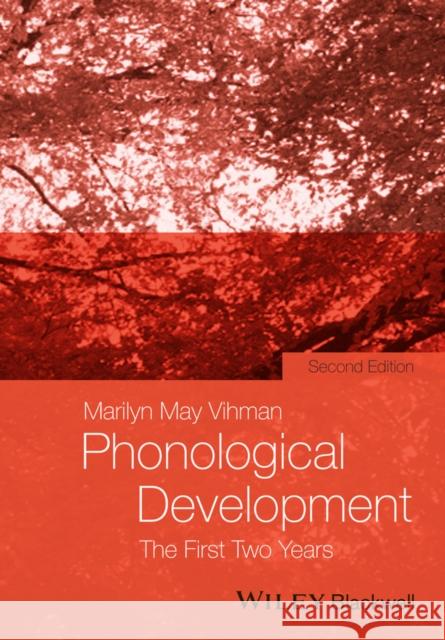
Phonological Development Vihman, Marilyn May 9781118342800 John Wiley & Sons - książkaWidoczna okładka, to zdjęcie poglądowe, a rzeczywista szata graficzna może różnić się od prezentowanej.

Phonological Development

ISBN-13: 9781118342800 / Angielski / Miękka / 2014 / 448 str.

Marilyn May Vihman
cena 258,93
(netto: 246,60 VAT:  5%)

Najniższa cena z 30 dni: 258,93
Termin realizacji zamówienia:
ok. 30 dni roboczych
Dostawa w 2026 r.

Darmowa dostawa!

Drawing on major research developments in the field, Vihman has updated and extensively revised the 1996 edition of her classic text to provide a thorough and stimulating overview of current studies of child production and perception and early word learning.


  • Offers a full survey of the thinking on how babies develop phonological knowledge
  • Provides a much needed update on the field - one in which this book remains unique, and in which there have also been dramatic developments since the publication of the first edition
  • Surveys what has been learned about phonological development and raises questions for further study
  • The only book that includes balanced treatment of research in perception and production and attempts a synthesis of these fields, which have generally developed in isolation from one another
  • Includes a new chapter providing an overview of communicative and attentional development, as well as perceptual and vocal development, in the first 18 months, with additional focus on both implicit and explicit learning mechanisms

Drawing on major research developments in the field, Vihman has updated and extensively revised the 1996 edition of her classic text to provide a thorough and stimulating overview of current studies of child production and perception and early word learning.

Kategorie:
Nauka, Językoznawstwo
Kategorie BISAC:
Language Arts & Disciplines > Linguistics - Phonetics & Phonology
Wydawca:
John Wiley & Sons
Język:
Angielski
ISBN-13:
9781118342800
Rok wydania:
2014
Ilość stron:
448
Waga:
0.68 kg
Wymiary:
24.13 x 17.02 x 2.29
Oprawa:
Miękka
Wolumenów:
01
Dodatkowe informacje:
Bibliografia

"This open-minded, comprehensive overview of the intersecting components of phonological development is a masterpiece that should shape new directions of research for many years to come. Vihman elucidates the many underlying assumptions, some in conflict with one another, that have guided research on phonological development, and lays out clearly the relevance of individual variability in very young children. Vihman's work will cause researchers in the disparate areas of perception, production, word learning, variation, and phonological universals to be informed by each other's results, potentially revolutionizing our understanding of phonological development."-Sharon Inkelas, University of California, Berkeley"Phonological Development: The First Two Years (Second Edition) is essential reading and a primary text for all specialists and students in language development as well as those interested in phonological development in particular. It provides in-depth and up-to-date coverage of all areas of research relevant to understanding phonological development, with comprehensive reviews of both empirical findings and theoretical frameworks. An emphasis is made on the need to relate the development of perception and production, and the study of phonological development to broader areas of language acquisition. Besides eleven chapters, it also contains valuable appendices on protowords and template analyses. To my knowledge it is the most thorough and important book on this topic to date."-David Ingram, Arizona State University"Marilyn Vihman's work unfolds on the center court of child phonology research. This book gives a broad and insightful account of this complex topic--a treatment that is likely to serve, for a long time, as an indispensable reference on the early stages of learning to speak." -Björn Lindblom, Stockholm University"This eagerly awaited second edition masterfully updates Vihman's review of research on earlier themes as well as on several new themes, much of which attests to the profound inspiration of the seminal first edition." -Mary Beckman, Ohio State University

Note on Second Edition xi

Acknowledgments xiii

1 Introduction 1

Biological Foundations of Language Development 3

Phonological Development: Goals and Challenges 10

Methodologies: Data Sources andTheoretical Perspectives 13

Overview 16

2 Precursors to Language: The First 18 Months of Life 18

TheDevelopment of Linguistic Form and Function 20

1 Early Capacities: Birth to 2 Months 23

2 Early Capacities: 2 to 4 Months 26

3 Early Capacities: 4 to 6 Months 28

4 First Advances: 6 to 9 Months 29

5 Bringing the Strands Together: 9 to 12 Months 31

6 Transition to Language Use: 12 to 18 Months 35

Learning Mechanisms 40

Summary: Precursors and the Transition to Language Use 46

3 Development in Perception: Early Capacities, Rapid Change 49

Issues that Motivated the Study of Infant Speech Perception 49

Methods Used to Study Infant Speech Perception 56

Discrimination: Infant Capacities 59

Mechanisms Underlying Infant Perception 60

Developmental Change in Perception 63

Perceptual Narrowing : Models of Developmental Change 67

Cross–Modal Perception 75

Summary:The Infant Listener From Universal to Particular 78

4 Infant Vocal Production 80

Early Vocal Production 81

The Social Context, I: Precanonical Period 91

The Emergence of Adult–Like Syllables 95

The Social Context, II: Canonical Period 101

Vowel Production in the First Year 103

Influence from the Ambient Language 105

Summary: Biological and Social Foundations 110

5 Perceptual Advances in the First Year: Prosody, Segmentation and Distributional Learning 112

The Role of Prosody and Infant–Directed Speech (IDS) 113

Prosodic Bootstrapping 117

Advances in Knowledge of Accentual Patterns and Phonotactics 121

Experimental Studies of Segmentation 125

Distributional or Statistical Learning 139

Summary: Rhythms and Segmental Patterns 143

6 The Transition to Language Use 145

Beginnings ofWord Comprehension 146

Development of Intentional Communication 150

ReferentialWord Use 161

Phonetic and Phonological Development 163

Rhythm in Child Production 168

Emergence of Phonological Systematicity 175

Summary: Continuity and Change 177

7 Experimental Studies ofWord–Form Learning 179

The Role of Phonology inWord Recognition andWord Learning 179

The Perceptual Basis ofWord Learning 180

Explorations of Phonological Specificity 186

Integrating the Findings 200

Neurophysiological Investigation ofWord Learning 202

Summary:Understanding theDevelopment of Representation 209

8 Phonological Development in the Bilingual Child 212

The Study of Child Bilingualism 213

Non–selectivity in Adult Bilingual Processing 214

Speech Perception and Processing 217

Bilingual Production 231

Separate Systems with Interaction 241

Summary: The Experience of the Bilingual Child 243

9 Theories, I: Formalist and PerceptionModels 245

What is the Source of the Linguistic System? 246

The First Linguistic Models 248

Contemporary Formalist Models 254

Contemporary Formalist Models: Critique and Appreciation 268

Perception Models 270

Perception Models: Critique and Appreciation 275

Summary:Theory and Data in Developmental Models 275

10 Theories, II: Functionalist or Emergentist Models 277

Biological Model 278

Self–Organizing Models 279

Usage–Based Models 285

Whole–Word Phonology 290

Functionalist or Emergentist Models: Critique and Appreciation 307

Summary: Emergent Phonology 309

11 Conclusion 311

Linking Perception and Production 312

Effects of Lexical Learning and Language Use 315

Appendix 1: Data Sources 318

Appendix 2: Protoword Forms and Uses 321

Appendix 3: Template Analyses 323

Word Template Analysis: A Diary Study 323

Word Template Analysis: Research Studies 331

Generality of Template Use 346

References 349

Name Index 407

Subject Index 417

Marilyn Vihman is Professor of Language and Linguistic Science at the University of York. She is co–editor of The Emergence of Phonology: Whole–word approaches and cross–linguistic evidence (with T. Keren–Portnoy, 2013), which includes both classic and new empirical studies of phonological development in eight languages.

The field of child phonology has seen major developments in research, with the emergence of exciting new methods in the 18 years since the publication of Vihman s classic first edition. Drawing on this progress, Vihman has updated and completely revised her successful text to focus on the very latest research in phonological development in the first two years of life the period of the most rapid learning and the most dramatic developmental advances.

Retaining its unique approach and coverage, the new edition expands the chapters on perception, vocal production and the transition into language use, including sections on the perception and production of native–language speech rhythms. A new chapter provides an overview of communicative and attentional as well as perceptual and vocal development in the first 18 months, with an additional focus on both implicit and explicit learning mechanisms. There are also entirely new chapters on segmentation and distributional learning, experiments in word learning, and bilingual phonological development. In addition, Phonological Development reviews theoretical models of perception as well as formalist and functionalist theoretical approaches to phonological development and concludes by considering the link between perception and production and the role of lexical knowledge and use in further learning. Vihman s much needed and timely update will provide an invaluable source book for students and researchers alike.

Vihman, Marilyn May Marilyn Vihman is Associate Professor in Communica... więcej >


Udostępnij

Facebook - konto krainaksiazek.pl


Opinie o Krainaksiazek.pl na Opineo.pl

Partner Mybenefit

Krainaksiazek.pl w programie rzetelna firma Krainaksiaze.pl - płatności przez paypal

Czytaj nas na:

Facebook - krainaksiazek.pl
  • książki na zamówienie
  • granty
  • książka na prezent
  • kontakt
  • pomoc
  • opinie
  • regulamin
  • polityka prywatności

Zobacz:

  • Księgarnia czeska

  • Wydawnictwo Książkowe Klimaty

1997-2025 DolnySlask.com Agencja Internetowa

© 1997-2022 krainaksiazek.pl
     
KONTAKT | REGULAMIN | POLITYKA PRYWATNOŚCI | USTAWIENIA PRYWATNOŚCI
Zobacz: Księgarnia Czeska | Wydawnictwo Książkowe Klimaty | Mapa strony | Lista autorów
KrainaKsiazek.PL - Księgarnia Internetowa

Polityka prywatnosci - link
Krainaksiazek.pl - płatnośc Przelewy24
Przechowalnia Przechowalnia






