• Wyszukiwanie zaawansowane
  • Kategorie
  • Kategorie BISAC
  • Książki na zamówienie
  • Promocje
  • Granty
  • Książka na prezent
  • Opinie
  • Pomoc
  • Załóż konto
  • Zaloguj się

Philosophy of Science for Scientists » książka


zaloguj się | załóż konto
Logo Krainaksiazek.pl

koszyk

konto

szukaj
topmenu
Księgarnia internetowa
Szukaj
Książki na zamówienie
Promocje
Granty
Książka na prezent
Moje konto
Pomoc
 
 
Wyszukiwanie zaawansowane
Pusty koszyk
Bezpłatna dostawa dla zamówień powyżej 20 złBezpłatna dostawa dla zamówień powyżej 20 zł

Kategorie główne

• Nauka
 [2949965]
• Literatura piękna
 [1857847]

  więcej...
• Turystyka
 [70818]
• Informatyka
 [151303]
• Komiksy
 [35733]
• Encyklopedie
 [23180]
• Dziecięca
 [617748]
• Hobby
 [139972]
• AudioBooki
 [1650]
• Literatura faktu
 [228361]
• Muzyka CD
 [398]
• Słowniki
 [2862]
• Inne
 [444732]
• Kalendarze
 [1620]
• Podręczniki
 [167233]
• Poradniki
 [482388]
• Religia
 [509867]
• Czasopisma
 [533]
• Sport
 [61361]
• Sztuka
 [243125]
• CD, DVD, Video
 [3451]
• Technologie
 [219309]
• Zdrowie
 [101347]
• Książkowe Klimaty
 [123]
• Zabawki
 [2362]
• Puzzle, gry
 [3791]
• Literatura w języku ukraińskim
 [253]
• Art. papiernicze i szkolne
 [7933]
Kategorie szczegółowe BISAC

Philosophy of Science for Scientists

ISBN-13: 9783319799704 / Angielski / Miękka / 2019 / 257 str.
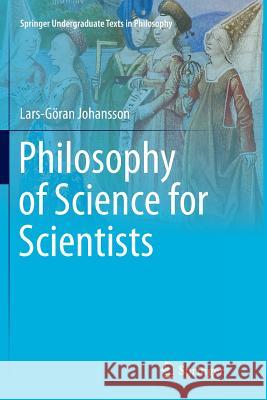
Lars-Goeran Johansson
Philosophy of Science for Scientists Lars-Goeran Johansson   9783319799704 Springer International Publishing AG - książkaWidoczna okładka, to zdjęcie poglądowe, a rzeczywista szata graficzna może różnić się od prezentowanej.

Philosophy of Science for Scientists

ISBN-13: 9783319799704 / Angielski / Miękka / 2019 / 257 str.

Lars-Goeran Johansson
cena 229,96 zł
(netto: 219,01 VAT:  5%)

Najniższa cena z 30 dni: 219,73 zł
Termin realizacji zamówienia:
ok. 22 dni roboczych
Bez gwarancji dostawy przed świętami

Darmowa dostawa!

This textbook offers an introduction to the philosophy of science. It helps undergraduate students from the natural, the human and social sciences to gain an understanding of what science is, how it has developed, what its core traits are, how to distinguish between science and pseudo-science and to discover what a scientific attitude is. It argues against the common assumption that there is fundamental difference between natural and human science, with natural science being concerned with testing hypotheses and discovering natural laws, and the aim of human and some social sciences being to understand the meanings of individual and social group actions. Instead examines the similarities between the sciences and shows how the testing of hypotheses and doing interpretation/hermeneutics are similar activities. The book makes clear that lessons from natural scientists are relevant to students and scholars within the social and human sciences, and vice versa. It teaches its readers how to effectively demarcate between science and pseudo-science and sets criteria for true scientific thinking. Divided into three parts, the book first examines the question What is Science? It describes the evolution of science, defines knowledge, and explains the use of and need for hypotheses and hypothesis testing. The second half of part I deals with scientific data and observation, qualitative data and methods, and ends with a discussion of theories on the development of science. Part II offers philosophical reflections on four of the most important con cepts in science: causes, explanations, laws and models. Part III presents discussions on philosophy of mind, the relation between mind and body, value-free and value-related science, and reflections on actual trends in science.


Kategorie:
Nauka, Filozofia
Kategorie BISAC:
Science > Philosophy & Social Aspects
Science > Fizyka
Mathematics > Logic
Wydawca:
Springer International Publishing AG
Język:
Angielski
ISBN-13:
9783319799704
Rok wydania:
2019
Wydanie:
Softcover Repri
Ilość stron:
257
Waga:
0.39 kg
Wymiary:
23.39 x 15.6 x 1.47
Oprawa:
Miękka
Wolumenów:
01
Dodatkowe informacje:
Wydanie ilustrowane

"Target audience comprises 'students of engineering, physics, biology, social science, medicine and nursing' ... this book allows readers from a global audience to grasp the 'flavour' of the long and rich Germanic and Scandinavian tradition." (Agustín Adúriz-Bravo, Science and Education, Vol. 28, 2019)


"The aim of Lars-Göran Johansson's textbook Philosophy of Science for Scientists is ... to provide an introduction to the philosophy of science for students in all fields of science. ... the book is supposed to be suitable for an undergraduate level course in the philosophy of science for philosophy students." (Amanda Thorell, Theoria, Vol. 83, 2017)

"Lars-Göran Johansson's recent book Philosophy of science for scientists is the only textbook in the philosophy of science that is addressed specifically to an audience consisting of scientists. ... In its breadth of treated topics, the book can serve as a basic text to many different courses in the philosophy of science." (Maarten Franssen, Metascience, Vol. 26, 2017)

"Philosophy of Science for Scientists by Lars-Goran Johansson: a lovely textbook for undergraduates. It is a highly readable introduction to how one can view the practice of science. ... this is an excellent introduction to understanding science in a general sense. Students and practitioners will find it worthwhile to read and discuss." (David S. Mazel, MAA Reviews, maa.org, November, 2016)

"This is an excellent book that can serve as a very appropriate textbook for the first course in Philosophy of Science. ... it is a very well written book and is an enjoyable reading. ... It is well written by a great authority in the field and I strongly recommend it to you if you are interested in to understand what science is and why science is important for knowledge and our understanding of reality." (Philosophy, Religion and Science Book Reviews, Bookinspections.wordpress.com, July, 2016)

Preface and overview of the bookPart 1: What is science?.- 1. The Evolution of Science.- 2. Knowledge.- 3. Hypotheses and Hypothesis Testing.- 4. On Scientific Data.- 5. Qualitative Data and Methods.- 6. Theories about the Development of Science.- Part 2. Philosophical reflections on four core concepts in science: causes, explanations, laws and models.- 7. On Causes and Correlations.- 8. Explanations.- 9. Explanation in the Humanities and Social Sciences.- 10. Scientific Laws.- 11. Theories, Models and Reality.- Part 3. Some auxiliaries.- 12. The Mind-Body Problem.- 13. Science and Values.- 14. Some trends in science.- Appendix.- Logical Forms.- Index.

Lars-Göran Johansson holds a B.Sc. (mathematics and physics) from University of Gothenburg and a Ph.D in theoretical philosophy from Stockholm University. He is author of three books: Introduktion till vetenskapsteorin, Interpreting Quantum Mechanics. A Realist View in Schrödinger’s Vein and (together with Pauliina Remes, George Masterton and Tomas Ekenberg) Kunskapsteori. En introduktion till vetande, berättigande och sanning. He has also published papers and book chapters on  laws of nature, induction, causation, probability  and time. Since 2008 he is professor in theoretical philosophy at Uppsala University.

This textbook offers an introduction to the philosophy of science. It helps undergraduate students from the natural, the human and social sciences to gain an understanding of what science is, how it has developed, what its core traits are, how to distinguish between science and pseudo-science and to discover what a scientific attitude is. It argues against the common assumption that there is fundamental difference between natural and human science, with natural science being concerned with testing hypotheses and discovering natural laws, and the aim of human and some social sciences being to understand the meanings of individual and social group actions. Instead examines the similarities between the sciences and shows how the testing of hypotheses and doing interpretation/hermeneutics are similar activities. The book makes clear that lessons from natural scientists are relevant to students and scholars within the social and human sciences, and vice versa. It teaches its readers how to effectively demarcate between science and pseudo-science and sets criteria for true scientific thinking.


Divided into three parts, the book first examines the question What is Science? It describes the evolution of science, defines knowledge, and explains the use of and need for hypotheses and hypothesis testing. The second half of part I deals with scientific data and observation, qualitative data and methods, and ends with a discussion of theories on the development of science. Part II offers philosophical reflections on four of the most important concepts in science: causes, explanations, laws and models. Part III presents discussions on philosophy of mind, the relation between mind and body, value-free and value-related science, and reflections on actual trends in science.




Udostępnij

Facebook - konto krainaksiazek.pl


Opinie o Krainaksiazek.pl na Opineo.pl

Partner Mybenefit

Krainaksiazek.pl w programie rzetelna firma Krainaksiaze.pl - płatności przez paypal

Czytaj nas na:

Facebook - krainaksiazek.pl
  • książki na zamówienie
  • granty
  • książka na prezent
  • kontakt
  • pomoc
  • opinie
  • regulamin
  • polityka prywatności

Zobacz:

  • Księgarnia czeska

  • Wydawnictwo Książkowe Klimaty

1997-2025 DolnySlask.com Agencja Internetowa

© 1997-2022 krainaksiazek.pl
     
KONTAKT | REGULAMIN | POLITYKA PRYWATNOŚCI | USTAWIENIA PRYWATNOŚCI
Zobacz: Księgarnia Czeska | Wydawnictwo Książkowe Klimaty | Mapa strony | Lista autorów
KrainaKsiazek.PL - Księgarnia Internetowa

Polityka prywatnosci - link
Krainaksiazek.pl - płatnośc Przelewy24
Przechowalnia Przechowalnia



