• Wyszukiwanie zaawansowane
  • Kategorie
  • Kategorie BISAC
  • Książki na zamówienie
  • Promocje
  • Granty
  • Książka na prezent
  • Opinie
  • Pomoc
  • Załóż konto
  • Zaloguj się

Philosophy of Arithmetic: Psychological and Logical Investigations with Supplementary Texts from 1887-1901 » książka


zaloguj się | załóż konto
Logo Krainaksiazek.pl

koszyk

konto

szukaj
topmenu
Księgarnia internetowa
Szukaj
Książki na zamówienie
Promocje
Granty
Książka na prezent
Moje konto
Pomoc
 
 
Wyszukiwanie zaawansowane
Pusty koszyk
Bezpłatna dostawa dla zamówień powyżej 20 złBezpłatna dostawa dla zamówień powyżej 20 zł

Kategorie główne

• Nauka
 [2946600]
• Literatura piękna
 [1856966]

  więcej...
• Turystyka
 [72221]
• Informatyka
 [151456]
• Komiksy
 [35826]
• Encyklopedie
 [23190]
• Dziecięca
 [619653]
• Hobby
 [140543]
• AudioBooki
 [1577]
• Literatura faktu
 [228355]
• Muzyka CD
 [410]
• Słowniki
 [2874]
• Inne
 [445822]
• Kalendarze
 [1744]
• Podręczniki
 [167141]
• Poradniki
 [482898]
• Religia
 [510455]
• Czasopisma
 [526]
• Sport
 [61590]
• Sztuka
 [243598]
• CD, DVD, Video
 [3423]
• Technologie
 [219201]
• Zdrowie
 [101638]
• Książkowe Klimaty
 [124]
• Zabawki
 [2473]
• Puzzle, gry
 [3898]
• Literatura w języku ukraińskim
 [254]
• Art. papiernicze i szkolne
 [8170]
Kategorie szczegółowe BISAC

Philosophy of Arithmetic: Psychological and Logical Investigations with Supplementary Texts from 1887-1901

ISBN-13: 9781402015465 / Angielski / Twarda / 2003 / 515 str.
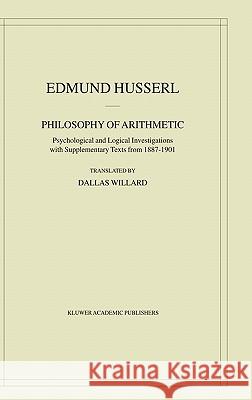
Edmund Husserl; D. Willard; Dallas Willard
Philosophy of Arithmetic: Psychological and Logical Investigations with Supplementary Texts from 1887-1901 Husserl, Edmund 9781402015465 Kluwer Academic Publishers - książkaWidoczna okładka, to zdjęcie poglądowe, a rzeczywista szata graficzna może różnić się od prezentowanej.

Philosophy of Arithmetic: Psychological and Logical Investigations with Supplementary Texts from 1887-1901

ISBN-13: 9781402015465 / Angielski / Twarda / 2003 / 515 str.

Edmund Husserl; D. Willard; Dallas Willard
cena 1533,32 zł
(netto: 1460,30 VAT:  5%)

Najniższa cena z 30 dni: 1465,09 zł
Termin realizacji zamówienia:
ok. 22 dni roboczych
Bez gwarancji dostawy przed świętami

Darmowa dostawa!

In his first book, Philosophy of Arithmetic, Edmund Husserl provides a carefully worked out account of number as a categorial or formal feature of the objective world, and of arithmetic as a symbolic technique for mastering the infinite field of numbers for knowledge. It is a realist account of numbers and number relations that interweaves them into the basic structure of the universe and into our knowledge of reality. It provides an answer to the question of how arithmetic applies to reality, and gives an account of how, in general, formalized systems of symbols work in providing access to the world. The "appendices" to this book provide some of Husserl's subsequent discussions of how formalisms work, involving David Hilbert's program of completeness for arithmetic. "Completeness" is integrated into Husserl's own problematic of the "imaginary," and allows him to move beyond the analysis of "representations" in his understanding of the logic of mathematics.
Husserl's work here provides an alternative model of what "conceptual analysis" should be - minus the "linguistic turn," but inclusive of language and linguistic meaning. In the process, he provides case after case of "Phenomenological Analysis" - fortunately unencumbered by that title - of the convincing type that made Husserl's life and thought a fountainhead of much of the most important philosophical work of the twentieth Century in Europe. Many Husserlian themes to be developed at length in later writings first emerge here: Abstraction, internal time consciousness, polythetic acts, acts of higher order ('founded' acts), Gestalt qualities and their role in knowledge, formalization (as opposed to generalization), essence analysis, and so forth.
This volume is a window on a period of rich and illuminating philosophical activity that has been rendered generally inaccessible by the supposed "revolution" attributed to "Analytic Philosophy" so-called. Careful exposition and critique is given to every serious alternative account of number and number relations available at the time. Husserl's extensive and trenchant criticisms of Gottlob Frege's theory of number and arithmetic reach far beyond those most commonly referred to in the literature on their views.


Kategorie:
Nauka, Matematyka
Kategorie BISAC:
Mathematics > Arithmetic
Mathematics > Teoria liczb
Mathematics > Filozofia i historia matematyki
Wydawca:
Kluwer Academic Publishers
Język:
Angielski
ISBN-13:
9781402015465
Rok wydania:
2003
Wydanie:
2003
Numer serii:
000421037
Ilość stron:
515
Waga:
1.06 kg
Wymiary:
23.5 x 15.5
Oprawa:
Twarda
Wolumenów:
01
Dodatkowe informacje:
Bibliografia
Wydanie ilustrowane

From the reviews:

"This translation is the crowning achievement of Dallas Willard's monumental research into Husserl's early philosophy ... . The volume is hence a good starting point for English-speaking students from freshman to graduate level who wish to familiarise themselves with Husserl's philosophy of mathematics ... . Willard succeeds in creating a very readable English text, maintaining a good balance between correctly rendering difficult and ambiguous German terms and writing in a clear and easy way." (Carlo Ierna, Husserl Studies, Vol. 24, 2008)

Foreword. First Part: The Authentic Concepts of Multiplicity, Unity and Whole Number. Introduction. I: The Origination of the Concept of Multiplicity through that of the Collective Combination. The Analysis of the Concept of the Whole Number Presupposes that of the Concept of Multiplicity. The Concrete Bases of the Abstraction Involved. Independence of the Abstraction from the Nature of the Contents Colligated. The Origination of the Concept of the Multiplicity through Reflexion on the Collective Mode of Combination. II: Critical Developments. The Collective Unification and the Unification of Partial Phenomena in the Total Field of Consciousness at a Given Moment. The Collective 'Together' and the Temporal 'Simultaneously'. Collection and Temporal Succession. The Collective Synthesis and the Spatial Synthesis. A: F.A. Lange's Theory. B: Baumann's Theory. Colligating, Enumerating and Distinguishing. Critical Supplement. III: The Psychological Nature of the Collective Combination. Review. The Collection as a Special Type of Combination. On the Theory of Relations. Psychological Characterization of the Collective Combination. IV: Analysis of the Concept of Number in Terms of its Origin and Content. Completion of the Analysis of the Concept of Multiplicity. The Concept `Something'. The Cardinal Numbers and the Generic Concept of Number. Relationship between the Concepts `Cardinal Number' and `Multiplicity'. One and Something. Critical Supplement. V: The Relations 'More' and 'Less'. The Psychological Origin of these Relations. Comparison of Arbitrary Multiplicities, as well as of Numbers, in Terms of More and Less. The Segregation of the Number Species Conditioned upon the Knowledge of More and Less. VI: The Definition of Number-Equality through the Concept of Reciprocal One-to-One Correlation. Leibniz's Definition of the General Concept of Equality. The Definition of Number-Equality. Concerning Definitions of Equality for Special Cases. Application to the Equality of Arbitrary Multiplicities. Comparison of Multiplicities of One Genus. Comparison of Multiplicities with Respect to their Number. The True Sense of the Equality Definition under Discussion. Reciprocal Correlation and Collective Combination. The Independence of Number-Equality from the Type of Linkage. VII: Definitions of Number in Terms of Equivalence. Structure of the Equivalence Theory. Illustrations. Critique. Frege's Attempt. Kerry's Attempt. Concluding Remark. VIII: Discussions Concerning Unity and Multiplicity. The Definition of Number as a Multiplicity of Units. One as an Abstract, Positive Partial Content. One as Mere Sign. One and Zero as Numbers. The Concept of the Unit and the Concept of the Number One. Further Distinctions Concerning One and Unit. Sameness and Distinctness of the Units. Further Misunderstandings. Equivocations of the Name 'Unit'. The Arbitrary Character of the Distinction between Unit and Multiplicity. The Multiplicity Regarded as One Multiplicity, as One Enumerated Unit, as One Whole. Herbartian Arguments. IX: The Sense of the Statement of Number. Contradictory Views. Refutation, and the Position Taken. Appendix to the First Part: The Nominalist Attempts of Helmholtz and Kronecker. Second Part: The Symbolic Number Concepts and the Logical Sources of Cardinal Arithmetic. X: Operations on Numbers and the Authentic Number Concepts. The Numbers in Arithmetic are Not Abstracta. The Fundamental Activities on Numbers. Addition. Partition. Arithmetic Does Not Operate with

Husserl, Edmund Edmund Husserl wird 1859 als Sohn einer judischen ... więcej >


Udostępnij

Facebook - konto krainaksiazek.pl


Opinie o Krainaksiazek.pl na Opineo.pl

Partner Mybenefit

Krainaksiazek.pl w programie rzetelna firma Krainaksiaze.pl - płatności przez paypal

Czytaj nas na:

Facebook - krainaksiazek.pl
  • książki na zamówienie
  • granty
  • książka na prezent
  • kontakt
  • pomoc
  • opinie
  • regulamin
  • polityka prywatności

Zobacz:

  • Księgarnia czeska

  • Wydawnictwo Książkowe Klimaty

1997-2025 DolnySlask.com Agencja Internetowa

© 1997-2022 krainaksiazek.pl
     
KONTAKT | REGULAMIN | POLITYKA PRYWATNOŚCI | USTAWIENIA PRYWATNOŚCI
Zobacz: Księgarnia Czeska | Wydawnictwo Książkowe Klimaty | Mapa strony | Lista autorów
KrainaKsiazek.PL - Księgarnia Internetowa

Polityka prywatnosci - link
Krainaksiazek.pl - płatnośc Przelewy24
Przechowalnia Przechowalnia






