• Wyszukiwanie zaawansowane
  • Kategorie
  • Kategorie BISAC
  • Książki na zamówienie
  • Promocje
  • Granty
  • Książka na prezent
  • Opinie
  • Pomoc
  • Załóż konto
  • Zaloguj się

Pattern-Based Compression of Multi-Band Image Data for Landscape Analysis » książka


zaloguj się | załóż konto
Logo Krainaksiazek.pl

koszyk

konto

szukaj
topmenu
Księgarnia internetowa
Szukaj
Książki na zamówienie
Promocje
Granty
Książka na prezent
Moje konto
Pomoc
 
 
Wyszukiwanie zaawansowane
Pusty koszyk
Bezpłatna dostawa dla zamówień powyżej 20 złBezpłatna dostawa dla zamówień powyżej 20 zł

Kategorie główne

• Nauka
 [2946912]
• Literatura piękna
 [1852311]

  więcej...
• Turystyka
 [71421]
• Informatyka
 [150889]
• Komiksy
 [35717]
• Encyklopedie
 [23177]
• Dziecięca
 [617324]
• Hobby
 [138808]
• AudioBooki
 [1671]
• Literatura faktu
 [228371]
• Muzyka CD
 [400]
• Słowniki
 [2841]
• Inne
 [445428]
• Kalendarze
 [1545]
• Podręczniki
 [166819]
• Poradniki
 [480180]
• Religia
 [510412]
• Czasopisma
 [525]
• Sport
 [61271]
• Sztuka
 [242929]
• CD, DVD, Video
 [3371]
• Technologie
 [219258]
• Zdrowie
 [100961]
• Książkowe Klimaty
 [124]
• Zabawki
 [2341]
• Puzzle, gry
 [3766]
• Literatura w języku ukraińskim
 [255]
• Art. papiernicze i szkolne
 [7810]
Kategorie szczegółowe BISAC

Pattern-Based Compression of Multi-Band Image Data for Landscape Analysis

ISBN-13: 9781441942715 / Angielski / Miękka / 2010 / 190 str.
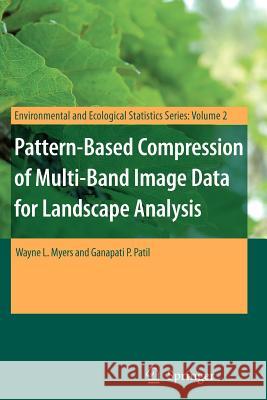
Wayne L. Myers; Ganapati P. Patil
Pattern-Based Compression of Multi-Band Image Data for Landscape Analysis Wayne L. Myers Ganapati P. Patil 9781441942715 Not Avail - książkaWidoczna okładka, to zdjęcie poglądowe, a rzeczywista szata graficzna może różnić się od prezentowanej.

Pattern-Based Compression of Multi-Band Image Data for Landscape Analysis

ISBN-13: 9781441942715 / Angielski / Miękka / 2010 / 190 str.

Wayne L. Myers; Ganapati P. Patil
cena 403,47
(netto: 384,26 VAT:  5%)

Najniższa cena z 30 dni: 385,52
Termin realizacji zamówienia:
ok. 22 dni roboczych
Bez gwarancji dostawy przed świętami

Darmowa dostawa!

We offer here a non-conventional approach to muhivariate ima- structured data for which the basis is well tested but the analytical ramifi- cations are still unfolding. Although we do not formally pursue them, there are several parallels with the nature of neural networks. We employ a systematic set of statistical heuristics for modeling multivariate image data in a quasi-perceptual manner. When the human eye perceives a scene, the elements of the scene are segregated heuristically into compo- nents according to similarity and dissimilarity, and then the relationships among the components are interpreted. Similarly, we segregate or seg- ment the scene into hierarchically organized components that are subject to subsequent statistical analysis in many modes for interpretive purposes. We refer to the segregated scene segments as patterns, since they provide a basis for perception of pattern. Since they are also hierarchically organ- ized, we refer to them further as polypatterns. This leads us to our acro- nym of Progressively Segmented Image Modeling As Poly-Patterns (PSIMAPP). Likewise, we formalize our approach in terms of pattern processes and segmentation sequences. In alignment with the terminology of image analysis, we refer to our multivariate measures as being signal bands.


Kategorie:
Nauka, Biologia i przyroda
Kategorie BISAC:
Science > Environmental Science (see also Chemistry - Environmental)
Technology & Engineering > Remote Sensing & Geographic Information Systems
Science > Life Sciences - Ecology
Wydawca:
Not Avail
Seria wydawnicza:
Environmental and Ecological Statistics
Język:
Angielski
ISBN-13:
9781441942715
Rok wydania:
2010
Numer serii:
000336043
Ilość stron:
190
Waga:
0.33 kg
Wymiary:
23.5 x 15.5
Oprawa:
Miękka
Wolumenów:
01
Dodatkowe informacje:
Glosariusz/słownik

Innovative Imaging, Parsing Patterns and Motivating Models.- Pattern Progressions and Segmentation Sequences for IMAGE Intensity Modeling and Grouped Enhancement.- Collective and Composite Contrast for Pattern Pictures.- Content Classification and Thematic Transforms.- Comparative Change and Pattern Perturbation.- Conjunctive Context.- Advanced Aspects and Anticipated Applications.

Dr. Wayne L. Myers earned M.F. and Ph.D. degrees in forest ecology and forest entomology at the University of Michigan. He began his professional career in Canada as a research forest entomologist and biometrician. He then joined the faculty of forestry at Michigan State University specializing in biometrics and remote sensing. The position at Michigan State also encompassed consultancies with the U.S. Forest Service and a work in Brazil. He moved to Penn State University in 1978 in the School of Forest Resources. He is professor of forest biometrics and Director of the Office for Remote Sensing and Spatial Information Resources (ORSSIR) in the Penn State Institutes of Environment.

He has thirty-five years of experience in research on development of remote sensing, geographic information systems, and related spatial technologies with applications focusing on natural resources and environment. This extends back to participation as a co-investigator in early investigations of ERTS/LANDSAT as the first spaceborne civilian multispectral sensor.

His recent research has focused on dual level progressive segmentation of multispectral images for purposes of compression, integration with geographic information systems and pattern-based change detection. He has developed concepts and computation of echelons of spatial structure in digital surfaces that facilitate extracting major change features from change indicator images. Echelons offer alternatives to thresholding in surface or pseudo-surface rasters. Dome domains provide a further generalization of topological structure in signal surfaces.

He has extensive international experience including long-term advisory for the U.S. Agency for International Development in India and research fellowships in Malaysia. He has placed special emphasis on interdisciplinary research and team approach.

G.P. Patil: is Distinguished Professor of Mathematical and Environmental Statistics in the Department of Statistics at the Pennsylvania State University, and is a former Visiting Professor of Biostatistics at Harvard University in the Harvard School of Public Health.

He has a Ph.D. in Mathematics, D.Sc. in Statistics, one Honorary Degree in Biological Sciences, and another in Letters. GP is a Fellow of American Statistical Association, Fellow of American Association of Advancement of Science, Fellow of Institute of Mathematical Statistics, Elected Member of the International Statistical Institute, Founder Fellow of the National Institute of Ecology and the Society for Medical Statistics in India.

GP has been a founder of Statistical Ecology Section of International Association for Ecology and Ecological Society of America, a founder of Statistics and Environment Section of American Statistical Association, and a founder of the International Society for Risk Analysis. He is founding editor-in-chief of the international journal, Environmental and Ecological Statistics and founding director of the Penn State Center for Statistical Ecology and Environmental Statistics. He has published thirty volumes and three hundred research papers. GP has received several distinguished awards which include: Distinguished Statistical Ecologist Award of the International Association for Ecology, Distinguished Achievement Medal for Statistics and the Environment of the American Statistical Association, Distinguished Twentieth Century Service Award for Statistical Ecology and Environmental Statistics of the Ninth Lukacs Symposium, Best Paper Award of the American Fisheries Society, and lately, the Best Paper Award of the American Water Resources Association, among others.

Currently, GP is principal investigator of a multi-year NSF grant for surveillance geoinformatics for hotspot detection and prioritization across geographic regions and networks for digital government in the 21st Century.

Pattern-Based Compression of Multi-Band Image Data for Landscape Analysis describes an integrated approach to using remotely sensed data in conjunction with geographic information systems (GIS) for landscape analysis. Remotely sensed data are compressed by compound segmentation so that the first level is an image-like raster map for GIS, and a second level affords approximate restoration. Pattern processing is implemented in software by PSIMAPP Progressively Segmented Image Modeling As Poly-Patterns.

There are seven notable areas of advantage in this approach:

  • Controlling and creating contrast for pictorial presentations.
  • Classifying content for constructing categorical maps. Whereas digital image data are usually directed toward algorithmic assignment of image elements to candidate categories of content, this approach is equally applicable to assisting interactive interpretive assignment by a human analyst.
  • Detecting difference between instances of imaging. Whereas conventional change detection is done in the signal domain, this approach supports dual pattern matching in signal and spatial domains.
  • Advantage in contextual considerations. Having parsed patterns into collective components allows analysts to conduct comparatives in multiple modes. The components can be combined according to signal similarities and proximate positioning to generate generalized images that portray progressively more prominent patterning. The patterns can be treated as multivariate trends for removal to reach residuals that are regionalized in accordance with scenarios of spatial statistics. An entirely new arena of analysis is posed by pattern profiles of cumulated components over blocks at several scales. Compositional components of complexes can be considered in terms of chromaticity or ratio relations among signal sets by partial ordering and rank range runs.
  • Informational compression for conveyance by computer media. The poly-pattern models occupy the equivalent of two single-byte signal bands along with tables of pattern properties.
  • Although approximation in restoration might appear to be a drawback, it leads to the sixth aspect of advantage. Digital image data are often proprietary with strictures on distribution. Since the poly-pattern models do not provide capability for complete restoration, and in view of their numerous advantages, they become substantially different derivative products in much the same manner as a thematic map. Therefore, most of the proprietary concerns relative to the original data should be obviated.

The interface between image analysis and GIS. GIS provides the popular platform for utilization of geo-spatial information. Since relatively few of the regular GIS users are image analysts, poly-pattern packaging facilitates broader access to image-based information.

Myers, Wayne L. Dr. Wayne L. Myers earned M.F. and Ph.D. degrees i... więcej >


Udostępnij

Facebook - konto krainaksiazek.pl


Opinie o Krainaksiazek.pl na Opineo.pl

Partner Mybenefit

Krainaksiazek.pl w programie rzetelna firma Krainaksiaze.pl - płatności przez paypal

Czytaj nas na:

Facebook - krainaksiazek.pl
  • książki na zamówienie
  • granty
  • książka na prezent
  • kontakt
  • pomoc
  • opinie
  • regulamin
  • polityka prywatności

Zobacz:

  • Księgarnia czeska

  • Wydawnictwo Książkowe Klimaty

1997-2025 DolnySlask.com Agencja Internetowa

© 1997-2022 krainaksiazek.pl
     
KONTAKT | REGULAMIN | POLITYKA PRYWATNOŚCI | USTAWIENIA PRYWATNOŚCI
Zobacz: Księgarnia Czeska | Wydawnictwo Książkowe Klimaty | Mapa strony | Lista autorów
KrainaKsiazek.PL - Księgarnia Internetowa

Polityka prywatnosci - link
Krainaksiazek.pl - płatnośc Przelewy24
Przechowalnia Przechowalnia





