• Wyszukiwanie zaawansowane
  • Kategorie
  • Kategorie BISAC
  • Książki na zamówienie
  • Promocje
  • Granty
  • Książka na prezent
  • Opinie
  • Pomoc
  • Załóż konto
  • Zaloguj się

Pascal-Xsc: Language Reference with Examples » książka


zaloguj się | załóż konto
Logo Krainaksiazek.pl

koszyk

konto

szukaj
topmenu
Księgarnia internetowa
Szukaj
Książki na zamówienie
Promocje
Granty
Książka na prezent
Moje konto
Pomoc
 
 
Wyszukiwanie zaawansowane
Pusty koszyk
Bezpłatna dostawa dla zamówień powyżej 20 złBezpłatna dostawa dla zamówień powyżej 20 zł

Kategorie główne

• Nauka
 [2950560]
• Literatura piękna
 [1849509]

  więcej...
• Turystyka
 [71097]
• Informatyka
 [151150]
• Komiksy
 [35848]
• Encyklopedie
 [23178]
• Dziecięca
 [617388]
• Hobby
 [139064]
• AudioBooki
 [1657]
• Literatura faktu
 [228597]
• Muzyka CD
 [383]
• Słowniki
 [2855]
• Inne
 [445295]
• Kalendarze
 [1464]
• Podręczniki
 [167547]
• Poradniki
 [480102]
• Religia
 [510749]
• Czasopisma
 [516]
• Sport
 [61293]
• Sztuka
 [243352]
• CD, DVD, Video
 [3414]
• Technologie
 [219456]
• Zdrowie
 [101002]
• Książkowe Klimaty
 [124]
• Zabawki
 [2311]
• Puzzle, gry
 [3459]
• Literatura w języku ukraińskim
 [254]
• Art. papiernicze i szkolne
 [8079]
Kategorie szczegółowe BISAC

Pascal-Xsc: Language Reference with Examples

ISBN-13: 9783540551379 / Angielski / Miękka / 1992 / 344 str.
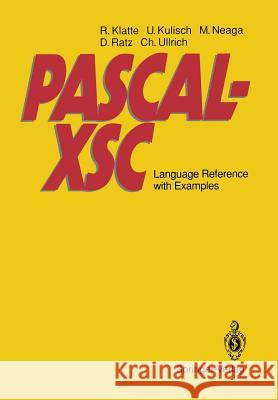
Rudi Klatte; Ulrich Kulisch; Michael Neaga
Pascal-Xsc: Language Reference with Examples Corliss, G. F. 9783540551379 Springer - książkaWidoczna okładka, to zdjęcie poglądowe, a rzeczywista szata graficzna może różnić się od prezentowanej.

Pascal-Xsc: Language Reference with Examples

ISBN-13: 9783540551379 / Angielski / Miękka / 1992 / 344 str.

Rudi Klatte; Ulrich Kulisch; Michael Neaga
cena 200,77
(netto: 191,21 VAT:  5%)

Najniższa cena z 30 dni: 192,74
Termin realizacji zamówienia:
ok. 22 dni roboczych
Dostawa w 2026 r.

Darmowa dostawa!

This manual describes a PASCAL extension for scientific computation with the short title PASCAL-XSC (PASCAL eXtension for Scientific Computation). The language is the result of a long term effort of members of the Institute for Applied Mathematics of Karlsruhe University and several associated scientists. PASCAL XSC is intended to make the computer more powerful arithmetically than usual. It makes the computer look like a vector processor to the programmer by providing the vector/matrix operations in a natural form with array data types and the usual operator symbols. Programming of algorithms is thus brought considerably closer to the usual mathematical notation. As an additional feature in PASCAL-XSC, all predefined operators for real and complex numbers and intervals, vectors, matrices, and so on, deliver an answer that differs from the exact result by at most one rounding. Numerical mathematics has devised algorithms that deliver highly accurate and automatically verified results by applying mathematical fixed point theorems. That is, these computations carry their own accuracy control. However, their imple mentation requires arithmetic and programming tools that have not been available previously. The development of PASCAL-XSC has been aimed at providing these tools within the PASCAL setting. Work on the subject began during the 1960's with the development of a general theory of computer arithmetic. At first, new algorithms for the realization of the arithmetic operations had to be developed and implemented."


Kategorie:
Nauka, Matematyka
Kategorie BISAC:
Mathematics > Systemy liczbowe
Computers > Programming - Compilers
Computers > Software Development & Engineering - General
Wydawca:
Springer
Język:
Angielski
ISBN-13:
9783540551379
Rok wydania:
1992
Wydanie:
Softcover Repri
Ilość stron:
344
Waga:
0.55 kg
Wymiary:
24.41 x 16.99 x 1.83
Oprawa:
Miękka
Wolumenów:
01
Dodatkowe informacje:
Bibliografia
Wydanie ilustrowane

1 Introduction.- 1.1 Typography.- 1.2 Historical Remarks and Motivation.- 1.3 Advanced Computer Arithmetic.- 1.4 Connection with Programming Languages.- 1.5 Survey of PASCAL-XSC.- 1.5.1 Universal Operator Concept and Arbitrary Result Type.- 1.5.2 Overloading of Procedures, Functions, and Operators.- 1.5.3 Module Concept.- 1.5.4 Dynamic Arrays and Subarrays.- 1.5.5 String Concept.- 1.5.6 Arithmetic and Rounding.- 1.5.7 Accurate Expressions.- 2 Language Reference.- 2.1 Basic Symbols.- 2.2 Identifiers.- 2.3 Constants, Types, and Variables.- 2.3.1 Simple Types.- 2.3.2 Structured Types.- 2.3.2.1 Arrays.- 2.3.2.2 Subarrays.- 2.3.2.3 Access to Index Bounds.- 2.3.2.4 Dynamic Arrays.- 2.3.2.5 Strings.- 2.3.2.6 Dynamic Strings.- 2.3.2.7 Records.- 2.3.2.8 Records with Variants.- 2.3.2.9 Sets.- 2.3.2.10 Files.- 2.3.2.11 Text Files.- 2.3.3 Structured Arithmetic Standard Types.- 2.3.3.1 The Type complex.- 2.3.3.2 The Type interval.- 2.3.3.3 The Type cinterval.- 2.3.3.4 Vector Types and Matrix Types.- 2.3.4 Pointers.- 2.3.5 Compatibility of Types.- 2.3.5.1 Compatibility of Array Types.- 2.3.5.2 Compatibility of Strings.- 2.4 Expressions.- 2.4.1 Standard Expressions.- 2.4.1.1 Integer Expressions.- 2.4.1.2 Real Expressions.- 2.4.1.3 Boolean Expressions.- 2.4.1.4 Character Expressions.- 2.4.1.5 Enumeration Expressions.- 2.4.2 Accurate Expressions (#-Expressions).- 2.4.3 Expressions for Structured Types and Pointer Expressions.- 2.4.3.1 Array Expressions.- 2.4.3.2 String Expressions.- 2.4.3.3 Record Expressions.- 2.4.3.4 Set Expressions.- 2.4.3.5 Pointer Expressions.- 2.4.4 Extended Accurate Expressions (#-Expressions).- 2.4.4.1 #-Expressions for the Arithmetic Types.- 2.4.4.2 #-Expressions for Vectors.- 2.4.4.3 #-Expressions for Matrices.- 2.4.4.4 List of the Operands in #-Expressions.- 2.4.4.5 Review of General #-Expressions.- 2.5 Statements.- 2.5.1 Assignment Statement.- 2.5.2 Input/Output Statements.- 2.5.3 Empty Statement.- 2.5.4 Procedure Statement.- 2.5.5 goto-Statement.- 2.5.6 Compound Statement.- 2.5.7 Conditional Statements.- 2.5.7.1 if-Statement.- 2.5.7.2 case-Statement.- 2.5.8 Repetitive Statements.- 2.5.8.1 while-Statement.- 2.5.8.2 repeat-Statement.- 2.5.8.3 for-Statement.- 2.5.9 with-Statement.- 2.6 Program Structure.- 2.7 Subroutines.- 2.7.1 Procedures.- 2.7.2 List of Predefined Procedures and Input/Output Statements.- 2.7.3 Functions.- 2.7.4 Functions with Arbitrary Result Type.- 2.7.5 List of Predefined Functions.- 2.7.6 Operators.- 2.7.7 Table of Predefined Operators.- 2.7.8 forward- and external-Declaration.- 2.7.9 Modified Call by Reference for Structured Types.- 2.7.10 Overloading of Procedures, Functions, and Operators.- 2.7.11 Overloading of read and write.- 2.7.12 Overloading of the Assignment Operator :=.- 2.8 Modules.- 2.9 String Handling and Text Processing.- 2.9.1 Input of Characters and Strings.- 2.10 How to Use Dynamic Arrays.- 3 The Arithmetic Modules.- 3.1 The Module C_ARI.- 3.2 The Module I_ARI.- 3.3 The Module CI_ARI.- 3.4 The Module MV_ARI.- 3.5 The Module MVC_ARI.- 3.6 The Module MVI_ARI.- 3.7 The Module MVCI_ARI.- 3.8 The Hierarchy of the Arithmetic Modules.- 3.9 A Complete Sample Program.- 4 Problem-Solving Routines.- 5 Exercises with Solutions.- 5.1 Test of Representability.- 5.2 Summation of Exponential Series.- 5.3 Influence of Rounding Errors.- 5.4 Scalar Product.- 5.5 Boothroyd/Dekker Matrices.- 5.6 Complex Functions.- 5.7 Surface Area of a Parallelepiped.- 5.8 Parallelism and Intersection of Lines.- 5.9 Transposed Matrix, Symmetry.- 5.10 Rail Route Map.- 5.11 Inventory Lists.- 5.12 Complex Numbers and Polar Representation.- 5.13 Complex Division.- 5.14 Electric Circuit.- 5.15 Alternating Current Measuring Bridge.- 5.16 Optical Lens.- 5.17 Interval Evaluation of a Polynomial.- 5.18 Calculations for Interval Matrices.- 5.19 Differentiation Arithmetic.- 5.20 Newton’s Method with Automatic Differentiation.- 5.21 Measurement of Time.- 5.22 Iterative Method.- 5.23 Trace of a Product Matrix.- 5.24 Calculator for Polynomials.- 5.25 Interval Newton Method.- 5.26 Runge-Kutta Method.- 5.27 Rational Arithmetic.- 5.28 Evaluation of Polynomials.- A Syntax Diagrams.- B Indices and Lists.- B.1 Syntax Diagrams.- B.2 Reserved Words.- B.3 Predefined Identifiers.- B.4 Operators.- B.4.1 Basic Operators.- B.4.2 Arithmetic Operators.- B.4.3 Relational Operators for the Arithmetic Types.- B.4.4 Assignment Operators.- B.5 Predefined Functions.- B.6 Transfer Functions.- B.7 Predefined Procedures.- B.8 #-Expressions.- B.8.1 Real and Complex #-Expressions.- B.8.2 Real and Complex Interval #-Expressions.

Prof. Dr. Ulrich Kulisch (Karlsruhe) ist auf dem Gebiet der Numerischen Mathematik tätig.


Udostępnij

Facebook - konto krainaksiazek.pl


Opinie o Krainaksiazek.pl na Opineo.pl

Partner Mybenefit

Krainaksiazek.pl w programie rzetelna firma Krainaksiaze.pl - płatności przez paypal

Czytaj nas na:

Facebook - krainaksiazek.pl
  • książki na zamówienie
  • granty
  • książka na prezent
  • kontakt
  • pomoc
  • opinie
  • regulamin
  • polityka prywatności

Zobacz:

  • Księgarnia czeska

  • Wydawnictwo Książkowe Klimaty

1997-2025 DolnySlask.com Agencja Internetowa

© 1997-2022 krainaksiazek.pl
     
KONTAKT | REGULAMIN | POLITYKA PRYWATNOŚCI | USTAWIENIA PRYWATNOŚCI
Zobacz: Księgarnia Czeska | Wydawnictwo Książkowe Klimaty | Mapa strony | Lista autorów
KrainaKsiazek.PL - Księgarnia Internetowa

Polityka prywatnosci - link
Krainaksiazek.pl - płatnośc Przelewy24
Przechowalnia Przechowalnia





