• Wyszukiwanie zaawansowane
  • Kategorie
  • Kategorie BISAC
  • Książki na zamówienie
  • Promocje
  • Granty
  • Książka na prezent
  • Opinie
  • Pomoc
  • Załóż konto
  • Zaloguj się

Partial Identification of Probability Distributions » książka


zaloguj się | załóż konto
Logo Krainaksiazek.pl

koszyk

konto

szukaj
topmenu
Księgarnia internetowa
Szukaj
Książki na zamówienie
Promocje
Granty
Książka na prezent
Moje konto
Pomoc
 
 
Wyszukiwanie zaawansowane
Pusty koszyk
Bezpłatna dostawa dla zamówień powyżej 20 złBezpłatna dostawa dla zamówień powyżej 20 zł

Kategorie główne

• Nauka
 [2949965]
• Literatura piękna
 [1857847]

  więcej...
• Turystyka
 [70818]
• Informatyka
 [151303]
• Komiksy
 [35733]
• Encyklopedie
 [23180]
• Dziecięca
 [617748]
• Hobby
 [139972]
• AudioBooki
 [1650]
• Literatura faktu
 [228361]
• Muzyka CD
 [398]
• Słowniki
 [2862]
• Inne
 [444732]
• Kalendarze
 [1620]
• Podręczniki
 [167233]
• Poradniki
 [482388]
• Religia
 [509867]
• Czasopisma
 [533]
• Sport
 [61361]
• Sztuka
 [243125]
• CD, DVD, Video
 [3451]
• Technologie
 [219309]
• Zdrowie
 [101347]
• Książkowe Klimaty
 [123]
• Zabawki
 [2362]
• Puzzle, gry
 [3791]
• Literatura w języku ukraińskim
 [253]
• Art. papiernicze i szkolne
 [7933]
Kategorie szczegółowe BISAC

Partial Identification of Probability Distributions

ISBN-13: 9780387004549 / Angielski / Twarda / 2003 / 179 str.
Charles F. Manski; C. F. Manski
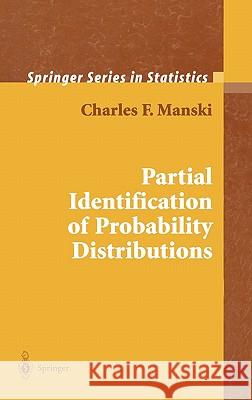
Partial Identification of Probability Distributions Charles F. Manski C. F. Manski 9780387004549 Springer - książkaWidoczna okładka, to zdjęcie poglądowe, a rzeczywista szata graficzna może różnić się od prezentowanej.

Partial Identification of Probability Distributions

ISBN-13: 9780387004549 / Angielski / Twarda / 2003 / 179 str.

Charles F. Manski; C. F. Manski
cena 564,88 zł
(netto: 537,98 VAT:  5%)

Najniższa cena z 30 dni: 539,74 zł
Termin realizacji zamówienia:
ok. 22 dni roboczych
Bez gwarancji dostawy przed świętami

Darmowa dostawa!

Sample data alone never suffice to draw conclusions about populations. Inference always requires assumptions about the population and sampling process. Statistical theory has revealed much about how strength of assumptions affects the precision of point estimates, but has had much less to say about how it affects the identification of population parameters. Indeed, it has been commonplace to think of identification as a binary event - a parameter is either identified or not - and to view point identification as a pre-condition for inference. Yet there is enormous scope for fruitful inference using data and assumptions that partially identify population parameters. This book explains why and shows how. The book presents in a rigorous and thorough manner the main elements of Charles Manski's research on partial identification of probability distributions. One focus is prediction with missing outcome or covariate data. Another is decomposition of finite mixtures, with application to the analysis of contaminated sampling and ecological inference. A third major focus is the analysis of treatment response. Whatever the particular subject under study, the presentation follows a common path. The author first specifies the sampling process generating the available data and asks what may be learned about population parameters using the empirical evidence alone. He then ask how the (typically) setvalued identification regions for these parameters shrink if various assumptions are imposed. The approach to inference that runs throughout the book is deliberately conservative and thoroughly nonparametric. Conservative nonparametric analysis enables researchers to learn from the available data without imposing untenable assumptions. It enables establishment of a domain of consensus among researchers who may hold disparate beliefs about what assumptions are appropriate. Charles F. Manski is Board of Trustees Professor at Northwestern University. He is author of Identification Problems in the Social Sciences and Analog Estimation Methods in Econometrics. He is a Fellow of the American Academy of Arts and Sciences, the American Association for the Advancement of Science, and the Econometric Society.


Kategorie:
Nauka, Matematyka
Kategorie BISAC:
Mathematics > Prawdopodobieństwo i statystyka
Business & Economics > Statystyka gospodarcza
Business & Economics > Ekonometria
Wydawca:
Springer
Seria wydawnicza:
Springer Series in Statistics
Język:
Angielski
ISBN-13:
9780387004549
Rok wydania:
2003
Wydanie:
2003
Numer serii:
000022130
Ilość stron:
179
Waga:
0.46 kg
Wymiary:
23.5 x 15.5
Oprawa:
Twarda
Wolumenów:
01
Dodatkowe informacje:
Bibliografia

From the reviews:

"Charles Manski has produced a nice and compact text written with extreme care, providing technical detail, and mathematical proofs where needed." Biometrics, March 2005

"This book is an excellent and rigorous presentation of the state of research in the area of partial identification of populations and credible inference, in which the author has made many important contributions. ... The overall quality of the book is very good. ... The main part of each chapter is written in a textbook style. ... Clearly, both methodology and the applications presented are intended to provide statisticians with a good foundation for further study in the subject ... ." (Evdokia Xekalaki, Zentralblatt MATH, Vol. 1047 (22), 2004)

"I found the material very pertinent, departing, as it does, from the usual parametric approach in which the conclusions depend rather critically on the probability model adopted. Given a chance, it will make the traditionalist, like me, stop and think and perhaps, try to mend their ways a little. The main part of each chapter is written in textbook style, but fairly formally and rigorously ... . At the end of each chapter appear 'Complements', giving examples and extensions, and 'Endnotes'... ." (M. J. Crowder, Short Book Reviews, Vol. 23 (3), 2003)

"This book, containing ten chapters, is the first comprehensive presentation of the theory of partial identification of probability distributions. It gives an overview of the research into this topic." (M. Riedel, Mathematical Reviews, Issue 2006 g)

"The book is carefully and thoughtfully written. Some chapters start with a cogent section on the "anatomy of the problem," and all end with complements addressing specific contexts." (Alan F. Kaar, Journal of the American Statistical Association, Vol. 102, No. 477, 2007)

Missing Outcomes * Instrumental Variables * Conditional Prediction with Missing Data * Contaminated Outcomes * Regressions, Short and Long * Response-Based Sampling * Analysis of Treatment Response * Monotone Treatment Response * Monotone Instrumental Variables * The Mixing Problem

 Charles F. Manski is Board of Trustees Professor at Northwestern University. He is author of Identification Problems in the Social Sciences and Analog Estimation Methods in Econometrics. He is a Fellow of the American Academy of Arts and Sciences, the American Association for the Advancement of Science, and the Econometric Society.

Sample data alone never suffice to draw conclusions about populations. Inference always requires assumptions about the population and sampling process. Statistical theory has revealed much about how strength of assumptions affects the precision of point estimates, but has had much less to say about how it affects the identification of population parameters. Indeed, it has been commonplace to think of identification as a binary event – a parameter is either identified or not – and to view point identification as a pre-condition for inference. Yet there is enormous scope for fruitful inference using data and assumptions that partially identify population parameters. This book explains why and shows how.

The book presents in a rigorous and thorough manner the main elements of Charles Manski’s research on partial identification of probability distributions. One focus is prediction with missing outcome or covariate data. Another is decomposition of finite mixtures, with application to the analysis of contaminated sampling and ecological inference. A third major focus is the analysis of treatment response.

Whatever the particular subject under study, the presentation follows a common path. The author first specifies the sampling process generating the available data and asks what may be learned about population parameters using the empirical evidence alone. He then ask how the (typically) setvalued identification regions for these parameters shrink if various assumptions are imposed. The approach to inference that runs throughout the book is deliberately conservative and thoroughly nonparametric. Conservative nonparametric analysis enables researchers to learn from the available data without imposing untenable assumptions. It enables establishment of a domain of consensus among researchers who may hold disparate beliefs about what assumptions are appropriate.

Charles F. Manski is Board of Trustees Professor at Northwestern University. He is author of Identification Problems in the Social Sciences and Analog Estimation Methods in Econometrics. He is a Fellow of the American Academy of Arts and Sciences, the American Association for the Advancement of Science, and the Econometric Society.

Manski, Charles F. Charles F. Manski is Board of Trustees Professor o... więcej >


Udostępnij

Facebook - konto krainaksiazek.pl


Opinie o Krainaksiazek.pl na Opineo.pl

Partner Mybenefit

Krainaksiazek.pl w programie rzetelna firma Krainaksiaze.pl - płatności przez paypal

Czytaj nas na:

Facebook - krainaksiazek.pl
  • książki na zamówienie
  • granty
  • książka na prezent
  • kontakt
  • pomoc
  • opinie
  • regulamin
  • polityka prywatności

Zobacz:

  • Księgarnia czeska

  • Wydawnictwo Książkowe Klimaty

1997-2025 DolnySlask.com Agencja Internetowa

© 1997-2022 krainaksiazek.pl
     
KONTAKT | REGULAMIN | POLITYKA PRYWATNOŚCI | USTAWIENIA PRYWATNOŚCI
Zobacz: Księgarnia Czeska | Wydawnictwo Książkowe Klimaty | Mapa strony | Lista autorów
KrainaKsiazek.PL - Księgarnia Internetowa

Polityka prywatnosci - link
Krainaksiazek.pl - płatnośc Przelewy24
Przechowalnia Przechowalnia



