• Wyszukiwanie zaawansowane
  • Kategorie
  • Kategorie BISAC
  • Książki na zamówienie
  • Promocje
  • Granty
  • Książka na prezent
  • Opinie
  • Pomoc
  • Załóż konto
  • Zaloguj się

Origins of Mind » książka


zaloguj się | załóż konto
Logo Krainaksiazek.pl

koszyk

konto

szukaj
topmenu
Księgarnia internetowa
Szukaj
Książki na zamówienie
Promocje
Granty
Książka na prezent
Moje konto
Pomoc
 
 
Wyszukiwanie zaawansowane
Pusty koszyk
Bezpłatna dostawa dla zamówień powyżej 20 złBezpłatna dostawa dla zamówień powyżej 20 zł

Kategorie główne

• Nauka
 [2946912]
• Literatura piękna
 [1852311]

  więcej...
• Turystyka
 [71421]
• Informatyka
 [150889]
• Komiksy
 [35717]
• Encyklopedie
 [23177]
• Dziecięca
 [617324]
• Hobby
 [138808]
• AudioBooki
 [1671]
• Literatura faktu
 [228371]
• Muzyka CD
 [400]
• Słowniki
 [2841]
• Inne
 [445428]
• Kalendarze
 [1545]
• Podręczniki
 [166819]
• Poradniki
 [480180]
• Religia
 [510412]
• Czasopisma
 [525]
• Sport
 [61271]
• Sztuka
 [242929]
• CD, DVD, Video
 [3371]
• Technologie
 [219258]
• Zdrowie
 [100961]
• Książkowe Klimaty
 [124]
• Zabawki
 [2341]
• Puzzle, gry
 [3766]
• Literatura w języku ukraińskim
 [255]
• Art. papiernicze i szkolne
 [7810]
Kategorie szczegółowe BISAC

Origins of Mind

ISBN-13: 9789400795051 / Angielski / Miękka / 2015 / 420 str.
Liz Swan
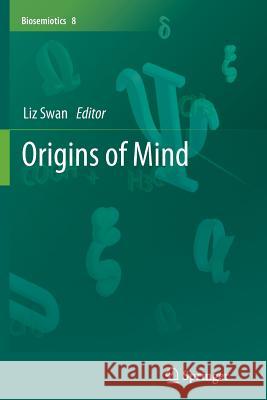
Origins of Mind Liz Swan 9789400795051 Springer - książkaWidoczna okładka, to zdjęcie poglądowe, a rzeczywista szata graficzna może różnić się od prezentowanej.

Origins of Mind

ISBN-13: 9789400795051 / Angielski / Miękka / 2015 / 420 str.

Liz Swan
cena 805,10
(netto: 766,76 VAT:  5%)

Najniższa cena z 30 dni: 771,08
Termin realizacji zamówienia:
ok. 22 dni roboczych
Bez gwarancji dostawy przed świętami

Darmowa dostawa!
inne wydania

The big question of how and why mindedness evolved necessitates collaborative, multidisciplinary investigation. Biosemiotics provides a new conceptual space that attracts a multitude of thinkers in the biological and cognitive sciences and the humanities who recognize continuity in the biosphere from the simplest to the most complex organisms, and who are united in the project of trying to account for even language and human consciousness in this comprehensive picture of life. The young interdiscipline of biosemiotics has so far by and large focused on codes, signs and sign processes in the microworld--a fact that reflects the field's strong representation in microbiology and embryology. What philosophers of mind and cognitive scientists can contribute to the growing interdiscipline are insights into how the biosemiotic weltanschauung applies to complex organisms like humans where such signs and sign processes constitute human society and culture.


Kategorie:
Nauka, Filozofia
Kategorie BISAC:
Science > Life Sciences - General
Philosophy > Mind & Body
Philosophy > Reference
Wydawca:
Springer
Język:
Angielski
ISBN-13:
9789400795051
Rok wydania:
2015
Wydanie:
2013
Ilość stron:
420
Waga:
0.60 kg
Wymiary:
23.39 x 15.6 x 2.24
Oprawa:
Miękka
Wolumenów:
01
Dodatkowe informacje:
Wydanie ilustrowane

From the reviews:

"The chapters provide one of the best explorations of mind-as-process in an age where only empirical phenomena exist, i.e., where there are no extra-empirical things (naturalism). This wide-ranging exploration of an increasingly influential approach to understanding the meaning of 'mind' will interest philosophers, psychologists, neuroscientists, and cognitive scientists. Summing Up: Highly recommended. Upper-division undergraduates and above." (R. Paul Thompson, Choice, Vol. 50 (11), August, 2013)

Introduction: exploring the origins of mindedness in nature; Liz Swan
BIOSEMIOTICS
1. Organic Codes and the Natural History of Mind; Marcello Barbieri
2. The Descent of Humanity; Angelo Recchia-Luciani
3. From Non-Minds to Minds: biosemantics and the Tertium Quid; Crystal L’Hote
4. Cybersemiotics:  a new foundation for a transdisciplinary theory of consciousness, cognition, meaning and communication; Soren Brier
MENTAL REPRESENTATION
5. The Emergence of Empathy in the Context of Cross-Species Mind-reading; John Sarnecki
6. The Evolution of Scenario Visualization and the Early Hominin Mind; Rob Arp
7. Representation in Biological Systems: teleofunction, etiology, and structural preservation; Michael Nair-Collins
8. Beyond embodiment: from internal representation of action to symbolic processes; Isabel Barahona da Fonseca
CONSCIOUSNESS
9. Imitation, Learning, and Conceptual Thought: an embodied, developmental approach; Ellen Fridland
10. Evolving Consciousness: the very idea! James Fetzer
11. Mind or Mechanism: which came first? Teed Rockwell
12. Origins of the Qualitative Aspects of Consciousness: evolutionary answers to Chalmers’ hard problem; Jonathan Tsou
PHILOSOPHY OF MIND
13. Neuropragmatism on the Origins of Conscious Minding; Tibor Solymosi
14. Not So Exceptional: away from Chomskian salationism and towards a naturally gradual   account of mindfulness; Andrew Winters and Alex Levine
15. Mental Organs and the Origins of Mind; Thomas Ray
16. Mnemo-psychography: the origin of mind and the problem of biological memory storage; Frank Scalambrino
SYNTHETIC INTELLIGENCE
17. Minimal Mind; Alexei Sharov
18. Concept Combination and the Origins of Complex Cognition; Liane Gabora and Kirsty Kitto
19. The Mind of the Noble Ape in Three Simulations; Tom Barbalet
20. From the Natural Brain to the Artificial Mind; Massimo Negrotti

The big question of how and why mindedness evolved necessitates collaborative, multidisciplinary investigation. Biosemiotics provides a new conceptual space that attracts a multitude of thinkers in the biological and cognitive sciences and the humanities who recognize continuity in the biosphere from the simplest to the most complex organisms, and who are united in the project of trying to account for even language and human consciousness in this comprehensive picture of life. What philosophers of mind and cognitive scientists can contribute to the growing interdiscipline are insights into how the biosemiotic weltanschauung applies to complex organisms like humans where such signs and sign processes constitute human society and culture.

The purpose of this volume is to gather together a sampling of contemporary thinking on when, why, and how mindedness evolved in the natural world from researchers working in the biological, cognitive, and medical sciences. The question of the origin of mind is no longer the exclusive domain of philosophers; it has, in recent decades, become a respectable question for research scientists to work on as well.

The volume’s contents are pluralistic. One element that most of the chapters in the volume have in common is in their adherence to the principle that the phenomenon of mindedness, including the peculiarities of human mindedness, is a biological phenomenon. Fully represented in this volume are thoughts, ideas, and theories that contribute to our naturalistic understanding of mindedness that address its biological origins and evolutionary development. The volume is divided into five sections devoted to the sub-topics of: biosemiotics theories of mindedness, the evolution of mental representation in humans, the evolution of various aspects of consciousness, problems in philosophy of mind, and simulation approaches to understanding human intelligence.


Udostępnij

Facebook - konto krainaksiazek.pl


Opinie o Krainaksiazek.pl na Opineo.pl

Partner Mybenefit

Krainaksiazek.pl w programie rzetelna firma Krainaksiaze.pl - płatności przez paypal

Czytaj nas na:

Facebook - krainaksiazek.pl
  • książki na zamówienie
  • granty
  • książka na prezent
  • kontakt
  • pomoc
  • opinie
  • regulamin
  • polityka prywatności

Zobacz:

  • Księgarnia czeska

  • Wydawnictwo Książkowe Klimaty

1997-2025 DolnySlask.com Agencja Internetowa

© 1997-2022 krainaksiazek.pl
     
KONTAKT | REGULAMIN | POLITYKA PRYWATNOŚCI | USTAWIENIA PRYWATNOŚCI
Zobacz: Księgarnia Czeska | Wydawnictwo Książkowe Klimaty | Mapa strony | Lista autorów
KrainaKsiazek.PL - Księgarnia Internetowa

Polityka prywatnosci - link
Krainaksiazek.pl - płatnośc Przelewy24
Przechowalnia Przechowalnia





