Optics and Photonics: An Introduction » książka





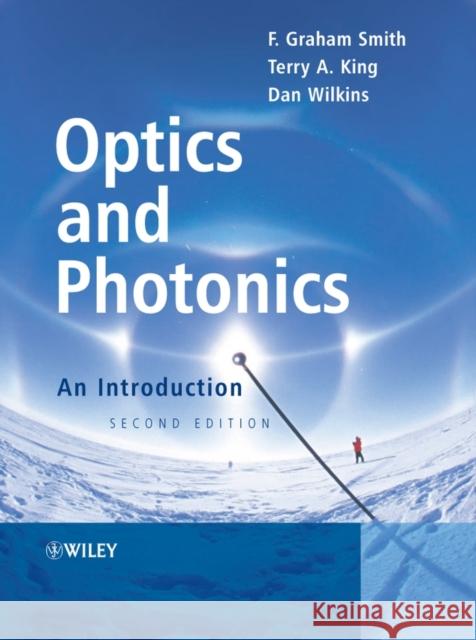
Optics and Photonics: An Introduction
ISBN-13: 9780470017838 / Angielski / Twarda / 2007 / 520 str.
Optics and Photonics: An Introduction
ISBN-13: 9780470017838 / Angielski / Twarda / 2007 / 520 str.
(netto: 856,31 VAT: 5%)
Najniższa cena z 30 dni: 875,66
ok. 30 dni roboczych.
Darmowa dostawa!
The Second Edition of this successful textbook provides a clear, well-written introduction to both the fundamental principles of optics and the key aspects of photonics to show how the subject has developed in the last few decades, leading to many modern applications. Optics and Photonics: An Introduction, Second Edition thus provides a complete undergraduate course on optics in a single integrated text, and is an essential resource for all undergraduate physics, science and engineering students taking a variety of optics based courses. Specific changes for this edition include:
- New material on modern optics and photonics
- Rearrangement of chapters to give a logical progression, comprising groups of chapters on geometric optics, wave optics and photonics
- Many more worked examples and problems
- Substantial revisions to chapters on Holography, Lasers and the Interaction of Light with Matter
PREFACE.
1. LIGHT AS WAVES, RAYS AND PHOTONS.
The nature of light.
Waves and rays.
Total internal reflection.
The light wave.
Electromagnetic waves.
The electromagnetic spectrum.
Stimulated emission: the laser. Photons and material particles.
2. GEOMETRIC OPTICS.
The thin prism: the ray approach and the wavefront approach.
The lens as an assembly of prisms.
Refraction at a spherical surface.
Two surfaces; the simple lens.
Imaging in spherical mirrors.
General properties of imaging systems.
Separated thin lenses in air.
Ray tracing by matrices.
Locating the cardinal points: position of a nodal point, focal point, principal point, focal length, the other cardinal points.
Perfect imaging.
Perfect imaging of surfaces.
Ray and wave aberrations.
Wave aberration on–axis spherical aberration.
Off–axis aberrations.
The influence of aperture stops.
The correction of chromatic aberration.
Achromatism in separated lens systems.
Adaptive optics.
3. OPTICAL INSTRUMENTS.
The human eye.
The simple lens magnifier.
The compound microscope.
The confocal scanning microscope.
Resolving power; conventional and near–field microscopes.
The telescope.
Advantages of the various types of telescope.
Binoculars.
The camera.
Illumination in optical instruments.
4. PERIODIC AND NON–PERIODIC WAVES.
Simple harmonic waves.
Positive and negative frequencies.
Standing waves. Beats between oscillators.
Similarities between beats and standing wave patterns.
Standing waves at a reflector.
The Doppler effect.
Doppler radar.
Astronomical aberration.
Fourier series.
Modulated waves: Fourier transforms.
Modulation by a non–periodic function.
Convolution.
Delta and grating functions.
Autocorrelation and the power spectrum.
Wave groups.
An angular spread of plane waves.
5. ELECTROMAGNETIC WAVES.
Maxwell s equations.
Transverse waves.
Reflection and transmission: Fresnel s equations.
Total internal reflection: evanescent waves.
Energy flow.
Photon momentum and radiation pressure.
Blackbody radiation.
6. FIBRE AND WAVEGUIDE OPTICS.
The light pipe.
Guided waves.
The slab dielectric guide.
Evanescent fields in fibre optics.
Cylindrical fibres and waveguides.
Numerical aperture. Materials for optical fibres.
Dispersion in optical fibres.
Dispersion compensation.
Modulation and communications.
Fibre optical components.
Hole–array light guide; photonic crystal fibres.
Optical fibre sensors.
Fabrication of optical fibres.
7. POLARIZATION OF LIGHT.
Polarization of transverse waves.
Analysis of elliptically polarized waves.
Polarizers.
Liquid crystal displays.
Birefringence in anisotropic media.
Birefringent polarizers.
Generalizing Snell s law for anisotropic materials.
Quarter– and half–wave plates.
Optical activity.
Formal descriptions of polarization.
Induced birefringence.
8. INTERFERENCE.
Interference.
Young s experiment.
Newton s rings.
Interference effects with a plane–parallel plate.
Thin films.
Michelson s spectral interferometer.
Multiple beam interference.
The Fabry Pérot interferometer.
Interference filters.
9. INTERFEROMETRY: LENGTH, ANGLE AND ROTATION.
The Rayleigh interferometer.
Wedge fringes and end gauges.
The Twyman and Green interferometer.
The standard of length.
The Michelson Morley experiment.
Detecting gravitational waves by interferometry.
The Sagnac ring interferometer.
Optical fibres in interferometers.
The ring laser gyroscope.
Measuring angular width.
The effect of slit width.
Source size and coherence.
Michelson s stellar interferometer.
Very long baseline interferometry.
The intensity interferometer.
10. DIFFRACTION.
Diffraction at a single slit.
The general aperture.
Rectangular and circular apertures: uniformly illuminated single slit: two infinitesimally narrow slits: two slits with finite width: uniformly illuminated rectangular aperture: uniformly illuminated circular aperture.
Fraunhofer and Fresnel diffraction.
Shadow edges Fresnel diffraction at a straight edge.
Diffraction of cylindrical wavefronts.
Fresnel diffraction by slits and strip obstacles.
Spherical waves and circular apertures: half–period zones.
Fresnel Kirchhoff diffraction theory.
Babinet s principle.
The field at the edge of an aperture.
11. THE DIFFRACTION GRATING AND ITS APPLICATIONS.
The diffraction grating.
Diffraction pattern of the grating.
The effect of slit width and shape.
Fourier transforms in grating theory.
Missing orders and blazed gratings.
Making gratings.
Concave gratings.
Blazed, echellette, echelle and echelon gratings.
Radio antenna arrays: end–fire array shooting equally in both directions: end–fire array shooting in only one direction: the broadside array: two–dimensional broadside arrays.
X–ray diffraction with a ruled grating.
Diffraction by a crystal lattice.
The Talbot effect.
12. SPECTRA AND SPECTROMETRY.
Spectral lines.
Linewidth and lineshape.
The prism spectrometer.
The grating spectrometer.
Resolution and resolving power.
Resolving power: the prism spectrometer.
Resolving power: grating spectrometers.
The Fabry Pe´rot spectrometer.
Twin beam spectrometry; Fourier transform spectrometry.
Irradiance fluctuation, or photon–counting spectrometry.
Scattered laser light.
13. COHERENCE AND CORRELATION.
Temporal and spatial coherence.
Correlation as a measure of coherence.
Temporal coherence of a wavetrain.
Fluctuations in irradiance.
The van Cittert Zernike theorem.
Autocorrelation and coherence.
Two–dimensional angular resolution.
Irradiance fluctuations: the intensity interferometer.
Spatial filtering.
14. HOLOGRAPHY.
Reconstructing a plane wave.
Gabor s original method.
Basic holography analysis.
Holographic recording: off–axis holography.
Aspect effects.
Types of hologram.
Holography in colour.
The rainbow hologram.
Holography of moving objects.
Holographic interferometry.
Holographic optical elements.
Holographic data storage.
15. LASERS.
Stimulated emission.
Pumping: the energy source.
Absorption and emission of radiation.
Laser gain.
Population inversion.
Threshold gain coefficient.
Laser resonators.
Beam irradiance and divergence.
Examples of important laser systems: gas lasers, solid state lasers, liquid lasers.
16. LASER LIGHT.
Laser linewidth.
Spatial coherence: laser speckle.
Temporal coherence and coherence length.
Laser pulse duration: Q–switching, mode–locking.
Laser radiance.
Focusing laser light.
Photon momentum: optical tweezers and trapping; optical tweezers; laser cooling.
Non–linear optics.
17. SEMICONDUCTORS AND SEMICONDUCTOR LASERS.
Semiconductors.
Semiconductor diodes.
LEDs and semiconductor lasers; heterojunction lasers.
Semiconductor laser cavities.
Wavelengths and tuning of semiconductor lasers.
Modulation.
Organic semiconductor LEDs and lasers.
18. SOURCES OF LIGHT.
Classical radiation processes: radiation from an accelerated charge; the Hertzian dipole.
Free free radiation.
Cyclotron and synchrotron radiation.
Free electron lasers.
Cerenkov radiation.
The formation of spectral lines: the Bohr model; nuclear mass; quantum mechanics; angular momentum and electron spin.
Light from the Sun and Stars.
Thermal sources.
Fluorescent lights. Luminescence sources.
Electroluminescence.
19. INTERACTION OF LIGHT WITH MATTER.
The classical resonator.
Rayleigh scattering.
Polarization and refractive index in dielectrics.
Free electrons.
Faraday rotation in a plasma.
Resonant atoms in gases.
The refractive index of dense gases, liquids and solids.
Anisotropic refraction.
Brillouin scattering.
Raman scattering.
Thomson and Compton scattering by electrons.
A summary of scattering processes.
20. THE DETECTION OF LIGHT.
Photoemissive detectors.
Semiconductor detectors.
Semiconductor junction photodiodes.
Imaging detectors. Noise in photodetectors. Image intensifiers.
Photography.
Thermal detectors.
21. OPTICS AND PHOTONICS IN NATURE.
Light and colour in the open air.
The development of eyes.
Corneal and lens focusing.
Compound eyes.
Reflection optics.
Fluorescence and photonics in a butterfly.
Biological light detectors.
Photosynthesis.
Appendix 1: Answers to Selected Problems.
Appendix 2: Radiometry and Photometry.
Appendix 3: Refractive Indices of Common Materials.
Appendix 4: Spectral Lineshapes and Linewidths.
Appendix 5: Further Reading.
INDEX.
Sir Francis Graham Smith. Old School House, Henbury, Macclesfield, Cheshire SK11 9PH, UK
Now retired, Graham Smith has had a distinguished career in radio astronomy having held the post of Astronomer Royal 1982 1990, and most recently was Langworthy Professor of Physics at Manchester University.
Professor Terry King. School of Physics & Astronomy, University of Manchester, Manchester M13 9PL, UK
Currently head of the Laser Photonics Group, Terry King has many years experience in research, teaching and consultancy.
Professor Daniel Wilkins. Department of Physics, University of Nebraska, Omaha, NE 68182–0266, USA
Dan Wilkins holds the Milo Bail Chair of Physics at Nebraska and has taught optics and a wide variety of undergraduate courses for many years. His main research focus is general relativity theory.
The second edition of this successful textbook provides a clear, well–written introduction to both the fundamental principles of optics and the key aspects of photonics to show how the subject has developed in the last few decades, leading to many modern applications. The book thus provides a complete undergraduate course on optics in a single integrated text. The new edition has been completely updated and specific important changes include:
- New material on modern optics and photonics.
- A rearrangement of chapters to give a logical progression comprising groups of chapters on geometric optics, wave optics and photonics.
- Many more worked examples and problems.
In addition, substantial revisions have been made to chapters on holography, lasers and the interaction of light with matter. For this edition Smith and King have been joined by a new co–author, Professor Dan Wilkins from the University of Nebraska at Omaha, who has many years experience of teaching optics courses.
This balanced, practical, modern introduction to optics and photonics and will prove invaluable to students taking optics courses within science and engineering.




Czytaj nas na:
1997-2026 DolnySlask.com Agencja Internetowa
KrainaKsiazek.PL - Księgarnia Internetowa


