• Wyszukiwanie zaawansowane
  • Kategorie
  • Kategorie BISAC
  • Książki na zamówienie
  • Promocje
  • Granty
  • Książka na prezent
  • Opinie
  • Pomoc
  • Załóż konto
  • Zaloguj się

Optically Anomalous Crystals » książka


zaloguj się | załóż konto
Logo Krainaksiazek.pl

koszyk

konto

szukaj
topmenu
Księgarnia internetowa
Szukaj
Książki na zamówienie
Promocje
Granty
Książka na prezent
Moje konto
Pomoc
 
 
Wyszukiwanie zaawansowane
Pusty koszyk
Bezpłatna dostawa dla zamówień powyżej 20 złBezpłatna dostawa dla zamówień powyżej 20 zł

Kategorie główne

• Nauka
 [2946600]
• Literatura piękna
 [1856966]

  więcej...
• Turystyka
 [72221]
• Informatyka
 [151456]
• Komiksy
 [35826]
• Encyklopedie
 [23190]
• Dziecięca
 [619653]
• Hobby
 [140543]
• AudioBooki
 [1577]
• Literatura faktu
 [228355]
• Muzyka CD
 [410]
• Słowniki
 [2874]
• Inne
 [445822]
• Kalendarze
 [1744]
• Podręczniki
 [167141]
• Poradniki
 [482898]
• Religia
 [510455]
• Czasopisma
 [526]
• Sport
 [61590]
• Sztuka
 [243598]
• CD, DVD, Video
 [3423]
• Technologie
 [219201]
• Zdrowie
 [101638]
• Książkowe Klimaty
 [124]
• Zabawki
 [2473]
• Puzzle, gry
 [3898]
• Literatura w języku ukraińskim
 [254]
• Art. papiernicze i szkolne
 [8170]
Kategorie szczegółowe BISAC

Optically Anomalous Crystals

ISBN-13: 9789048173310 / Angielski / Miękka / 2010 / 277 str.
Alexander Shtukenberg; Yurii Punin; Bart Kahr
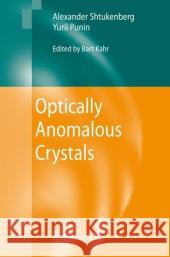
Optically Anomalous Crystals Alexander Shtukenberg Yurii Punin Bart Kahr 9789048173310 Springer - książkaWidoczna okładka, to zdjęcie poglądowe, a rzeczywista szata graficzna może różnić się od prezentowanej.

Optically Anomalous Crystals

ISBN-13: 9789048173310 / Angielski / Miękka / 2010 / 277 str.

Alexander Shtukenberg; Yurii Punin; Bart Kahr
cena 403,47 zł
(netto: 384,26 VAT:  5%)

Najniższa cena z 30 dni: 385,52 zł
Termin realizacji zamówienia:
ok. 22 dni roboczych
Bez gwarancji dostawy przed świętami

Darmowa dostawa!

Optically Anomalous Crystals begins with an historical introduction covering the contributions of Brewster, Biot, Mallard, Brauns, Tamman, and many other distinguished crystallographers. From this follows a tutorial in crystal optics. Further chapters discuss the two main mechanisms of optical dissymmetry: 1. the piezo-optic effect, and 2. the kinetic ordering of atoms. The text then tackles complex, inhomogeneous crystals, and the complex optical properties resulting from the superposition of anomalies having various etiologies. The book treats the literature comprehensively, but uses illustrations from the authors' laboratories as the subjects of detailed analyses. This is an invaluable text for crystallographers, mineralogists, and petrologists interested in the growth of minerals and synthetic crystals, and their optical properties. It is also ideally suited to students of optical mineralogy, professional scientists and engineers as well as historians of science.


Kategorie:
Nauka, Fizyka
Kategorie BISAC:
Science > Physics - Crystallography
Science > Chemia - Nieorganiczna
Science > Earth Sciences - Mineralogy
Wydawca:
Springer
Język:
Angielski
ISBN-13:
9789048173310
Rok wydania:
2010
Ilość stron:
277
Waga:
0.44 kg
Wymiary:
23.5 x 15.5
Oprawa:
Miękka
Wolumenów:
01
Dodatkowe informacje:
Wydanie ilustrowane

From the reviews:

"The present volume constitutes a comprehensive and detailed review of the current state of knowledge about anomalous crystals. ... The text is illustrated by many figures and black-and-white photographs ... . This book is well referenced ... . this is an authoritative and insightful book on a fascinating book on a fascinating research topic. For the specialist, it is an invaluable work of reference and source of information and inspiration; those unfamiliar with this field will find stimulation and entertainment by browsing the book." (Pedro Cintas, Angewandte Chemie, Vol. 46 (32), 2007)

1. Crystal Optics 1.1. Introduction to Crystal Optics in Transmitted Light 1.1.1. Light in Isotropic Media 1.1.2. Light in Anisotropic Medium: Linear Birefringence 1.1.3. Symmetry of the Optical Indicatrix 1.1.4. Other Linear Optical Phenomena 1.1.5. Composition, Structure, and Optics 1.2. Characterizing the Optical Indicatrix 1.3. Definition of Optical Anomalies in Terms of the Indicatrix 1.4. Anomalies of Obvious Etiology 1.4.1. Gross Compositional Inhomogeneity 1.4.2. Macroscopic Deformations of Crystals 1.5. Abundance of Optical Anomalies 2. Stress Induced Optical Anomalies 2.1. Introduction 2.2. Phenomenological Description of Piezooptic Effects 2.2.1. Piezooptic and Elastooptic Coefficients 2.2.2. Piezooptic Phenomena in Amorphous Solids 2.2.3. Piezooptic Phenomenon in Cubic Crystals 2.2.4. Piezooptic Phenomenon in Uniaxial Crystals 2.2.5. The General Case 2.2.6. Example: Piezooptic Effect in PbMoO4 2.3. Numerical Estimations of Stress and Stress-Induced Optical Anomalies 2.4. Sources of Stress 2.5. Inclusions 2.6. Dislocations 2.6.1. Single Dislocations 2.6.2. Dislocation Ensembles 2.6.3. Macroblocks, Grain, and Twin Boundaries 2.7. Thermoelasticity and Thermoplasticity 2.8. Compositional Heterometry 2.8.1. What is Heterometry? 2.8.2. Zoning 2.8.3. Growth Sector Zoning 2.8.4. Sub-Sector Zoning 2.8.5. Effect of Growth Conditions on the Stress-Induced Optical Anomalies 3. Kinetic Ordering-Disordering 3.1. Introduction 3.1.1. Kinetic Ordering 3.1.2. Kinetic Disordering 3.2. Crystal Symmetry 3.2.1. The Neumann-Curie Principle 3.2.2. Application of Group Theory 3.3. Optical Inhomogeneity of Crystals 3.3.1. Sector Zoning 3.3.2. Sub-Sector Zoning 3.3.3. Sector Zoning vs Sub-Sector zoning 3.3.4. Concentric Zoning 3.3.5. Anomalous Progression of Anomalous Birefringence 3.4. Kinetic Ordering and Crystal Structure 3.4.1. Experimental Analyses 3.4.2. Desymmetrization by X-Ray Diffraction 3.4.3. Kinetic Ordering and the Optical Indicatrix 3.4.4. Kinetic Ordering and Anomalous Pleochroism 3.4.5. Metastability of Kinetic Ordering 3.4.6. Kinetic Ordering vs. Structure of the Growing Surface 3.4.7. Relaxation by Diffusion 3.5. Factors Affecting Growth Ordering 3.5.1. Crystal Composition 3.5.2. Composition of Growth Medium 3.5.3. Temperature and Pressure 3.5.4. Growth Rate 3.5.5. Hydrodynamics and Mass Transfer 4. Heterogeneous Crystals 4.1. Optics of Heterogeneous Crystals 4.2. Optically Homogeneous Systems 4.2.1. Inclusions 4.2.2. Optically Homogeneous Heterostructures 4.2.3. Heterostructures of Polytype Modifications 4.2.4. The Reverse Problem for the Polytype Intergrowths 4.2.5. Polysynthetic Twinning 4.2.6. Ex-Solution Structures 4.2.7. Syntaxy 4.2.8. Chaotic Misorientation of Components 4.3. Optically Heterogeneous Systems 4.3.1. Introduction 4.3.2. Isogyres 4.3.3. Isochromes 4.3.4. Modeling Distorted Conoscopic Figures 4.3.5. Calculation of the Distorted Conoscopic Figures: Some Examples 4.3.6. Distorted Conoscopic Figures as a Characteristic of Crystal Inhomogeneity 4.4. Heterogeneity at Different Length Scales 5. Superimposition of Optical Anomalies 5.1. General Remarks 5.2. Internal Stress 5.2.1. Composit

Alexander Shtukenberg was born in St. Petersburg in 1971. He received his diploma in crystallography and mineralogy from the St. Petersburg State University in 1993, and his PhD in 1997. Following postdoctoral fellowships at the Mineralogy and Petrography Institute of the University of Bonn and at the Paul Drude Institute for Solid State Electronics, Berlin, he has returned to his alma mater as an instructor in crystallography. Shtukenberg’s research has focused on the structure and properties of solid solutions. He has published 27 papers in addition to the monograph, Optical Anomalies in Crystals.

Yurii Punin was born in St. Petersburg in 1941. He completed his education at the St. Petersburg State University in 1963. Following military service, he began his research career at the Earth Crust Research Institute of St. Petersburg State University completing a PhD thesis in 1970 on the kinetics of crystal growth. After habilitation in 1994, Punin received a professorship in the crystallography at the St. Petersburg State University. He has served as the head of the crystallography department since 2002. Punin is a specialist in the field of crystal growth from solution, having developed the theory of strain induced growth defects that provides insights into twinning, mosaicity, and order-disorder transitions. He has created a widely regarded course of lectures on "Crystal Growth" in addition to the publication of 120 papers and 2 books.

Editor:

Bart Kahr was born in New York City in 1961. He attended Middlebury College in Vermont. Following doctoral research on the stereochemistry of unusual molecules at Princeton University, he joined the laboratory of J. Michael McBride at Yale University where he studied the history of optically anomalous crystals. In 1990, he joined the chemistry faculty of Purdue University and was named a National Science Foundation Young Investigator. In 1997, Kahr moved his laboratory to the University of Washington in Seattle where he is currently Professor of Chemistry. His research group studies the growth, structure, and physical properties of crystalline solids, as well as the history of crystallography. He is the author or co-author of 100 scientific publications.

Optical anomalies in crystals are puzzles that collectively constituted the greatest unsolved problems in crystallography in the 19th Century. The most common anomaly is a discrepancy between a crystal’s symmetry as determined by its shape or by X-ray analysis, and that determined by monitoring the polarization state of traversing light. These discrepancies were perceived as a great impediment to the development of the sciences of crystals on the basis of Curie’s Symmetry Principle, the grand organizing idea in the physical sciences to emerge in the latter half of the 19th Century.

Optically Anomalous Crystals begins with an historical introduction covering the contributions of Brewster, Biot, Mallard, Brauns, Tamman, and many other distinguished crystallographers. From this follows a tutorial in crystal optics. Further chapters discuss the two main mechanisms of optical dissymmetry: 1. the piezo-optic effect, and 2. the kinetic ordering of atoms. The text then tackles complex, inhomogeneous crystals, and the complex optical properties resulting from the superposition of anomalies having various etiologies. The book treats the literature comprehensively, but uses illustrations from the authors’ laboratories as the subjects of detailed analyses.

This is an invaluable text for crystallographers, mineralogists, and petrologists interested in the growth of minerals and synthetic crystals, and their optical properties. It is also ideally suited to students of optical mineralogy, professional scientists and engineers as well as historians of science.

Shtukenberg, Alexander Alexander Shtukenberg was born in St. Petersburg i... więcej >


Udostępnij

Facebook - konto krainaksiazek.pl


Opinie o Krainaksiazek.pl na Opineo.pl

Partner Mybenefit

Krainaksiazek.pl w programie rzetelna firma Krainaksiaze.pl - płatności przez paypal

Czytaj nas na:

Facebook - krainaksiazek.pl
  • książki na zamówienie
  • granty
  • książka na prezent
  • kontakt
  • pomoc
  • opinie
  • regulamin
  • polityka prywatności

Zobacz:

  • Księgarnia czeska

  • Wydawnictwo Książkowe Klimaty

1997-2025 DolnySlask.com Agencja Internetowa

© 1997-2022 krainaksiazek.pl
     
KONTAKT | REGULAMIN | POLITYKA PRYWATNOŚCI | USTAWIENIA PRYWATNOŚCI
Zobacz: Księgarnia Czeska | Wydawnictwo Książkowe Klimaty | Mapa strony | Lista autorów
KrainaKsiazek.PL - Księgarnia Internetowa

Polityka prywatnosci - link
Krainaksiazek.pl - płatnośc Przelewy24
Przechowalnia Przechowalnia




