• Wyszukiwanie zaawansowane
  • Kategorie
  • Kategorie BISAC
  • Książki na zamówienie
  • Promocje
  • Granty
  • Książka na prezent
  • Opinie
  • Pomoc
  • Załóż konto
  • Zaloguj się

Optical Precursors: From Classical Waves to Single Photons » książka


zaloguj się | załóż konto
Logo Krainaksiazek.pl

koszyk

konto

szukaj
topmenu
Księgarnia internetowa
Szukaj
Książki na zamówienie
Promocje
Granty
Książka na prezent
Moje konto
Pomoc
 
 
Wyszukiwanie zaawansowane
Pusty koszyk
Bezpłatna dostawa dla zamówień powyżej 20 złBezpłatna dostawa dla zamówień powyżej 20 zł

Kategorie główne

• Nauka
 [2952079]
• Literatura piękna
 [1850969]

  więcej...
• Turystyka
 [71058]
• Informatyka
 [151066]
• Komiksy
 [35579]
• Encyklopedie
 [23181]
• Dziecięca
 [620496]
• Hobby
 [139036]
• AudioBooki
 [1646]
• Literatura faktu
 [228729]
• Muzyka CD
 [379]
• Słowniki
 [2932]
• Inne
 [445708]
• Kalendarze
 [1409]
• Podręczniki
 [164793]
• Poradniki
 [480107]
• Religia
 [510956]
• Czasopisma
 [511]
• Sport
 [61267]
• Sztuka
 [243299]
• CD, DVD, Video
 [3411]
• Technologie
 [219640]
• Zdrowie
 [100984]
• Książkowe Klimaty
 [124]
• Zabawki
 [2281]
• Puzzle, gry
 [3363]
• Literatura w języku ukraińskim
 [258]
• Art. papiernicze i szkolne
 [8020]
Kategorie szczegółowe BISAC

Optical Precursors: From Classical Waves to Single Photons

ISBN-13: 9789814451932 / Angielski / Miękka / 2013 / 79 str.
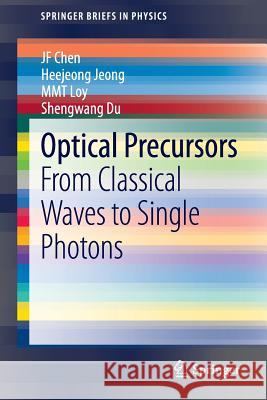
Michael Loy; Shengwang Du; Jiefei Chen
Optical Precursors: From Classical Waves to Single Photons Chen, Jiefei 9789814451932 Springer - książkaWidoczna okładka, to zdjęcie poglądowe, a rzeczywista szata graficzna może różnić się od prezentowanej.

Optical Precursors: From Classical Waves to Single Photons

ISBN-13: 9789814451932 / Angielski / Miękka / 2013 / 79 str.

Michael Loy; Shengwang Du; Jiefei Chen
cena 201,24
(netto: 191,66 VAT:  5%)

Najniższa cena z 30 dni: 192,74
Termin realizacji zamówienia:
ok. 22 dni roboczych.

Darmowa dostawa!

Ever since Einstein's special relativity in 1905, the principle of invariant light speed in vacuum has been attracting attention from a wide range of disciplines. How to interpret the principle of light speed? Is light referred to continuous light, or light pulse with definite boundaries? Recent discovery of superluminal medium triggered vigorous discussion within the Physics community. Can communication via such "superluminal channel" break the speed limit and thus violate causality principle? Or, will a single photon, which is not governed by classical laws of Physics, tend to break the speed limit? To solve these problems, this Brief brings in Optical Precursors, the theoretical works for which started as early as 1914. This is a typical optical phenomenon combining wave propagation theory and light-wave interaction. Both theory and experimental works are covered in this Brief. The study of precursor verifies that the effective information carried by light pulses can never exceed the speed of light in vacuum- c. Further, through observation from nonclassical single photon source, the precursor rules out the probability of a single photon traveling with the speed, breaking the classical limit.


Kategorie:
Nauka, Fizyka
Kategorie BISAC:
Science > Prąd
Science > Fizyka atomowa i molekularna
Science > Optyka
Wydawca:
Springer
Seria wydawnicza:
Springerbriefs in Physics
Język:
Angielski
ISBN-13:
9789814451932
Rok wydania:
2013
Wydanie:
2013
Numer serii:
000417619
Ilość stron:
79
Waga:
0.14 kg
Wymiary:
22.61 x 15.49 x 1.02
Oprawa:
Miękka
Wolumenów:
01
Dodatkowe informacje:
Wydanie ilustrowane

Introduction.- Theory of optical precursors.- Searching for precursors: From microwave to primary optical experiments.- Observation of optical precursors in cold atoms.- Optical precursor of a single photon.- Discussion and outlook.

Professor Michael Loy earned both his BSc (1966) and PhD (1971) degrees at the University of California at Berkeley. He joined HKUST in 1993 as Professor of Physics and served as Dean of Science from 1998 to 2004. Before coming to HKUST, Professor Loy worked for more than 20 years at IBM's T. J. Watson Research Center in New York. He is a Fellow of the American Physical Society. He is also a member of the Optical Society of America. His main research interests include nonlinear optical propagation effects, two-photon coherent transients, nonlinear optical studies of surfaces, the state-selective studies of molecule-surface interactions. His recent work involves desorption of molecules from surfaces induced by femtosecond laser pulses.

Prof Shengwang Du joined HKUST's Department of Physics as an Assistant Professor in 2008. He obtained BS in Electrical Engineering from Nanjing University, MS in Physics from Peking University, MS in Electrical Engineering and PhD in Physics from the University of Colorado at Boulder. He had been a Postdoctoral Scholar at Stanford University before joining HKUST.

Prof. Jiefei Chen obtained her PhD in Physics from the Hong Kong University of Science and Technology and is currently Professor in the Department of Physics at the East China Normal University. Her areas of interest are Atomic and Molecular Optics, Quantum optics, and Nonlinear Optics.

Dr. Heejeong Jeong is a Research Staff Member at the Samsung Advanced Institute of Technology in Yong-in, Korea. She received her Ph.D. degree from the Physics Dept. at Duke Univ., Durham, NC in 2006 for her study of the Optical Precursors using cold potassium atoms, under the supervision of Dr. Daniel J. Gauthier. She continued her research of Optical Precursors for two years at Thayer School of Engineering, Dartmouth College as a Postdoctoral Research Associate. In 2008, she joined Samsung Electronics (Suwon, Korea) and moved to SAIT to carry out research and development of next generation optoelectronic devices.

Ever since Einstein’s special relativity in 1905, the principle of invariant light speed in vacuum has been attracting attention from a wide range of disciplines. How to interpret the principle of light speed? Is light referred to continuous light, or light pulse with definite boundaries? Recent discovery of superluminal medium triggered vigorous discussion within the Physics community. Can communication via such “superluminal channel” break the speed limit and thus violate causality principle? Or, will a single photon, which is not governed by classical laws of Physics, tend to break the speed limit? To solve these problems, in this Brief we bring in optical precursor, the theoretical works for which started as early as 1914. This is a typical optical phenomenon combining wave propagation theory and light-wave interaction. Both theory and experimental works are covered in this Brief. The study of precursor verifies that the effective information carried by light pulses can never exceed the speed of light in vacuum- c. Further, through observation from nonclassical single photon source, the precursor rules out the probability of a single photon traveling with the speed, breaking the classical limit.




Udostępnij

Facebook - konto krainaksiazek.pl


Opinie o Krainaksiazek.pl na Opineo.pl

Partner Mybenefit

Krainaksiazek.pl w programie rzetelna firma Krainaksiaze.pl - płatności przez paypal

Czytaj nas na:

Facebook - krainaksiazek.pl
  • książki na zamówienie
  • granty
  • książka na prezent
  • kontakt
  • pomoc
  • opinie
  • regulamin
  • polityka prywatności

Zobacz:

  • Księgarnia czeska

  • Wydawnictwo Książkowe Klimaty

1997-2026 DolnySlask.com Agencja Internetowa

© 1997-2022 krainaksiazek.pl
     
KONTAKT | REGULAMIN | POLITYKA PRYWATNOŚCI | USTAWIENIA PRYWATNOŚCI
Zobacz: Księgarnia Czeska | Wydawnictwo Książkowe Klimaty | Mapa strony | Lista autorów
KrainaKsiazek.PL - Księgarnia Internetowa

Polityka prywatnosci - link
Krainaksiazek.pl - płatnośc Przelewy24
Przechowalnia Przechowalnia




