• Wyszukiwanie zaawansowane
  • Kategorie
  • Kategorie BISAC
  • Książki na zamówienie
  • Promocje
  • Granty
  • Książka na prezent
  • Opinie
  • Pomoc
  • Załóż konto
  • Zaloguj się

Ontology of Communication: Agent-Based Data-Driven or Sign-Based Substitution-Driven? » książka


zaloguj się | załóż konto
Logo Krainaksiazek.pl

koszyk

konto

szukaj
topmenu
Księgarnia internetowa
Szukaj
Książki na zamówienie
Promocje
Granty
Książka na prezent
Moje konto
Pomoc
 
 
Wyszukiwanie zaawansowane
Pusty koszyk
Bezpłatna dostawa dla zamówień powyżej 20 złBezpłatna dostawa dla zamówień powyżej 20 zł

Kategorie główne

• Nauka
 [2946912]
• Literatura piękna
 [1852311]

  więcej...
• Turystyka
 [71421]
• Informatyka
 [150889]
• Komiksy
 [35717]
• Encyklopedie
 [23177]
• Dziecięca
 [617324]
• Hobby
 [138808]
• AudioBooki
 [1671]
• Literatura faktu
 [228371]
• Muzyka CD
 [400]
• Słowniki
 [2841]
• Inne
 [445428]
• Kalendarze
 [1545]
• Podręczniki
 [166819]
• Poradniki
 [480180]
• Religia
 [510412]
• Czasopisma
 [525]
• Sport
 [61271]
• Sztuka
 [242929]
• CD, DVD, Video
 [3371]
• Technologie
 [219258]
• Zdrowie
 [100961]
• Książkowe Klimaty
 [124]
• Zabawki
 [2341]
• Puzzle, gry
 [3766]
• Literatura w języku ukraińskim
 [255]
• Art. papiernicze i szkolne
 [7810]
Kategorie szczegółowe BISAC

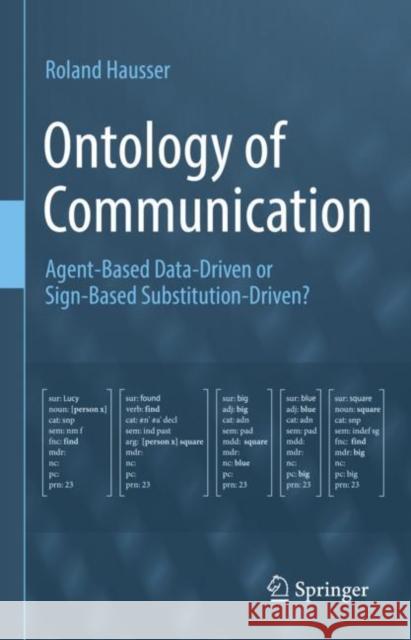
Ontology of Communication: Agent-Based Data-Driven or Sign-Based Substitution-Driven?

ISBN-13: 9783031227387 / Angielski / Twarda / 2023 / 258 str.
Roland Hausser
Ontology of Communication: Agent-Based Data-Driven or Sign-Based Substitution-Driven? Roland Hausser 9783031227387 Springer - książkaWidoczna okładka, to zdjęcie poglądowe, a rzeczywista szata graficzna może różnić się od prezentowanej.

Ontology of Communication: Agent-Based Data-Driven or Sign-Based Substitution-Driven?

ISBN-13: 9783031227387 / Angielski / Twarda / 2023 / 258 str.

Roland Hausser
cena 644,07
(netto: 613,40 VAT:  5%)

Najniższa cena z 30 dni: 616,85
Termin realizacji zamówienia:
ok. 22 dni roboczych
Bez gwarancji dostawy przed świętami

Darmowa dostawa!
inne wydania

The book gives a comprehensive discussion of Database Semantics (DBS) as an agent-based data-driven theory of how natural language communication essentially works. In language communication, agents switch betweenspeak mode, driven by cognition-internal content (input) resulting in cognition-external raw data (e.g. sound waves or pixels, which have no meaning or grammatical properties but can be measured by natural science), andhear mode, driven by the raw data produced by the speaker resulting in cognition-internal content.The motivation is to compare two approaches for an ontology of communication: agent-based data-driven vs. sign-based substitution-driven.Agent-basedmeans: design of a cognitive agent with (i) an interface component for converting raw data into cognitive content (recognition) and converting cognitive content into raw data (action), (ii) an on-board, content-addressable memory (database) for the storage and content retrieval, (iii) separate treatments of the speak and the hear mode.Data-drivenmeans: (a) mapping a cognitive content as input to the speak-mode into a language-dependent surface as output, (b) mapping a surface as input to the hear-mode into a cognitive content as output. Oppositely,sign-basedmeans: no distinction between speak and hear mode, whereassubstitution-drivenmeans: using a single start symbol as input for generating infinitely many outputs, based on substitutions by rewrite rules.Collecting recent research of the author, this beautiful, novel and original exposition begins with an introduction to DBS, makes a linguistic detour on subject/predicate gapping and slot-filler repetition, and moves on to discuss computational pragmatics, inference and cognition, grammatical disambiguation and other related topics. The book is mostly addressed to experts working in the field of computational linguistics, as well as to enthusiasts interested in the history and early development of this subject, starting with the pre-computational foundations of theoretical computer science and symbolic logic in the 30s.

The book gives a comprehensive discussion of Database Semantics (DBS) as an agent-based data-driven theory of how natural language communication essentially works. In language communication, agents switch between speak mode, driven by cognition-internal content (input) resulting in cognition-external raw data (e.g. sound waves or pixels, which have no meaning or grammatical properties but can be measured by natural science), and hear mode, driven by the raw data produced by the speaker resulting in cognition-internal content.



The motivation is to compare two approaches for an ontology of communication: agent-based data-driven vs. sign-based substitution-driven. Agent-based means: design of a cognitive agent with (i) an interface component for converting raw data into cognitive content (recognition) and converting cognitive content into raw data (action), (ii) an on-board, content-addressable memory (database) for the storage and content retrieval, (iii) separate treatments of the speak and the hear mode. Data-driven means: (a) mapping a cognitive content as input to the speak-mode into a language-dependent surface as output, (b) mapping a surface as input to the hear-mode into a cognitive content as output. Oppositely, sign-based means: no distinction between speak and hear mode, whereas substitution-driven means: using a single start symbol as input for generating infinitely many outputs, based on substitutions by rewrite rules.
Collecting recent research of the author, this beautiful, novel and original exposition begins with an introduction to DBS, makes a linguistic detour on subject/predicate gapping and slot-filler repetition, and moves on to discuss computational pragmatics, inference and cognition, grammatical disambiguation and other related topics. The book is mostly addressed to experts working in the field of computational linguistics, as well as to enthusiasts interested in the history and early development of this subject, starting with the pre-computational foundations of theoretical computer science and symbolic logic in the 30s.

Kategorie:
Informatyka, Bazy danych
Kategorie BISAC:
Language Arts & Disciplines > Linguistics - General
Computers > Speech & Audio Processing
Computers > Artificial Intelligence - Expert Systems
Wydawca:
Springer
Język:
Angielski
ISBN-13:
9783031227387
Rok wydania:
2023
Dostępne języki:
Ilość stron:
258
Oprawa:
Twarda
Dodatkowe informacje:
Wydanie ilustrowane

1. Introduction 

1.1 Ontology 
1.2 Computational Cognition
1.3 Agent-Based Data-Driven vs. Sign-Based Substitution-Driven 
1.4 Reconciling the Hierarchical and the Linear 
1.5 Speak Mode Converts Hierarchy into Linear Surface 
1.6 Hear Mode Re-Converts Linear Input into Hierarchical Output 
1.7 Derivation Order 
1.8 Type Transparency 
1.9 Four Kinds of Type-Token Relations 
1.10 Conclusion 
2. Laboratory Set-up of Database Semantics 
2.1 Early Times 
2.2 Study of the Language Signs 
2.3 Using Successful Communication for the Laboratory Set-Up 
2.4 From Operational Implementation to Declarative Specification 
2.5 Formal Fragments of Natural Language 
2.6 Incremental Upscaling Cycles 
2.7 Conclusion 
3. Outline of DBS 
3.1 Building Content in the Agent’s Hear Mode
3.2 Storage and Retrieval of Content in the On-Board Memory 
3.3 Speak Mode Riding Piggyback on the Think Mode 
3.4 Component Structure of Cognition 
3.5 Sensory Media, Processing Media, and Their Modalities 
3.6 Reference as a Purely Cognitive Process 
3.7 Grounding 
3.8 Conclusion 
4. Software Mechanisms of the Content Kinds 
4.1 Apparent Terminological Redundancy
4.2 Restriction of Figurative Use to Concepts 
4.3 Additional Constraint on Figurative Use 
4.4 Declarative Specification Of Concepts for Recognition 
4.5 Declarative Specification of Concepts for Action
4.6 Indirect Grounding of Indexicals and Names 
4.7 Conclusion 
5. Comparison of Coordination and Gapping 
5.1 Coordination of Elementary Adnominals 
5.2 Coordination of Phrasal Adnominal Modifiers 
5.3 Coordination of Phrasal Adverbial Modifiers 
5.4 Coordination of Elementary Nouns as Subject 
5.5 Intra- and Extrapropositional Verb Coordination 
5.6 Extrasentential Coordination 
5.7 Quasi Coordination in Subject Gapping 
5.8 Quasi Coordination in Predicate Gapping 
5.9 Quasi Coordination in Object Gapping 
5.10 Conclusion 
6. Are Iterating Slot-Filler Structures Universal? 
6.1 Language and Thought 
6.2 Slot-Filler Iteration 
6.3 Marked Slot-Filler Repetition in Infinitives
6.4 Marked Slot-Filler Repetition in Object Clauses 
6.5 Marked Slot-Filler Repetition in Adnominal Clauses 
6.6 Unmarked Slot-Filler Iteration in Gapping Constructions 
6.7 Long-Distance Dependency 
6.8 Conclusion 
7. Computational Pragmatics
7.1 Four Kinds of Content in DBS 
7.2 Coactivation Resulting in Resonating Content 
7.3 Literal Pragmatics of Adjusting Perspective
7.4 Nonliteral Pragmatics of Syntactic Mood Adaptation 
7.5 Nonliteral Pragmatics of Figurative Use
7.6 Conclusion
8. Discontinuous Structures in DBS and PSG
8.1 The Time-Linear Structure of Natural Language 
8.2 Constituent Structure Paradox of PSG
8.3 Suspension in Database Semantics 
8.4 Discontinuity with and without Suspension in DBS 
8.5 Conclusion 
9. Classical Syllogisms as Computational Inferences 
9.1 Logical vs. Common Sense Reasoning
9.2 Categorical Syllogisms 
9.3 Modus Ponendo Ponens 
9.4 Modus Tollendo Tollens 
9.5 Modi BARBARA and CELARENT
9.6 Modi DARII and FERIO 
9.7 Modi BAROCO and BOCARDO 
9.8 Combining S- and C-Inferencing 
9.9 Analogy 
9.10 Conclusion 
10. Grounding of Concepts in Science 
10.1 The Place of Concepts in a Content 
10.2 Definition of Concepts at the Elementary, Phrasal, or Clausal Level? 
10.3 Extending a Concept to its Class 
10.4 Language Communication
10.5 Combining Concepts into Content 
10.6 Language Surfaces and Meaning_1 Concepts in Communication 
10.7 Extero- and Interoception 
10.8 Emotion 
10.9 Conclusion 
11. Function Words 
11.1 Introduction
11.2 Interpreting Determiner Noun Combination in Hear Mode 
11.3 Producing Determiner Noun Combination in Speak Mode 
11.4 Prepositional Phrases
11.5 Auxiliaries 
11.6 Subordinating Conjunctions 
11.7 Coordinating Conjunctions 
11.8 Conclusion 
12. Language vs. Nonlanguage Cognition 
12.1 Building Blocks and Relations of Cognition 
12.2 Example of a Content 
12.3 Content as Input to the Speak Mode 
12.4 Content as Output of the Hear Mode 
12.5 Nonlanguage Cognition Provides Place Holder Values 
12.6 Function Word Absorbs Content Word
12.7 Type-Token Matching in Recognition and Action 
12.8 Language Communication 
12.9 Conclusion 
13. Grammatical Disambiguation 
13.1 Degrees of Computational Complexity 
13.2 Orthogonal LAG and PSG Complexity Hierarchies 
13.3 Comparing Explicitly Defined Examples in PSG and DBS 
13.4 Sub-Hierarchy of C1, C2, and C3 Lags
13.5 Applying LAG to Natural Language 
13.6 From LAG to the Hear Mode 
13.7 From the Hear Mode to the Speak Mode
13.8 Incremental Lexical Lookup in the Hear Mode .
13.9 Ambiguity in Natural Language 
13.10 Language Dependence of Grammatical Disambiguation 
13.11 Bach-Peters Sentence 
13.12 Conclusion 
14. Database Semantics vs. Predicate Calculus 
14.1 Definition of Predicate Calculus
14.2 PredC Overgeneration 
14.3 Determiners 
14.4 PredC Undergeneration 
14.5 Coreference by Address 
14.6 In PredC, Propositions Denote Truth Values
14.7 In Database Semantics, Propositions Are Content 
14.8 Extending PredC to Possible Worlds 
14.9 Semantic Relations of Structure 
14.10 Properties Common to Hear, Think, and Think-Speak Operations
14.11 Hear Mode Operations 
14.12 Activation in the Think and Think-Speak Modes
14.13 Inferencing 
14.14 Conclusion 
15. Agent-Based Memory as an On-board Database 
15.1 Input-Output of Conventional Database vs. On-Board Memory 
15.2 Data Structure and Operations in a Record-Based Database
15.3 Data Structure and Operations 
15.4 The On-Board Orientation System (OBOS) 
15.5 Loom-Like Clearance of the Now Front 
15.6 Resonating Content 1: Coactivation by Similarity 
15.7 Resonating Content 2: Coactivation by Token Line Intersection
15.8 Resonating Content 3: Coactivation by Continuation 
15.9 Memory-Based Concatenation in Nonlanguage Recognition 
15.10 Conclusion 
16. David Hume’s ‘Causation’ in Database Semantics 
16.1 Asymmetry in Natural Coordination 
16.2 Cause and Effect 
16.3 Necessary, Unnecessary, Sufficient, and Insufficient Causes 
16.4 Hume’s Copy Principle
16.5 Reconstruction of Elementary Recognition and Action
16.6 Computational Reconstruction of Complex Content 
16.7 From Individual Contents to a Content Class
16.8 Four Different Kinds of Content 
16.9 Accommodating Scenarios in DBS
16.10 Conclusion 
17. Concepts in Computational Cognition 
17.1 Concept-Based Interpretation of Indexicals and Names 
17.2 Concepts Grounded in Science 
17.3 ‘Natural Categories’ as Concepts 
17.4 Technical Concepts as a Subclass of ‘Natural Categories’ 
17.5 Grammatical Categories 
17.6 Hear Mode: Concatenating Proplets into Complex Content 
17.7 Speak Mode: Linearization of a Content by Navigation 
17.8 Natural Language Communication in Speech and Writing
17.9 Conclusion 
18. Paraphrase and ambiguity
18.1 Introduction: the Structure of Content 
18.2 Speak Mode Paraphrase: Different Surfaces for Same Content 
18.3 DBS Formalism for the Speak Mode (Language Production) 
18.4 Hear Mode Ambiguity: Different Contents for Same Surface
18.5 Ambiguity is Language-Dependent 
18.6 Grammatical Analysis of Ambiguity 
18.7 Local vs. Global Ambiguities
18.8 Iterating Local Ambiguities 
18.9 Conclusion
19. Recursion and Grammatical Disambiguation 
19.1 Speak Mode in Database Semantics 
19.2 Hear Mode in Database Semantics 
19.3 Recursion 
19.4 Conclusion 
Name Index
Bibliography 

Roland Hausser is Professor Emeritus for Theoretical and Computational Linguistics at the University Erlangen-Nürnberg and former director of its Laboratory of Computational Linguistics (CLUE), between 1989 and 2011. After obtaining his PhD at the University of Texas at Austin, the author held various positions at Carnegie Mellon, Stanford University or Ludwig-Maximilians-Universität München.

Prof. Hausser has been active and made significant contributions in the fields of Theoretical and Computational Linguistics, Human-Computer Interaction, Formal Grammars and Database Semantics. His research resulted in around 40 journal papers and conference proceedings, and he is the author of the Springer books “Foundations of Computational Linguistics”, “A Computational Model of Natural Language Communication” and “Computational Linguistics and Talking Robots”.

The book gives a comprehensive discussion of Database Semantics (DBS) as an agent-based data-driven theory of how natural language communication essentially works. In language communication, agents switch between speak mode, driven by cognition-internal content (input) resulting in cognition-external raw data (e.g. sound waves or pixels, which have no meaning or grammatical properties but can be measured by natural science), and hear mode, driven by the raw data produced by the speaker resulting in cognition-internal content.


The motivation is to compare two approaches for an ontology of communication: agent-based data-driven vs. sign-based substitution-driven. Agent-based means: design of a cognitive agent with (i) an interface component for converting raw data into cognitive content (recognition) and converting cognitive content into raw data (action), (ii) an on-board, content-addressable memory (database) for the storage and content retrieval, (iii) separate treatments of the speak and the hear mode. Data-driven means: (a) mapping a cognitive content as input to the speak-mode into a language-dependent surface as output, (b) mapping a surface as input to the hear-mode into a cognitive content as output. Oppositely, sign-based means: no distinction between speak and hear mode, whereas substitution-driven means: using a single start symbol as input for generating infinitely many outputs, based on substitutions by rewrite rules.

Collecting recent research of the author, this beautiful, novel and original exposition begins with an introduction to DBS, makes a linguistic detour on subject/predicate gapping and slot-filler repetition, and moves on to discuss computational pragmatics, inference and cognition, grammatical disambiguation and other related topics. The book is mostly addressed to experts working in the field of computational linguistics, as well as to enthusiasts interested in the history and early development of this subject, starting with the pre-computational foundations of theoretical computer science and symbolic logic in the 30s.


Udostępnij

Facebook - konto krainaksiazek.pl


Opinie o Krainaksiazek.pl na Opineo.pl

Partner Mybenefit

Krainaksiazek.pl w programie rzetelna firma Krainaksiaze.pl - płatności przez paypal

Czytaj nas na:

Facebook - krainaksiazek.pl
  • książki na zamówienie
  • granty
  • książka na prezent
  • kontakt
  • pomoc
  • opinie
  • regulamin
  • polityka prywatności

Zobacz:

  • Księgarnia czeska

  • Wydawnictwo Książkowe Klimaty

1997-2025 DolnySlask.com Agencja Internetowa

© 1997-2022 krainaksiazek.pl
     
KONTAKT | REGULAMIN | POLITYKA PRYWATNOŚCI | USTAWIENIA PRYWATNOŚCI
Zobacz: Księgarnia Czeska | Wydawnictwo Książkowe Klimaty | Mapa strony | Lista autorów
KrainaKsiazek.PL - Księgarnia Internetowa

Polityka prywatnosci - link
Krainaksiazek.pl - płatnośc Przelewy24
Przechowalnia Przechowalnia



