• Wyszukiwanie zaawansowane
  • Kategorie
  • Kategorie BISAC
  • Książki na zamówienie
  • Promocje
  • Granty
  • Książka na prezent
  • Opinie
  • Pomoc
  • Załóż konto
  • Zaloguj się

One-Dimensional Finite Elements: An Introduction to the Method » książka


zaloguj się | załóż konto
Logo Krainaksiazek.pl

koszyk

konto

szukaj
topmenu
Księgarnia internetowa
Szukaj
Książki na zamówienie
Promocje
Granty
Książka na prezent
Moje konto
Pomoc
 
 
Wyszukiwanie zaawansowane
Pusty koszyk
Bezpłatna dostawa dla zamówień powyżej 20 złBezpłatna dostawa dla zamówień powyżej 20 zł

Kategorie główne

• Nauka
 [2946600]
• Literatura piękna
 [1856966]

  więcej...
• Turystyka
 [72221]
• Informatyka
 [151456]
• Komiksy
 [35826]
• Encyklopedie
 [23190]
• Dziecięca
 [619653]
• Hobby
 [140543]
• AudioBooki
 [1577]
• Literatura faktu
 [228355]
• Muzyka CD
 [410]
• Słowniki
 [2874]
• Inne
 [445822]
• Kalendarze
 [1744]
• Podręczniki
 [167141]
• Poradniki
 [482898]
• Religia
 [510455]
• Czasopisma
 [526]
• Sport
 [61590]
• Sztuka
 [243598]
• CD, DVD, Video
 [3423]
• Technologie
 [219201]
• Zdrowie
 [101638]
• Książkowe Klimaty
 [124]
• Zabawki
 [2473]
• Puzzle, gry
 [3898]
• Literatura w języku ukraińskim
 [254]
• Art. papiernicze i szkolne
 [8170]
Kategorie szczegółowe BISAC

One-Dimensional Finite Elements: An Introduction to the Method

ISBN-13: 9783662667576 / Angielski
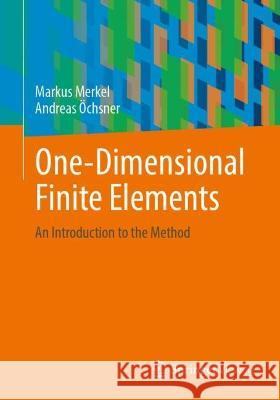
Markus Merkel; Andreas Öchsner
One-Dimensional Finite Elements: An Introduction to the Method Markus Merkel Andreas ?chsner 9783662667576 Springer Vieweg - książkaWidoczna okładka, to zdjęcie poglądowe, a rzeczywista szata graficzna może różnić się od prezentowanej.

One-Dimensional Finite Elements: An Introduction to the Method

ISBN-13: 9783662667576 / Angielski

Markus Merkel; Andreas Öchsner
cena 484,18 zł
(netto: 461,12 VAT:  5%)

Najniższa cena z 30 dni: 424,07 zł
Termin realizacji zamówienia:
ok. 22 dni roboczych
Bez gwarancji dostawy przed świętami

Darmowa dostawa!

The basic idea of this introduction to the finite element method is based on the concept of explaining the complex method using only one-dimensional elements. Thus, the mathematical description remains largely simple and straightforward. The emphasis in each chapter is on explaining the method and understanding it itself. The reader learns to understand the assumptions and derivations in various physical problems in structural mechanics and to critically assess the possibilities and limitations of the finite element method.The restriction to one-dimensional elements thus enables the methodical understanding of important topics (e.g. plasticity or composite materials), which a prospective computational engineer encounters in professional practice, but which are rarely treated in this form at universities. Thus, an easy entry - also into more advanced application areas - is ensured by the concept of (a) introduction to the basics (b) exact derivation with restriction to one-dimensional elements (and in many cases also to one-dimensional problems) (c) extensive examples and advanced tasks (with short solution in the appendix).For illustration purposes, each chapter is deepened with extensively calculated and commented examples as well as with further tasks including short solutions


The basic idea of this introduction to the finite element method is based on the concept of explaining the complex method using only one-dimensional elements. Thus, the mathematical description remains largely simple and straightforward. The emphasis in each chapter is on explaining the method and understanding it itself. The reader learns to understand the assumptions and derivations in various physical problems in structural mechanics and to critically assess the possibilities and limitations of the finite element method.
The restriction to one-dimensional elements thus enables the methodical understanding of important topics (e.g. plasticity or composite materials), which a prospective computational engineer encounters in professional practice, but which are rarely treated in this form at universities. Thus, an easy entry - also into more advanced application areas - is ensured by the concept of (a) introduction to the basics (b) exact derivation with restriction to one-dimensional elements (and in many cases also to one-dimensional problems) (c) extensive examples and advanced tasks (with short solution in the appendix).For illustration purposes, each chapter is deepened with extensively calculated and commented examples as well as with further tasks including short solutions

Kategorie:
Technologie
Kategorie BISAC:
Science > Mechanics - Solids
Technology & Engineering > Industrial Design - Product
Wydawca:
Springer Vieweg
Język:
Angielski
ISBN-13:
9783662667576

Introduction.- Motivation to the finite element method.- Beam element.- Analogies to the extension bar.- Bending element.- General 1D element.- Plane and spatial frame structures.- Beams with shear component.- Beams of composite material.- Nonlinear elasticity.- Plasticity.- Stability (buckling).- Dynamics.- Special elements.- Appendix.

Prof. Dr.-Ing. Markus Merkel

studied mechanical engineering at the University of Erlangen-Nuremberg and earned his doctorate there at the Chair of Engineering Mechanics. He has been a professor at Aalen University since 2004 and represents the finite element method in teaching.

Prof. Dr.-Ing. Andreas Öchsner

studied aerospace engineering at the University of Stuttgart and earned his doctorate at the University of Erlangen-Nuremberg. He has been a professor of mechanical engineering at Esslingen University of Applied Sciences since 2018 and is responsible, among other things, for training students in lightweight construction and structural simulation.

In this introduction, the finite element method is broken down in its complexity to one-dimensional elements. Thus, the mathematical description remains largely simple and manageable.

The emphasis in each chapter is on explaining the method and understanding it. Readers learn to understand the assumptions and derivations in various physical problems in structural mechanics and to critically evaluate the possibilities and limitations of the finite element method.

This approach enables the methodical understanding of important topics, such as plasticity or composites, and ensures an easy entry into more advanced application areas. Detailed calculated and commented examples and further tasks with short solutions in the appendix support the learning success.

In the third edition of this textbook, the basic concept for the treatment of the finite element method with one-dimensional problems has been retained. Additionally, thermoelasticity has been included, as well as numerous tasks with solutions supplemented.

The content

Introduction.- Motivation to the finite element method.- Beam element.- Analogies to the extension bar.- Bending element.- General 1D element.- Plane and spatial frame structures.- Beams with shear component.- Beams of composite material.- Nonlinear elasticity.- Plasticity.- Stability (buckling).- Dynamics.- Special elements.- Appendix.

The target groups

Students and computational engineers in professional practice

The authors

Prof. Dr.-Ing. Markus Merkel

studied mechanical engineering at the University of Erlangen-Nuremberg and earned his doctorate there at the Chair of Engineering Mechanics. He has been a professor at Aalen University since 2004 and represents the finite element method in teaching.

Prof. Dr.-Ing. Andreas Öchsner

studied aerospace engineering at the University of Stuttgart and earned his doctorate at the University of Erlangen-Nuremberg. He has been a professor of mechanical engineering at Esslingen University of Applied Sciences since 2018 and is responsible, among other things, for training students in lightweight construction and structural simulation.

This book is a translation of an original German edition. The translation was done with the help of artificial intelligence (machine translation by the service DeepL.com). A subsequent human revision was done primarily in terms of content, so that the book will read stylistically differently from a conventional translation.


Udostępnij

Facebook - konto krainaksiazek.pl


Opinie o Krainaksiazek.pl na Opineo.pl

Partner Mybenefit

Krainaksiazek.pl w programie rzetelna firma Krainaksiaze.pl - płatności przez paypal

Czytaj nas na:

Facebook - krainaksiazek.pl
  • książki na zamówienie
  • granty
  • książka na prezent
  • kontakt
  • pomoc
  • opinie
  • regulamin
  • polityka prywatności

Zobacz:

  • Księgarnia czeska

  • Wydawnictwo Książkowe Klimaty

1997-2025 DolnySlask.com Agencja Internetowa

© 1997-2022 krainaksiazek.pl
     
KONTAKT | REGULAMIN | POLITYKA PRYWATNOŚCI | USTAWIENIA PRYWATNOŚCI
Zobacz: Księgarnia Czeska | Wydawnictwo Książkowe Klimaty | Mapa strony | Lista autorów
KrainaKsiazek.PL - Księgarnia Internetowa

Polityka prywatnosci - link
Krainaksiazek.pl - płatnośc Przelewy24
Przechowalnia Przechowalnia




