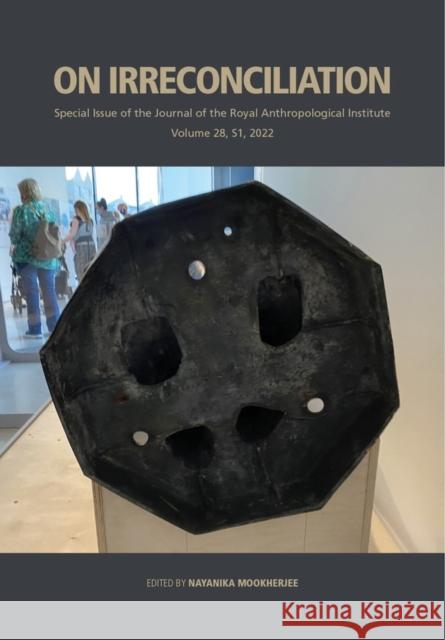
1. Introduction - On Irreconciliation: Nayanika Mookherjee (Durham University)2. Being held accountable: why attributing responsibility matters: Lisette Josephides (Queens University, Belfast)3. Civil war and the non-linearity of time: Approaching a Mozambican politics of irreconciliation: Bjørn Enge Bertelsen (University of Bergen)4. 'I was celebrating the justice the victims got'; exploring irreconciliation among Bangladeshi human rights activists in London: Jacco Visser (Aarhus University)5. Perpetration, Impunity and Irreconciliation in Canada's TRC on Indian Residential Schools: Ronald Niezen (McGill University)6. Irreconciliation, Reciprocity, and Social Change (Afterword 1): Professor Richard Wilson (University of Connecticut)7. Irreconciliation as Practice: Resisting Impunity and Closure in Argentina: Noa Vaisman (Aarhus University)8. Absence in Technicolour: Protesting Enforced Disappearances in Northern Sri Lanka: Vindhya Buthpitiya (University College London)9. Rendering the Absent Visible: Victimhood and the Irreconciliability of Violence: Kamari Maxine Clarke (The University of California, Los Angeles)10. Irreconcilable Times: Nayanika Mookherjee (Durham University)11. Action beyond intent: experiencing ir/reconciliation (Afterword II): Professor Sara Schneiderman (University of British Columbia)
Nayanika Mookherjee is Professor of Political Anthropology and Co- Director of the Institute of Advanced Studies, at Durham University. Based on her book The Spectral Wound: Sexual Violence, Public Memories and the Bangladesh War of 1971 (2015), in 2019 she co-authored a graphic novel and animation film and received the 2019 Praxis Award from the Washington Association of Professional Anthropologists. Her research addresses gendered violence during conflict, debates on irreconciliation and transnational adoption. She has published extensively on anthropology of violence, ethics and aesthetics including editing and contributing to journal special issues on 'The Aesthetics of Nation' (2011) (with Christopher Pinney), 'The Self in South Asia,' (2013); Aesthetics, Politics and Conflict (2015) (with Tariq Jazeel). She has had fellowships with ESRC, Wenner-Gren Foundation for Anthropological Research, British Academy, Leverhulme and the Rockerfeller Foundation at Bellagio. In 2017, she co-founded and co-chaired Durham University's first Black, Asian and Minority Ethnic (BAME) staff and postgraduate students' network.