• Wyszukiwanie zaawansowane
  • Kategorie
  • Kategorie BISAC
  • Książki na zamówienie
  • Promocje
  • Granty
  • Książka na prezent
  • Opinie
  • Pomoc
  • Załóż konto
  • Zaloguj się

Ocaml Scientific Computing: Functional Programming in Data Science and Artificial Intelligence » książka


zaloguj się | załóż konto
Logo Krainaksiazek.pl

koszyk

konto

szukaj
topmenu
Księgarnia internetowa
Szukaj
Książki na zamówienie
Promocje
Granty
Książka na prezent
Moje konto
Pomoc
 
 
Wyszukiwanie zaawansowane
Pusty koszyk
Bezpłatna dostawa dla zamówień powyżej 20 złBezpłatna dostawa dla zamówień powyżej 20 zł

Kategorie główne

• Nauka
 [2949965]
• Literatura piękna
 [1857847]

  więcej...
• Turystyka
 [70818]
• Informatyka
 [151303]
• Komiksy
 [35733]
• Encyklopedie
 [23180]
• Dziecięca
 [617748]
• Hobby
 [139972]
• AudioBooki
 [1650]
• Literatura faktu
 [228361]
• Muzyka CD
 [398]
• Słowniki
 [2862]
• Inne
 [444732]
• Kalendarze
 [1620]
• Podręczniki
 [167233]
• Poradniki
 [482388]
• Religia
 [509867]
• Czasopisma
 [533]
• Sport
 [61361]
• Sztuka
 [243125]
• CD, DVD, Video
 [3451]
• Technologie
 [219309]
• Zdrowie
 [101347]
• Książkowe Klimaty
 [123]
• Zabawki
 [2362]
• Puzzle, gry
 [3791]
• Literatura w języku ukraińskim
 [253]
• Art. papiernicze i szkolne
 [7933]
Kategorie szczegółowe BISAC

Ocaml Scientific Computing: Functional Programming in Data Science and Artificial Intelligence

ISBN-13: 9783030976446 / Angielski / Miękka / 2022
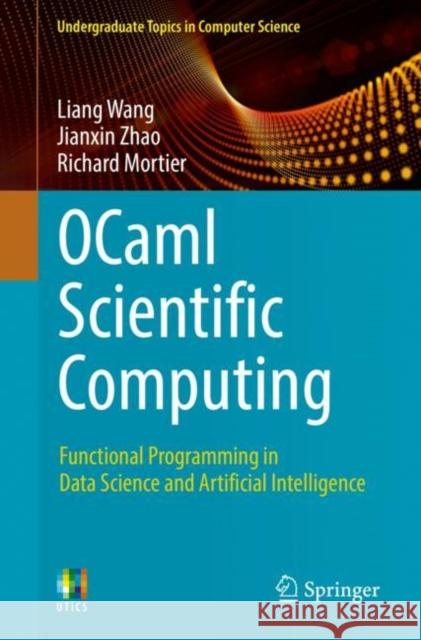
Liang Wang;Jianxin Zhao;Richard Mortier
Ocaml Scientific Computing: Functional Programming in Data Science and Artificial Intelligence Wang, Liang 9783030976446 Springer International Publishing - książkaWidoczna okładka, to zdjęcie poglądowe, a rzeczywista szata graficzna może różnić się od prezentowanej.

Ocaml Scientific Computing: Functional Programming in Data Science and Artificial Intelligence

ISBN-13: 9783030976446 / Angielski / Miękka / 2022

Liang Wang;Jianxin Zhao;Richard Mortier
cena 201,72 zł
(netto: 192,11 VAT:  5%)

Najniższa cena z 30 dni: 192,74 zł
Termin realizacji zamówienia:
ok. 22 dni roboczych
Bez gwarancji dostawy przed świętami

Darmowa dostawa!

This book is about the harmonious synthesis of functional programming and numerical computation. It shows how the expressiveness of OCaml allows for fast and safe development of data science applications. Step by step, the authors build up to use cases drawn from many areas of Data Science, Machine Learning, and AI, and then delve into how to deploy at scale, using parallel, distributed, and accelerated frameworks to gain all the advantages of cloud computing environments.To this end, the book is divided into three parts, each focusing on a different area. Part I begins by introducing how basic numerical techniques are performed in OCaml, including classical mathematical topics (interpolation and quadrature), statistics, and linear algebra. It moves on from using only scalar values to multi-dimensional arrays, introducing the tensor and Ndarray, core data types in any numerical computing system. It concludes with two more classical numerical computing topics, the solution of Ordinary Differential Equations (ODEs) and Signal Processing, as well as introducing the visualization module we use throughout this book. Part II is dedicated to advanced optimization techniques that are core to most current popular data science fields. We do not focus only on applications but also on the basic building blocks, starting with Algorithmic Differentiation, the most crucial building block that in turn enables Deep Neural Networks. We follow this with chapters on Optimization and Regression, also used in building Deep Neural Networks. We then introduce Deep Neural Networks as well as topic modelling in Natural Language Processing (NLP), two advanced and currently very active fields in both industry and academia. Part III collects a range of case studies demonstrating how you can build a complete numerical application quickly from scratch using Owl. The cases presented include computer vision and recommender systems. This book aims at anyone with a basic knowledge of functional programming and a desire to explore the world of scientific computing, whether to generally explore the field in the round, to build applications for particular topics, or to deep-dive into how numerical systems are constructed. It does not assume strict ordering in reading – readers can simply jump to the topic that interests them most. 

Kategorie:
Informatyka
Kategorie BISAC:
Computers > Data Science - General
Computers > Artificial Intelligence - Expert Systems
Computers > Information Theory
Wydawca:
Springer International Publishing
Seria wydawnicza:
Undergraduate Topics in Computer Science
Język:
Angielski
ISBN-13:
9783030976446
Rok wydania:
2022
Waga:
0.59 kg
Wymiary:
23.5 x 15.5
Oprawa:
Miękka
Dodatkowe informacje:
Wydanie ilustrowane

Part I: Numerical Techniques.- 1. Introduction.- 2. Numerical Algorithms.- 3. Statistics.- 4. Linear Algebra.- 5. N-Dimensional Arrays.- 6. Ordinary Differential Equations.- 7. Signal Processing.- Part II: Advanced Data Analysis Techniques.- 8. Algorithmic Differentiation.- 9. Optimisation.- 10. Regression.- 11. Neural Network.- 12. Vector Space Modelling.- Part III: Use Cases.- 13. Case Study: Image Recognition.- 14. Case Study: Instance Segmentation.- 15. Case Study: Neural Style Transfer.- 16. Case Study: Recommender System.

Liang Wang is a Principal AI Architect at Nokia, a Senior Researcher at the University of Cambridge, an Intel Software Innovator, and the Chief Scientific Officer at IKVA. He has a broad research interest in artificial intelligence, machine learning, operating systems, computer networks, optimization theory, and graph theory.

Jianxin Zhao is a PhD graduate from the University of Cambridge. His research interests include numerical computation, artificial intelligence, decentralized systems, and their application in the real world.

Richard Mortier is a Professor in Computing and Human-Data Interaction at the University of Cambridge. He works at the intersection of systems and networking with human-computer interaction, and he currently focuses on building user-centric systems infrastructure.


This book is about the harmonious synthesis of functional programming and numerical computation. It shows how the expressiveness of OCaml allows for fast and safe development of data science applications. Step by step, the authors build up to use cases drawn from many areas of Data Science, Machine Learning, and AI, and then delve into how to deploy at scale, using parallel, distributed, and accelerated frameworks to gain all the advantages of cloud computing environments.

To this end, the book is divided into three parts, each focusing on a different area. Part I begins by introducing how basic numerical techniques are performed in OCaml, including classical mathematical topics (interpolation and quadrature), statistics, and linear algebra. It moves on from using only scalar values to multi-dimensional arrays, introducing the tensor and Ndarray, core data types in any numerical computing system. It concludes with two more classical numerical computing topics, the solution of Ordinary Differential Equations (ODEs) and Signal Processing, as well as introducing the visualization module we use throughout this book. Part II is dedicated to advanced optimization techniques that are core to most current popular data science fields. We do not focus only on applications but also on the basic building blocks, starting with Algorithmic Differentiation, the most crucial building block that in turn enables Deep Neural Networks. We follow this with chapters on Optimization and Regression, also used in building Deep Neural Networks. We then introduce Deep Neural Networks as well as topic modelling in Natural Language Processing (NLP), two advanced and currently very active fields in both industry and academia. Part III collects a range of case studies demonstrating how you can build a complete numerical application quickly from scratch using Owl. The cases presented include computer vision and recommender systems.

This book aims at anyone with a basic knowledge of functional programming and a desire to explore the world of scientific computing, whether to generally explore the field in the round, to build applications for particular topics, or to deep-dive into how numerical systems are constructed. It does not assume strict ordering in reading – readers can simply jump to the topic that interests them most. 



Udostępnij

Facebook - konto krainaksiazek.pl


Opinie o Krainaksiazek.pl na Opineo.pl

Partner Mybenefit

Krainaksiazek.pl w programie rzetelna firma Krainaksiaze.pl - płatności przez paypal

Czytaj nas na:

Facebook - krainaksiazek.pl
  • książki na zamówienie
  • granty
  • książka na prezent
  • kontakt
  • pomoc
  • opinie
  • regulamin
  • polityka prywatności

Zobacz:

  • Księgarnia czeska

  • Wydawnictwo Książkowe Klimaty

1997-2025 DolnySlask.com Agencja Internetowa

© 1997-2022 krainaksiazek.pl
     
KONTAKT | REGULAMIN | POLITYKA PRYWATNOŚCI | USTAWIENIA PRYWATNOŚCI
Zobacz: Księgarnia Czeska | Wydawnictwo Książkowe Klimaty | Mapa strony | Lista autorów
KrainaKsiazek.PL - Księgarnia Internetowa

Polityka prywatnosci - link
Krainaksiazek.pl - płatnośc Przelewy24
Przechowalnia Przechowalnia





