• Wyszukiwanie zaawansowane
  • Kategorie
  • Kategorie BISAC
  • Książki na zamówienie
  • Promocje
  • Granty
  • Książka na prezent
  • Opinie
  • Pomoc
  • Załóż konto
  • Zaloguj się

Numerical Modelling of Material Deformation Processes: Research, Development and Applications » książka


zaloguj się | załóż konto
Logo Krainaksiazek.pl

koszyk

konto

szukaj
topmenu
Księgarnia internetowa
Szukaj
Książki na zamówienie
Promocje
Granty
Książka na prezent
Moje konto
Pomoc
 
 
Wyszukiwanie zaawansowane
Pusty koszyk
Bezpłatna dostawa dla zamówień powyżej 20 złBezpłatna dostawa dla zamówień powyżej 20 zł

Kategorie główne

• Nauka
 [2949965]
• Literatura piękna
 [1857847]

  więcej...
• Turystyka
 [70818]
• Informatyka
 [151303]
• Komiksy
 [35733]
• Encyklopedie
 [23180]
• Dziecięca
 [617748]
• Hobby
 [139972]
• AudioBooki
 [1650]
• Literatura faktu
 [228361]
• Muzyka CD
 [398]
• Słowniki
 [2862]
• Inne
 [444732]
• Kalendarze
 [1620]
• Podręczniki
 [167233]
• Poradniki
 [482388]
• Religia
 [509867]
• Czasopisma
 [533]
• Sport
 [61361]
• Sztuka
 [243125]
• CD, DVD, Video
 [3451]
• Technologie
 [219309]
• Zdrowie
 [101347]
• Książkowe Klimaty
 [123]
• Zabawki
 [2362]
• Puzzle, gry
 [3791]
• Literatura w języku ukraińskim
 [253]
• Art. papiernicze i szkolne
 [7933]
Kategorie szczegółowe BISAC

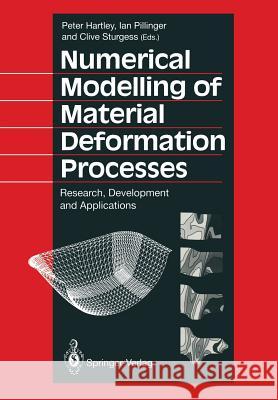
Numerical Modelling of Material Deformation Processes: Research, Development and Applications

ISBN-13: 9781447117476 / Angielski / Miękka / 2012 / 460 str.
Peter Hartley; Ian Pillinger; Clive E. N. Sturgess
Numerical Modelling of Material Deformation Processes: Research, Development and Applications Hartley, Peter 9781447117476 Springer - książkaWidoczna okładka, to zdjęcie poglądowe, a rzeczywista szata graficzna może różnić się od prezentowanej.

Numerical Modelling of Material Deformation Processes: Research, Development and Applications

ISBN-13: 9781447117476 / Angielski / Miękka / 2012 / 460 str.

Peter Hartley; Ian Pillinger; Clive E. N. Sturgess
cena 403,47
(netto: 384,26 VAT:  5%)

Najniższa cena z 30 dni: 385,52
Termin realizacji zamówienia:
ok. 22 dni roboczych
Bez gwarancji dostawy przed świętami

Darmowa dostawa!

The principal aim of this text is to encourage the development and application of numerical modelling techniques as an aid to achieving greater efficiency and optimization of metal-forming processes. The contents of this book have therefore been carefully planned to provide both an introduction to the fundamental theory of material deformation simulation, and also a comprehensive survey of the "state-of-the-art" of deformation modelling techniques and their application to specific and industrially relevant processes. To this end, leading international figures in the field of material deformation research have been invited to contribute chapters on subjects on which they are acknowledged experts. The information in this book has been arranged in four parts: Part I deals with plasticity theory, Part II with various numerical modelling techniques, Part III with specific process applications and material phenomena and Part IV with integrated computer systems. The objective of Part I is to establish the underlying theory of material deformation on which the following chapters can build. It begins with a chapter which reviews the basic theories of classical plasticity and describes their analytical representations. The second chapter moves on to look at the theory of deforming materials and shows how these expressions may be used in numerical techniques. The last two chapters of Part I provide a review of isotropic plasticity and anisotropic plasticity.


Kategorie:
Technologie
Kategorie BISAC:
Technology & Engineering > Mechanical
Technology & Engineering > Materials Science - General
Technology & Engineering > Industrial Engineering
Wydawca:
Springer
Język:
Angielski
ISBN-13:
9781447117476
Rok wydania:
2012
Wydanie:
Softcover Repri
Ilość stron:
460
Waga:
0.83 kg
Wymiary:
24.2 x 17.0
Oprawa:
Miękka
Wolumenów:
01

I. Introduction to Plasticity Theory.- 1 Classical Plasticity.- 1.1 General Theory.- 1.2 Plane Strain – The Slip-Line Field.- 1.3 Velocity Discontinuities.- 1.4 Stress Discontinuities.- 1.5 Limit Analysis.- 1.6 Instability.- 2 Finite Deformation of Solids.- 2.1 Introduction.- 2.2 Configurations.- 2.3 Metric Structure in the Current Configuration ?.- 2.4 Metric Structure in the Initial Configuration ?.- 2.5 Stresses.- 2.6 Covariant Derivatives and Gauss Theorem.- 2.7 Infinitesimal Volume Equilibrium Equations.- 2.8 The Virtual Work Principle – Conjugated Virtual Strains.- 2.9 Strains.- 2.10 Discretized Equilibrium Equations.- 2.11 Solution of the Discretized Equilibrium Equations.- 2.12 Conclusions.- 3 Isotropic Plasticity.- 3.1 Introduction.- 3.2 Constitutive Equations and Isotropy.- 3.3 Incompressibility and Planar Representation.- 3.4 The Yield Surface and Plastic Potential.- 3.5 The Tresca and von Mises Yield Criteria.- 3.6 Isotropic Plastic and Viscoplastic Equations.- 3.7 Isotropic Elastoplastic Equations.- 3.8 Finite Deformation Increments.- 4 Anisotropic Plasticity.- 4.1 Introduction.- 4.2 Examples of the Plastic Anisotropy of Engineering Materials.- 4.3 The Fundamental Plastic Anisotropy of Crystalline Materials.- 4.4 Anisotropic Polycrystalline Materials.- 4.5 Analytical Expressions for Anisotropic Yield Loci.- II. Review of Numerical Techniques in Material Deformation Processes.- 5 The Upper Bound Method.- 5.1 Introduction.- 5.2 The Upper Bound Theorem.- 5.3 Deformation Power (P1).- 5.4 Power Dissipation due to Velocity Discontinuities (P2).- 5.5 Power Dissipation due to Friction (P3).- 5.6 Upper Bound Solutions for Axisymmetric Problems.- 5.7 UBET.- 5.8 Conclusion.- 6 Boundary-Element Analysis of Forming Processes.- 6.1 Introduction.- 6.2 The Behaviour of Non-Newtonian Materials.- 6.3 Governing Equations.- 6.4 Boundary Integral Methods.- 6.5 Applications to Forming Problems.- 6.6 Conclusion.- 7 The Rigid-Plastic Finite-Element Method for Simulation of Deformation Processing.- 7.1 Introduction.- 7.2 History of the Rigid-Plastic Finite-Element Method.- 7.3 Theory.- 7.4 Finite-Element Implementation.- 7.5 Special Numerical Features of Deformation Processing Codes.- 7.6 Coupled Thermal and Deformation Processing.- 7.7 Conclusion.- 8 The Viscoplastic Approach for the Finite-Element Modelling of Metal-Forming Processes.- 8.1 Introduction.- 8.2 Constitutive Equations for a Viscoplastic Material.- 8.3 The Thermomechanical Formulation.- 8.4 The Steady-State Problem.- 8.5 Incremental Processes.- 8.6 Conclusion.- 9 The Elastic-Plastic Finite-Element Method.- 9.1 Introduction.- 9.2 Incremental Methodology.- 9.3 Discretization.- 9.4 Elastic-Plastic Formulation.- 9.5 FE Solution.- 9.6 Examples.- 9.7 Conclusions.- III. Specialized Applications and Topics.- 10 Numerical Modelling of Forging.- 10.1 Introduction.- 10.2 Finite-Element Plasticity.- 10.3 Forging Applications.- 10.4 Conclusions.- 11 Rolling Process Modelling.- 11.1 Introduction.- 11.2 Mathematical Models.- 11.3 Conclusions.- 12 Extrusion and Drawing.- 12.1 Introduction.- 12.2 Method of Modelling.- 12.3 Extrusion.- 12.4 Drawing.- 12.5 Conclusion.- 13 Numerical Modelling of Sheet Metal-Forming Problems.- 13.1 Introduction.- 13.2 Introductory Concepts.- 13.3 Solid Approach: Basic Equations for Nonlinear Deformation of Porous Metals.- 13.4 Rigid-Plastic/Viscoplastic Model: Flow Approach.- 13.5 Finite-Element Discretization: Computational Aspects.- 13.6 Viscous Shell Approach.- 13.7 Contact and Friction.- 13.8 Use of Constant Spatial Velocity Field.- 13.9 Inclusion of Elastic Effects in the Viscous Voided Shell Formulation.- 13.10 Examples.- 13.11 Conclusion.- 14 Forming of Metal Matrix Composites.- 14.1 Introduction.- 14.2 Consolidation and Deformation of Metal Matrix Composites.- 14.3 Application of the Finite-Element Method to Metal-Forming.- 14.4 Equivalent Material with Orthotropic Properties.- 14.5 Effect of Fibre Arrangement on Transverse Compression Deformation.- 14.6 Micromechanical Finite-Element Analysis of Fibre-Matrix Interfacial Stresses.- 14.7 Conclusions.- Appendix. Plane-Strain Orthotropic Formulation.- 15 Finite-Element Analysis of the Superplastic Forming of Thin Sheet Components.- 15.1 Introduction.- 15.2 Governing Equations.- 15.3 Finite-Element Discretization.- 15.4 Solution Procedures.- 15.5 Applications.- 15.6 Conclusions.- 16 Fracture in Forming Processes.- 16.1 Introduction.- 16.2 Criteria for Ductile Fracture.- 16.3 Predictions of Ductile Fracture Using the Finite-Element Method.- 16.4 Conclusions.- IV. Computer Integrated Systems.- 17 Integration of Numerical Modelling and CAD/CAM Systems.- 17.1 Introduction.- 17.2 Typical Tasks.- 17.3 Multilevel Approach.- 17.4 Interface Problems.- 17.5 Summary.- 18 Application of Knowledge-Based Techniques.- 18.1 Introduction.- 18.2 Application of Numerical Modelling and Knowledge-Based Systems.- 18.3 Design of Parts and Process Sequences in Cold Forging.- 18.4 Application of KBS in Hot Forging.- 18.5 Applications in Sheet-Metal Forming.- 18.6 Applications in FEM Modelling of Forming Processes.

Hartley, Peter Sheffiled Hallam University... więcej >


Udostępnij

Facebook - konto krainaksiazek.pl


Opinie o Krainaksiazek.pl na Opineo.pl

Partner Mybenefit

Krainaksiazek.pl w programie rzetelna firma Krainaksiaze.pl - płatności przez paypal

Czytaj nas na:

Facebook - krainaksiazek.pl
  • książki na zamówienie
  • granty
  • książka na prezent
  • kontakt
  • pomoc
  • opinie
  • regulamin
  • polityka prywatności

Zobacz:

  • Księgarnia czeska

  • Wydawnictwo Książkowe Klimaty

1997-2025 DolnySlask.com Agencja Internetowa

© 1997-2022 krainaksiazek.pl
     
KONTAKT | REGULAMIN | POLITYKA PRYWATNOŚCI | USTAWIENIA PRYWATNOŚCI
Zobacz: Księgarnia Czeska | Wydawnictwo Książkowe Klimaty | Mapa strony | Lista autorów
KrainaKsiazek.PL - Księgarnia Internetowa

Polityka prywatnosci - link
Krainaksiazek.pl - płatnośc Przelewy24
Przechowalnia Przechowalnia






