• Wyszukiwanie zaawansowane
  • Kategorie
  • Kategorie BISAC
  • Książki na zamówienie
  • Promocje
  • Granty
  • Książka na prezent
  • Opinie
  • Pomoc
  • Załóż konto
  • Zaloguj się

Number Theory » książka


zaloguj się | załóż konto
Logo Krainaksiazek.pl

koszyk

konto

szukaj
topmenu
Księgarnia internetowa
Szukaj
Książki na zamówienie
Promocje
Granty
Książka na prezent
Moje konto
Pomoc
 
 
Wyszukiwanie zaawansowane
Pusty koszyk
Bezpłatna dostawa dla zamówień powyżej 20 złBezpłatna dostawa dla zamówień powyżej 20 zł

Kategorie główne

• Nauka
 [2946350]
• Literatura piękna
 [1816154]

  więcej...
• Turystyka
 [70666]
• Informatyka
 [151172]
• Komiksy
 [35576]
• Encyklopedie
 [23172]
• Dziecięca
 [611458]
• Hobby
 [135995]
• AudioBooki
 [1726]
• Literatura faktu
 [225763]
• Muzyka CD
 [378]
• Słowniki
 [2917]
• Inne
 [444280]
• Kalendarze
 [1179]
• Podręczniki
 [166508]
• Poradniki
 [469467]
• Religia
 [507199]
• Czasopisma
 [496]
• Sport
 [61352]
• Sztuka
 [242330]
• CD, DVD, Video
 [3348]
• Technologie
 [219391]
• Zdrowie
 [98638]
• Książkowe Klimaty
 [124]
• Zabawki
 [2382]
• Puzzle, gry
 [3525]
• Literatura w języku ukraińskim
 [259]
• Art. papiernicze i szkolne
 [7107]
Kategorie szczegółowe BISAC

Number Theory

ISBN-13: 9780470424131 / Angielski / Twarda / 2010 / 784 str.
James Pommersheim
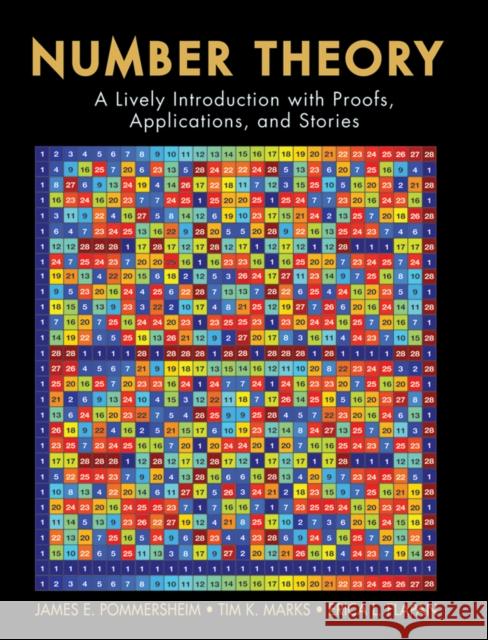
Number Theory Pommersheim, James 9780470424131  - książkaWidoczna okładka, to zdjęcie poglądowe, a rzeczywista szata graficzna może różnić się od prezentowanej.

Number Theory

ISBN-13: 9780470424131 / Angielski / Twarda / 2010 / 784 str.

James Pommersheim
cena 866,65
(netto: 825,38 VAT:  5%)

Najniższa cena z 30 dni: 856,07
Termin realizacji zamówienia:
ok. 22 dni roboczych.

Darmowa dostawa!

Number Theory: A Lively Introduction with Proofs, Applications, and Stories, is a new book that provides a rigorous yet accessible introduction to elementary number theory along with relevant applications. Readable discussions motivate new concepts and theorems before their formal definitions and statements are presented. Many theorems are preceded by Numerical Proof Previews, which are numerical examples that will help give students a concrete understanding of both the statements of the theorems and the ideas behind their proofs, before the statement and proof are formalized in more abstract terms. In addition, many applications of number theory are explained in detail throughout the text, including some that have rarely (if ever) appeared in textbooks. A unique feature of the book is that every chapter includes a math myth, a fictional story that introduces an important number theory topic in a friendly, inviting manner. Many of the exercise sets include in-depth Explorations, in which a series of exercises develop a topic that is related to the material in the section.


Kategorie:
Nauka, Matematyka
Kategorie BISAC:
Mathematics > Teoria liczb
Język:
Angielski
ISBN-13:
9780470424131
Rok wydania:
2010
Ilość stron:
784
Waga:
1.19 kg
Wymiary:
23.62 x 19.3 x 3.05
Oprawa:
Twarda
Wolumenów:
01

Preface.

To the Student.

To the Instructor.

Acknowledgements.

0. Prologue.

1. Numbers, Rational and Irrational.

(Historical figures: Pythagoras and Hypatia).

1.1 Numbers and the Greeks.

1.2 Numbers you know.

1.3 A First Look at Proofs.

1.4 Irrationality of he square root of 2.

1.5 Using Quantifiers.

2. Mathematical Induction.

(Historical figure: Noether).

2.1.The Principle of Mathematical Induction.

2.2 Strong Induction and the Well Ordering Principle.

2.3 The Fibonacci Sequence and the Golden Ratio.

2.4 The Legend of the Golden Ratio.

3. Divisibility and Primes.

(Historical figure: Eratosthenes).

3.1 Basic Properties of Divisibility.

3.2 Prime and Composite Numbers.

3.3 Patterns in the Primes.

3.4 Common Divisors and Common Multiples.

3.5 The Division Theorem.

3.6 Applications of gcd and lcm.

4.The Euclidean Algorithm.

(Historical figure: Euclid).

4.1 The Euclidean Algorithm.

4.2 Finding the Greatest Common Divisor.

4.3 A Greeker Argument that the square root of 2 is Irrational.

5. Linear Diophantine Equations.

(Historical figure: Diophantus).

5.1 The Equation aX + bY = 1.

5.2 Using the Euclidean Algorithm to Find a Solution.

5.3 The Diophantine Equation aX + bY = n.

5.4 Finding All Solutions to a Linear Diophantine Equation.

6. The Fundamental Theorem of Arithmetic.

(Historical figure: Mersenne).

6.1 The Fundamental Theorem.

6.2 Consequences of the Fundamental Theorem.

7. Modular Arithmetic.

(Historical figure: Gauss).

7.1 Congruence modulo n.

7.2 Arithmetic with Congruences.

7.3 Check Digit Schemes.

7.4 The Chinese Remainder Theorem.

7.5 The Gregorian Calendar.

7.6 The Mayan Calendar.

8. Modular Number Systems.

(Historical figure: Turing).

8.1 The Number System Zn: an Informal View.

8.2 The Number System Zn: Definition and Basic Properties.

8.3 Multiplicative Inverses in Zn.

8.4 Elementary Cryptography.

8.5 Encryption Using Modular Multiplication.

9. Exponents Modulo n.

(Historical figure: Fermat).

9.1 Fermat′s Little Theorem.

9.2 Reduced Residues and the Euler phi–function.

9.3 Euler′s Theorem.

9.4 Exponentiation Ciphers with a Prime modulus.

9.5 The RSA Encryption Algorithm.

10. Primitive Roots.

(Historical figure: Lagrange).

10.1 Zn.

10.2 Solving Polynomial Equations in Zn.

10.3 Primitive Roots.

10.4 Applications of Primitive Roots.

11. Quadratic Residues.

(Historical figure: Eisenstein)

11.1 Squares Modulo n

11.2 Euler′s Identity and the Quadratic Character of –1

11.3 The Law of Quadratic Reciprocity

11.4 Gauss′s Lemma

11.5 Quadratic Residues and Lattice Points.

11.6 The Proof of Quadratic Reciprocity.

12. Primality Testing.

(Historical figure: Erdös).

12.1 Primality testing.

12.2 Continued Consideration of Charmichael Numbers.

12.3 The Miller–Rabin Primality test.

12.4 Two Special Polynomial Equations in Zp.

12.5 Proof that Millar–Rabin is Effective.

12.6 Prime Certificates.

12.7 The AKS Deterministic Primality Test.

13. Gaussian Integers.

(Historical figure: Euler).

13.1 Definition of Gaussian Integers

13.2 Divisibility and Primes in Z[i].

13.3 The Division Theorem for the Gaussian Integers.

13.4 Unique Factorization in Z[i].

13.5 Gaussian Primes.

13.6 Fermat′s Two Squares Theorem.

14. Continued Fractions.

(Historical figure: Ramanujan).

14.1 Expressing Rational Numbers as Continued Fractions.

14.2 Expressing Irrational Numbers as Continued Fractions.

14.3 Approximating Irrational Numbers Using Continued Fractions.

14.4 Proving that Convergents are Fantastic Approximations.

15. Some Nonlinear Diophantine Equations.

(Historical figure: Germain).

15.1 Pell′s Equation

15.2 Fermat′s Last Theorem

15.3 Proof of Fermat′s Last Theorem for n = 4.

15.4 Germain′s Contributions to Fermat′s Last Theorem

15.5 A Geometric look at the Equation x4 + y4 = z2.

Appendix: Axioms of Number Theory.

A.1 What is a Number System?

A.2 Order Properties of the Integers.

A.3 Building Results From Our Axioms.

A.4 The Principle of Mathematical Induction.

James Pommersheim is the Katharine Piggott Professor of Mathematics at Reed College. He held post–doctoral positions at the Institute for Advanced Study, M.I.T., and U.C. Berkeley, and he served on the mathematics faculty at New Mexico State University and Pomona College. Pommersheim has published research papers in a wide variety of areas, including algebraic geometry, number theory, topology, and quantum computation. He has enjoyed teaching number theory to students at many levels: college math and math education students, talented high school students, and advanced graduate students. Pommersheim earned his Ph.D. from the University of Chicago, where he studied under William Fulton.

Tim Marks is a Research Scientist at Mitsubishi Electric Research Laboratories in Cambridge, Massachusetts. Previously, he taught high school mathematics and physics for three years, and he worked for three years as a mathematics textbook editor at McDougal Littell/ Houghton Mifflin. Marks and Pommersheim have taught number theory at the Johns Hopkins University′s Center for Talented Youth (CTY) summer program for 19 years. Marks earned his A.B. degree from Harvard University. He completed his Ph.D. and postdoctoral research at the University of California, San Diego.

Erica Flapan joined the mathematics department at Pomona College in 1986. She held post–doctoral positions at Rice University and the University of California, Santa Barbara. Flapan has taught a wide range of mathematics courses and has numerous publications in topology and its applications to chemistry, including her book When Topology Meets Chemistry. She developed a course entitled "Problem Solving in the Sciences, which aims to teach students the mathematics they need in order to succeed in science and economics. Flapan obtained her Ph.D. in knot theory from the University of Wisconsin and is the Lingurn H. Burkhead Professor of Mathematics at Pomona College.

Can learning math actually be fun? Number Theory: A Lively Introduction with Proofs, Applications, and Stories proves it can! Number Theory: A Lively Introduction with Proofs, Applications, and Stories will introduce you to elementary number theory, helping you develop your proof writing skills while learning the core concepts in number theory as well as advanced topics used in modern applications. To help you succeed, you′ll learn "math myths" fictional stories starring famous mathematicians that illustrate important number theory topics in a friendly, inviting manner that′s easy to understand and remember. "Numerical Proof Previews" give you a concrete way to understand the key ideas of a proof. Illustrations throughout the text add to the fun and your understanding. As accessible as the book is, it does not skimp on the serious mathematics. You′ll explore: Methods of proof and the basic properties of the integers, including mathematical induction Central concepts and theorems in elementary number theory using a developmental approach, including basic divisibility properties, prime numbers, the Euclidean Algorithm, modular arithmetic (including applications), Fermat′s Little Theorem, Euler′s Theorem, and RSA (public–key) encryption Primitive roots, primality testing, quadratic reciprocity, Gaussian integers, Fermat′s Two Squares Theorem, continued fractions, Pell′s Equation, and Fermat′s Last Theorem, and much more Ideal for first–timers in number theory as well as math majors and math education majors, Number Theory: A Lively Introduction with Proofs, Applications, and Stories  makes learning number theory a joy!


Udostępnij

Facebook - konto krainaksiazek.pl


Opinie o Krainaksiazek.pl na Opineo.pl

Partner Mybenefit

Krainaksiazek.pl w programie rzetelna firma Krainaksiaze.pl - płatności przez paypal

Czytaj nas na:

Facebook - krainaksiazek.pl
  • książki na zamówienie
  • granty
  • książka na prezent
  • kontakt
  • pomoc
  • opinie
  • regulamin
  • polityka prywatności

Zobacz:

  • Księgarnia czeska

  • Wydawnictwo Książkowe Klimaty

1997-2026 DolnySlask.com Agencja Internetowa

© 1997-2022 krainaksiazek.pl
     
KONTAKT | REGULAMIN | POLITYKA PRYWATNOŚCI | USTAWIENIA PRYWATNOŚCI
Zobacz: Księgarnia Czeska | Wydawnictwo Książkowe Klimaty | Mapa strony | Lista autorów
KrainaKsiazek.PL - Księgarnia Internetowa

Polityka prywatnosci - link
Krainaksiazek.pl - płatnośc Przelewy24
Przechowalnia Przechowalnia






