• Wyszukiwanie zaawansowane
  • Kategorie
  • Kategorie BISAC
  • Książki na zamówienie
  • Promocje
  • Granty
  • Książka na prezent
  • Opinie
  • Pomoc
  • Załóż konto
  • Zaloguj się

Nuclei in the Cosmos » książka


zaloguj się | załóż konto
Logo Krainaksiazek.pl

koszyk

konto

szukaj
topmenu
Księgarnia internetowa
Szukaj
Książki na zamówienie
Promocje
Granty
Książka na prezent
Moje konto
Pomoc
 
 
Wyszukiwanie zaawansowane
Pusty koszyk
Bezpłatna dostawa dla zamówień powyżej 20 złBezpłatna dostawa dla zamówień powyżej 20 zł

Kategorie główne

• Nauka
 [2946600]
• Literatura piękna
 [1856966]

  więcej...
• Turystyka
 [72221]
• Informatyka
 [151456]
• Komiksy
 [35826]
• Encyklopedie
 [23190]
• Dziecięca
 [619653]
• Hobby
 [140543]
• AudioBooki
 [1577]
• Literatura faktu
 [228355]
• Muzyka CD
 [410]
• Słowniki
 [2874]
• Inne
 [445822]
• Kalendarze
 [1744]
• Podręczniki
 [167141]
• Poradniki
 [482898]
• Religia
 [510455]
• Czasopisma
 [526]
• Sport
 [61590]
• Sztuka
 [243598]
• CD, DVD, Video
 [3423]
• Technologie
 [219201]
• Zdrowie
 [101638]
• Książkowe Klimaty
 [124]
• Zabawki
 [2473]
• Puzzle, gry
 [3898]
• Literatura w języku ukraińskim
 [254]
• Art. papiernicze i szkolne
 [8170]
Kategorie szczegółowe BISAC

Nuclei in the Cosmos

ISBN-13: 9783642488429 / Angielski / Miękka / 2012 / 236 str.
Heinz Oberhummer; J. H. Applegate; J. J. Cowan
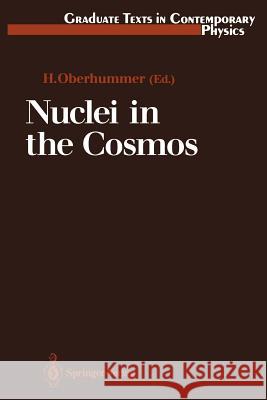
Nuclei in the Cosmos Heinz Oberhummer J. H. Applegate J. J. Cowan 9783642488429 Springer - książkaWidoczna okładka, to zdjęcie poglądowe, a rzeczywista szata graficzna może różnić się od prezentowanej.

Nuclei in the Cosmos

ISBN-13: 9783642488429 / Angielski / Miękka / 2012 / 236 str.

Heinz Oberhummer; J. H. Applegate; J. J. Cowan
cena 201,72 zł
(netto: 192,11 VAT:  5%)

Najniższa cena z 30 dni: 192,74 zł
Termin realizacji zamówienia:
ok. 22 dni roboczych
Bez gwarancji dostawy przed świętami

Darmowa dostawa!

Nuclear astrophysics as it stands today is a fascinating science. Even though, compared to other scientific fields, it is a young discipline which has developed only in this century, it has answered many questions concerning the under standing of our cosmos. One of these great achievements was the concept of nucleosynthesis, the creation of the elements in the early universe in interstellar matter and in stars. Nuclear astrophysics has continued, to solve many riddles of the evolution of the myriads of stars in our cosmos. This review volume attempts to provide an overview of the current status of nuclear astrophysics. Special emphasis is given to the interdisciplinary nature of the field: astronomy, nuclear physics, astrophysics and particle physics are equally involved. One basic effort of nuclear astrophysics is the collection of ob servational facts with astronomical methods. Laboratory studies of the nuclear processes involved in various astrophysical scenarios have provided fundamen tal information serving both as input for and test of astrophysical models. The theoretical understanding of nuclear reaction mechanisms is necessary, for example, to extrapolate the experimentally determined reaction rates to the thermonuclear energy range, which is relevant for the nuclear processes in our cosmos. Astrophysical models and calculations allow us to simulate how nuclear processes contribute to driving the evolution of stars, interstellar matter and the whole universe. Finally, elementary particle physics also plays an important role in the field of nuclear astrophysics, for instance through weak interaction processes involving neutrinos."


Kategorie:
Nauka, Fizyka
Kategorie BISAC:
Science > Astronomia, przestrzeń i czas
Science > Astrofizyka
Science > Fizyka jądrowa
Wydawca:
Springer
Seria wydawnicza:
Graduate Texts in Contemporary Physics
Język:
Angielski
ISBN-13:
9783642488429
Rok wydania:
2012
Wydanie:
Softcover Repri
Numer serii:
000009677
Ilość stron:
236
Waga:
0.36 kg
Wymiary:
23.39 x 15.6 x 1.35
Oprawa:
Miękka
Wolumenów:
01

Experimental Determination of Stellar Reaction Rates.- 1. Introduction.- 2. Direct Measurements.- 3. Indirect Approaches.- 4. Reactions Involving Radioactive Nuclides.- References.- Radioactive Ion Beams in Nuclear Astrophysics.- 1. Introduction.- 2. Interest of Radioactive Ion Beams in Nuclear Astrophysics.- 2.1 Nuclear Reactions of Astrophysical Interest Involving Radioactive Nuclei.- 2.2 Indirect Methods.- 2.3 Radioactive Ion Beams Versus Radioactive Targets.- 2.4 Remarks.- 3. Production of Radioactive Ion Beams.- 3.1 The Two Methods.- 3.2 Radioactive Ion Beams Produced by the Two-Accelerator Method.- 3.3 Proposals for RIB Production by the Two-Accelerator Method.- 4. Special Experimental Techniques in Nuclear Astrophysics Using Radioactive Ion Beams.- 4.1 Introduction.- 4.2 Targets.- 4.3 On-line Detectors.- 4.4 Off-line Detectors.- 5. Conclusions.- References.- Direct Reaction Mechanism in Astrophysically Relevant Processes.- 1. Introduction.- 2. Qualitative Features of Nuclear Reaction Mechanisms.- 3. Nuclear Reactions in Astrophysical Scenarios.- 4. Optical Potentials.- 5. Theoretical Descriptions of Direct Reactions.- 6. Examples.- 6.1 Transfer Reactions with Non-resonant Behaviour.- 6.2 Transfer Reactions with Resonant Behaviour.- 6.3 Direct Capture.- 7. Summary.- Acknowledgements.- References.- Nuclear Reaction Rates — from Laboratory Experiments and in the Stellar Plasma.- 1. Introduction.- 2. Theoretical Models for Extrapolating Measured Data.- 2.1 Example: The 12C(?,?)16O E1 Capture Reaction.- 2.2 The 12C(?,?)16O E2 Capture at Astrophysical Energies.- 3. Electron Screening in Laboratory Experiments.- 4. Screening Effects in the Plasma.- References.- Abundances in Galaxies.- 1. Introduction.- 2. Big Bang Nucleosynthesis and Light Element Abundances.- 3. Abundance Trends Between and Across Galaxies.- 4. Stellar Populations in Our Galaxy.- 5. Differential Abundance Variations Among Elements.- References.- Nuclei in Cosmic Rays.- 1. Introduction.- 2. Techniques for Measuring Composition from Satellites and Balloons.- 2.1 Electronic Detectors: The “Chicago Egg”.- 2.2 An Emulsion Experiment: JACEE.- 3. Results of Satellite and Balloon Experiments.- 4. How to Measure Cosmic Ray Composition above 1015 eV.- 4.1 Outline of Extensive Air Showers.- 4.2 Extensive Air Shower Properties Sensitive to Primary Particle Mass.- 4.3 A Proposed Experiment: KASCADE.- 5. Summary.- References.- Primordial Nucleosynthesis: Beyond the Standard Model.- 1. Introduction.- 2. Standard Primordial Nucleosynthesis.- 3. Observational Tests of the Standard Model.- 3.1 Helium.- 3.2 Lithium.- 4. The QCD Phase Transition.- 5. Neutrinos in the Early Universe.- 5.1 Sterile Neutrinos.- 5.2 Neutrino Oscillations.- 6. Cosmic Strings.- 7. Conclusions.- References.- Production of Heavy Elements in Inhomogeneous Cosmologies.- 1. Introduction.- 2. The QCD Transition in the Early Universe.- 3. The Standard Big Bang.- 4. Inhomogeneous Big Bang Scenarios.- 4.1 Light Element Production.- 4.2 The Formation of Heavy Elements.- 5. Computational Method.- 5.1 Inhomogeneous Big Bang in a Two Zone Model.- 5.2 The Nuclear Network.- 5.3 Important Reaction Rates and Their Determination.- 6. Results.- Acknowledgements.- References.- The s-Process: Branchings and Chronometers.- 1. Introduction.- 2. Chronometers — Models and Reality.- 3. s-Process Concepts.- 3.1 The Classical Approach.- 3.2 Stellar s-Process Models.- 4. s-Process Time Scales.- 4.1 Helium Shell Burning.- 4.2 Remixing to the Interstellar Medium and the Age of the Galaxy.- 4.3 Summary of Potential Chronometers.- 5. Selected Examples.- 5.1 176Lu — a Defect Cosmic Clock.- 5.2 The Branchings at 185W and 186Re — Neutron Density and r-Process Age.- 6. Conclusions.- References.- Beta Decay Far from Stability and Double Beta Decay, and Consequences for Astrophysics.- 1. Introduction.- 2. Calculations of Beta Decay Properties of Nuclei Far from Stability.- 2.1 Half-lives.- 2.2 ?-Delayed Fission and ?-Delayed Neutron Emission.- 3. Beta Decay Far from Stability and the Astrophysical r-Process.- 3.1 Synthesis of Heavy Elements in the Universe.- 4. The r-Process and the Age of the Universe.- 5. Age of the Universe, Cosmology and Neutrino Mass.- 6. Double Beta Decay and Neutrino Mass.- 6.1 Neutrino Mass and Particle Theories (GUTs, SUSYs).- 6.2 Double Beta Decay and Neutrino Mass.- 7. Conclusion.- References.


Udostępnij

Facebook - konto krainaksiazek.pl


Opinie o Krainaksiazek.pl na Opineo.pl

Partner Mybenefit

Krainaksiazek.pl w programie rzetelna firma Krainaksiaze.pl - płatności przez paypal

Czytaj nas na:

Facebook - krainaksiazek.pl
  • książki na zamówienie
  • granty
  • książka na prezent
  • kontakt
  • pomoc
  • opinie
  • regulamin
  • polityka prywatności

Zobacz:

  • Księgarnia czeska

  • Wydawnictwo Książkowe Klimaty

1997-2025 DolnySlask.com Agencja Internetowa

© 1997-2022 krainaksiazek.pl
     
KONTAKT | REGULAMIN | POLITYKA PRYWATNOŚCI | USTAWIENIA PRYWATNOŚCI
Zobacz: Księgarnia Czeska | Wydawnictwo Książkowe Klimaty | Mapa strony | Lista autorów
KrainaKsiazek.PL - Księgarnia Internetowa

Polityka prywatnosci - link
Krainaksiazek.pl - płatnośc Przelewy24
Przechowalnia Przechowalnia





