• Wyszukiwanie zaawansowane
  • Kategorie
  • Kategorie BISAC
  • Książki na zamówienie
  • Promocje
  • Granty
  • Książka na prezent
  • Opinie
  • Pomoc
  • Załóż konto
  • Zaloguj się

Nonequilibrium Vibrational Kinetics » książka


zaloguj się | załóż konto
Logo Krainaksiazek.pl

koszyk

konto

szukaj
topmenu
Księgarnia internetowa
Szukaj
Książki na zamówienie
Promocje
Granty
Książka na prezent
Moje konto
Pomoc
 
 
Wyszukiwanie zaawansowane
Pusty koszyk
Bezpłatna dostawa dla zamówień powyżej 20 złBezpłatna dostawa dla zamówień powyżej 20 zł

Kategorie główne

• Nauka
 [2949965]
• Literatura piękna
 [1857847]

  więcej...
• Turystyka
 [70818]
• Informatyka
 [151303]
• Komiksy
 [35733]
• Encyklopedie
 [23180]
• Dziecięca
 [617748]
• Hobby
 [139972]
• AudioBooki
 [1650]
• Literatura faktu
 [228361]
• Muzyka CD
 [398]
• Słowniki
 [2862]
• Inne
 [444732]
• Kalendarze
 [1620]
• Podręczniki
 [167233]
• Poradniki
 [482388]
• Religia
 [509867]
• Czasopisma
 [533]
• Sport
 [61361]
• Sztuka
 [243125]
• CD, DVD, Video
 [3451]
• Technologie
 [219309]
• Zdrowie
 [101347]
• Książkowe Klimaty
 [123]
• Zabawki
 [2362]
• Puzzle, gry
 [3791]
• Literatura w języku ukraińskim
 [253]
• Art. papiernicze i szkolne
 [7933]
Kategorie szczegółowe BISAC

Nonequilibrium Vibrational Kinetics

ISBN-13: 9783642486173 / Angielski / Miękka / 2012 / 344 str.
Mario Capitelli
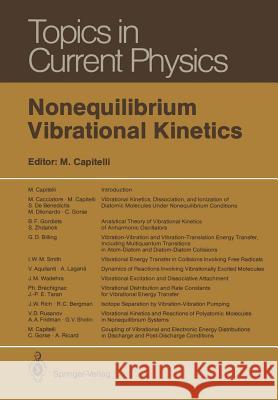
Nonequilibrium Vibrational Kinetics Mario Capitelli 9783642486173 Springer - książkaWidoczna okładka, to zdjęcie poglądowe, a rzeczywista szata graficzna może różnić się od prezentowanej.

Nonequilibrium Vibrational Kinetics

ISBN-13: 9783642486173 / Angielski / Miękka / 2012 / 344 str.

Mario Capitelli
cena 201,72 zł
(netto: 192,11 VAT:  5%)

Najniższa cena z 30 dni: 192,74 zł
Termin realizacji zamówienia:
ok. 22 dni roboczych
Bez gwarancji dostawy przed świętami

Darmowa dostawa!

This book is devoted to the systematic treatment of nonequi 1 ibrium vibrational kinetics in molecular systems. Particular emphasis is given to the vibrational excitation of diatomic molecules by low-energy electrons in a discharge and by IR photons in laser-pumped systems. The book follows the different steps of the introduction, redistribution, loss, and chemical conversion of the vibrational quanta, from the points of view of the overall kinetics and the dynamics of elementary processes. These two aspects are balanced in a multidisciplinary approach. The different chapters give the basic instruments (theoretical and experimental) which are needed to understand the ki- netics of nonequilibrium systems. The book will introduce the reader to different areas such as plasmachemistry, laser chemistry, IR and Raman spectroscopy, and relaxation phenomena, emphasizing how the vibrational energy affects such research fields. The chapters dedicated to collisional dynamics involving vibrational excited molecules provide an introduc- tion to the modern techniques uti 1 ized in the scattering theory of inelastic and reactive collisions. The extension of the vibrational kinetics to polyatomic mole- cules, discussed in Chap. 10, is the natural bridge between coll ision and coll i- sionless regimes. In conclusion, we hope that the approach followed in this book will stimulate the collaboration of researchers coming from different research fields, which are too often completely separate.


Kategorie:
Nauka, Fizyka
Kategorie BISAC:
Science > Fizyka jądrowa
Science > Fizyka atomowa i molekularna
Science > Fizyka kwantowa
Wydawca:
Springer
Seria wydawnicza:
Topics in Current Physics
Język:
Angielski
ISBN-13:
9783642486173
Rok wydania:
2012
Wydanie:
Softcover Repri
Numer serii:
000186407
Ilość stron:
344
Waga:
0.58 kg
Wymiary:
24.41 x 16.99 x 1.91
Oprawa:
Miękka
Wolumenów:
01
Dodatkowe informacje:
Wydanie ilustrowane

1. Introduction.- 1.1 Nonequilibrium Versus Equilibrium Vibrational Kinetics.- 1.2 Organization of This Book.- 2. Vibrational Kinetics, Dissociation, and Ionization of Diatomic Molecules Under Nonequilibrium Conditions.- 2.1 Laser-Induced Vibrational Kinetics.- 2.1.1 General Characteristics.- 2.1.2 Case Studies: Heteronuclear Diatomic Molecules.- 2.1.3 Homonuclear Diatomic Species.- 2.2 Nonequilibrium Vibrational Kinetics Under Electrical Discharges.- 2.2.1 General Considerations.- 2.2.2 Case Studies.- a) Nitrogen.- b) Hydrogen.- c) Carbon Monoxide.- 2.3 Post-Discharge Conditions.- 2.4 Summary.- References.- 3. Analytical Theory of Vibrational Kinetics of Anharmonic Oscillators.- 3.1 Historical Overview.- 3.2 Rate Equations and Probabilities of Elementary Processes.- 3.3 V-T Relaxation in an Inert Gas.- 3.4 Treanor Distribution in the V-V Exchange.- 3.5 V-V and V-T Exchange. Weak Excitation Regime.- 3.6 Resonance V-V Relaxation Under High-Excitation Conditions. Steady-State Conditions.- 3.7 Relaxation at Moderate Excitation of Vibrations.- 3.8 Non-Steady-State Relaxation Regime at High Excitation.- 3.9 Vibrational Kinetics and Chemical Reactions Involving Vibrational1y Excited Molecules.- 3.10 Laser Emission Excitation of Molecular Vibrations.- 3.11 Vibrational Relaxation Under Adiabatic Expansion in the Supersonic Nozzle.- 3.12 Further Studies and Outlook.- References.- 4. Vibration-Vibration and Vibration-Translation Energy Transfer, Including Multiquantum Transitions in Atom-Diatom and Diatom-Diatom Collisions.- 4.1 First-Order Theories.- 4.2 Scaling Theories.- 4.3 Semiclassical Theories.- 4.4 Analytical Expressions for V-V and V-T Rate Constants.- 4.5 Energy Transfer in Specific Systems.- 4.5.1 V-T Processes in the He + CO and CO + CO Systems.- 4.5.2 V-V Processes in CO + CO and CO + N2.- 4.A Appendix: Tables of Energy Transfer Rates in the H2 + H2, N2 + N2, He + CO, and CO + CO Systems.- References.- 5. Vibrational Energy Transfer in Collisions Involving Free Radicals.- 5.1 Mechanisms for Vibrational Relaxation.- 5.1.1 Collisions Between Species with Closed Electronic Shells.- 5.1.2 Electronically Nonadiabatic Mechanisms for Vibrational Relaxation.- 5.1.3 Vibrational Relaxation as the Result of Chemical Interaction.- 5.1.4 Summary of Vibrational Relaxation Mechanisms.- 5.2 Experimental Results and Discussion.- 5.2.1 Collisions Between Free Radicals and Noble Gas Atoms.- 5.2.2 Collisions Between Saturated Molecules in Singlet States and Radical Atoms.- a) The H3 System.- b) The H + HX (X = F, Cl) Systems.- c) The X, Y + HX (X = F, Cl, Br; Y = Cl, Br, 0) Systems.- 5.2.3 Collisions Between Unsaturated Molecules in Singlet States and Radical Atoms.- 5.2.4 Collisions Between Molecules and Molecular Free Radicals.- 5.2.5 Collisions Between Free Radicals.- 5.3 Conclusion and Prognosis.- References.- 6. Dynamics of Reactions Involving Vibrationally Excited Molecules.- 6.1 Experimental and Computational Results for Representative Atom-Diatom Reactions.- 6.1.1 Reactions of Atoms with Hydrogen Molecules and Isotopic Variants.- a) The Reaction H + H2.- b) The Reaction F + H2.- c) Reactions of Other Atoms with H2.- 6.1.2 Reactions of Atoms with Hydrogen Halides.- 6.1.3 Reactions of Atoms with Halogen and Interhalogen Molecules.- 6.1.4 Reactions of Atoms with Oxygen Molecules.- 6.1.5 Reactions Involving Other Diatomic Molecules and Ions.- 6.2 Theoretical Outlook.- 6.2.1 Coordinates for Rearrangement Processes.- 6.2.2 Decoupling Schemes for Rotations: Sudden Approximations.- 6.2.3 Hyperspherical Adiabatic Approach: Kinematic Effects for Vibrational Energy Exchange.- 6.3 Conclusions.- References.- 7. Vibrational Excitation and Dissociative Attachment.- 7.1 The Resonance Model.- 7.1.1 Qualitative Remarks.- 7.1.2 Quantitative Discussion.- 7.1.3 Cross Section for Dissociative Attachment.- 7.1.4 Cross Section for Vibrational Excitation.- 7.1.5 Semiclassical Approximation.- 7.2 Applications to Specific Molecules.- 7.2.1 Molecular Hydrogen.- a) Resonances.- b) Vibrational Excitation.- c) Dissociative Attachment.- d) Isotope Effect.- 7.2.2 Molecular Nitrogen.- a) Resonances.- b) Vibrational Excitation.- c) “Dissociative Attachment”.- 7.2.3 Carbon Monoxide.- a) Resonances.- b) Vibrational Excitation.- c) Dissociative Attachment.- 7.2.4 Hydrogen Chloride.- a) Resonances.- b) Vibrational Excitation.- c) Dissociative Attachment.- 7.3 Applications of the Attachment Process Under Nonequilibrium Conditions.- 7.3.1 Neutral Beam Injection in Fusion Plasma.- 7.3.2 Electron-Beam Switches.- 7.3.3 Laser Plasma Instabilities.- 7.3.4 Gaseous Dielectrics.- 7.A Appendix: Normalization of Continuum Functions.- References.- 8. Vibrational Distribution and Rate Constants for Vibrational Energy Transfer.- 8.1 Vibrational Distribution.- 8.1.1 The Vibrationally Excited Medium.- 8.1.2 Infrared Techniques.- a) Infrared Spontaneous Emission.- b) Probe Laser Technique.- c) Typical Results.- d) Conclusion.- 8.1.3 Light-Scattering Techniques.- a) Spontaneous Raman Scattering-Fluorescence.- b) Coherent Anti-Stokes Raman Scattering.- c) Summary.- 8.1.4 Other Techniques.- a) Multiphoton Ionization.- b) Velocity-Modulated Infrared Laser Spectroscopy.- 8.2 Rate Constants for Vibrational Energy Transfer.- 8.2.1 Steady-State Measurements.- 8.2.2 Time-Resolved Measurements.- a) Laser-Induced Infrared Fluorescence.- b) Two-Laser Experiments.- c) Other Time-Resolved Techniques.- References.- 9. Isotope Separation by Vibration-Vibration Pumping.- 9.1 Kinetic Modeling.- 9.2 Experimental Studies.- 9.2.1 Carbon Monoxide.- a) Optical Excitation.- b) Glow Discharge Excitation.- 9.2.2 Nitrogen/Oxygen Mixtures.- 9.3 V-V Pumping as an Alternative Method of Stable Isotope Preparation.- References.- 10. Vibrational Kinetics and Reactions of Polyatomic Molecules in Nonequilibrium Systems.- 10.1 Elementary Process of V-T Relaxation of Highly Excited Polyatomic Molecules.- 10.2 Elementary Process of V-V Exchange of Highly Excited Polyatomic Molecules.- 10.3 Population of Vibrationally Excited States of Polyatomic Molecules in Nonequilibrium Conditions.- 10.4 Reactions of Polyatomic Molecules Under Essentially Nonequilibrium Conditions.- 10.4.1 Fast Reactions.- 10.4.2 Slow Reactions.- 10.5 CO2 Dissociation Stimulated by Vibrational Excitation of Molecules in Plasma.- 10.5.1 Single-Temperature Approximation.- 10.5.2 Two-Temperature Approximation.- 10.6 Summary.- References.- 11. Coupling of Vibrational and Electronic Energy Distributions in Discharge and Post-Discharge Conditions.- 11.1 Coupling Between NV and the Free-Electron Energy Distribution Function.- 11.1.1 Electrical Discharges.- 11.1.2 Post-Discharge Conditions.- 11.2 Coupling Between NV and NV*.- 11.3 Conclusions.- References.- Additional References with Titles.


Udostępnij

Facebook - konto krainaksiazek.pl


Opinie o Krainaksiazek.pl na Opineo.pl

Partner Mybenefit

Krainaksiazek.pl w programie rzetelna firma Krainaksiaze.pl - płatności przez paypal

Czytaj nas na:

Facebook - krainaksiazek.pl
  • książki na zamówienie
  • granty
  • książka na prezent
  • kontakt
  • pomoc
  • opinie
  • regulamin
  • polityka prywatności

Zobacz:

  • Księgarnia czeska

  • Wydawnictwo Książkowe Klimaty

1997-2025 DolnySlask.com Agencja Internetowa

© 1997-2022 krainaksiazek.pl
     
KONTAKT | REGULAMIN | POLITYKA PRYWATNOŚCI | USTAWIENIA PRYWATNOŚCI
Zobacz: Księgarnia Czeska | Wydawnictwo Książkowe Klimaty | Mapa strony | Lista autorów
KrainaKsiazek.PL - Księgarnia Internetowa

Polityka prywatnosci - link
Krainaksiazek.pl - płatnośc Przelewy24
Przechowalnia Przechowalnia





