• Wyszukiwanie zaawansowane
  • Kategorie
  • Kategorie BISAC
  • Książki na zamówienie
  • Promocje
  • Granty
  • Książka na prezent
  • Opinie
  • Pomoc
  • Załóż konto
  • Zaloguj się

Non-affirmative Theory of Education and 'Bildung' » książka


zaloguj się | załóż konto
Logo Krainaksiazek.pl

koszyk

konto

szukaj
topmenu
Księgarnia internetowa
Szukaj
Książki na zamówienie
Promocje
Granty
Książka na prezent
Moje konto
Pomoc
 
 
Wyszukiwanie zaawansowane
Pusty koszyk
Bezpłatna dostawa dla zamówień powyżej 20 złBezpłatna dostawa dla zamówień powyżej 20 zł

Kategorie główne

• Nauka
 [2949965]
• Literatura piękna
 [1857847]

  więcej...
• Turystyka
 [70818]
• Informatyka
 [151303]
• Komiksy
 [35733]
• Encyklopedie
 [23180]
• Dziecięca
 [617748]
• Hobby
 [139972]
• AudioBooki
 [1650]
• Literatura faktu
 [228361]
• Muzyka CD
 [398]
• Słowniki
 [2862]
• Inne
 [444732]
• Kalendarze
 [1620]
• Podręczniki
 [167233]
• Poradniki
 [482388]
• Religia
 [509867]
• Czasopisma
 [533]
• Sport
 [61361]
• Sztuka
 [243125]
• CD, DVD, Video
 [3451]
• Technologie
 [219309]
• Zdrowie
 [101347]
• Książkowe Klimaty
 [123]
• Zabawki
 [2362]
• Puzzle, gry
 [3791]
• Literatura w języku ukraińskim
 [253]
• Art. papiernicze i szkolne
 [7933]
Kategorie szczegółowe BISAC

Non-affirmative Theory of Education and 'Bildung'

ISBN-13: 9783031305535 / Angielski
Michael Uljens
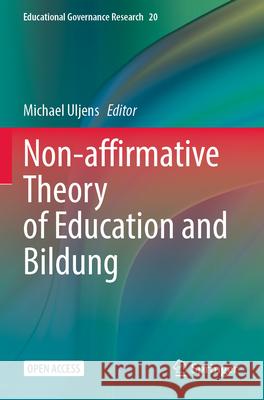
Non-affirmative Theory of Education and 'Bildung' Michael Uljens 9783031305535 Springer - książkaWidoczna okładka, to zdjęcie poglądowe, a rzeczywista szata graficzna może różnić się od prezentowanej.

Non-affirmative Theory of Education and 'Bildung'

ISBN-13: 9783031305535 / Angielski

Michael Uljens
cena 161,36 zł
(netto: 153,68 VAT:  5%)

Najniższa cena z 30 dni: 154,18 zł
Termin realizacji zamówienia:
ok. 22 dni roboczych
Bez gwarancji dostawy przed świętami

Darmowa dostawa!
inne wydania

Interpreting the modern heritage of ‘Bildung’ in connection to education theory, this open access volume explores non-affirmative theory of education and ‘Bildung’ as a language of education for the 21st century. In this ‘Bildung’-centered view of education, discerning thought on knowledge and values are critical objectives of education. To promote these aims, education practice must recognize but not affirm existing conditions or future ideals but instead pedagogically summon the student to self-directed critical treatment of the contents. Drawing on contemporary developments of modern education theory, especially as developed by Dietrich Benner in Berlin, the volume highlight how ‘educative teaching’ aims at supporting the growth of the individual as a person and citizen.The volume shows how it is possible to identify a position beyond education either as a mere transformative or a reproductive power. Instead of such an instrumentalism, education is seen as a critical societal practice, necessary for reflexive action and democracy. In different ways, the chapters demonstrate how non-affirmative theory offer an alternative to contemporary neo-liberal and conservative policies. The non-affirmative approach offers a strong education theory, relationally connecting the interactive level of teaching, studying and learning with the societal level and educational governance. Non-affirmative theory on education and ‘Bildung’ provides an elaborate point of departure for empirical research on teaching and educational leadership, teacher education and policy making.In five sections, the volume highlights how non-affirmative education theory relate to Didaktik, educative teaching, school didactics, democratic education and social justice. The approach is also analysed in relation to phenomenology, sociology, hermeneutics, cultural-historical activity theory, discursive institutionalism, empirical research, educational leadership and governance and 21st century competencies.Chapter “On Affirmativity and Non-affirmativity in the Context of Theories of Education and Bildung” is available open access under a Creative Commons Attribution-NonCommercial-NoDerivatives 4.0 International License via link.springer.com.


Interpreting the modern heritage of ‘Bildung’ in connection to education theory, this open access volume explores non-affirmative theory of education and ‘Bildung’ as a language of education for the 21st century. In this ‘Bildung’-centered view of education, discerning thought on knowledge and values are critical objectives of education. To promote these aims, education practice must recognize but not affirm existing conditions or future ideals but instead pedagogically summon the student to self-directed critical treatment of the contents. Drawing on contemporary developments of modern education theory, especially as developed by Dietrich Benner in Berlin, the volume highlight how ‘educative teaching’ aims at supporting the growth of the individual as a person and citizen.The volume shows how it is possible to identify a position beyond education either as a mere transformative or a reproductive power. Instead of such an instrumentalism, education is seen as a critical societal practice, necessary for reflexive action and democracy. In different ways, the chapters demonstrate how non-affirmative theory offer an alternative to contemporary neo-liberal and conservative policies. The non-affirmative approach offers a strong education theory, relationally connecting the interactive level of teaching, studying and learning with the societal level and educational governance. Non-affirmative theory on education and ‘Bildung’ provides an elaborate point of departure for empirical research on teaching and educational leadership, teacher education and policy making.In five sections, the volume highlights how non-affirmative education theory relate to Didaktik, educative teaching, school didactics, democratic education and social justice. The approach is also analysed in relation to phenomenology, sociology, hermeneutics, cultural-historical activity theory, discursive institutionalism, empirical research, educational leadership and governance and 21st century competencies. Chapter “On Affirmativity and Non-affirmativity in the Context of Theories of Education and Bildung” is available open access under a Creative Commons Attribution-NonCommercial-NoDerivatives 4.0 International License via link.springer.com.

Kategorie:
Podręczniki
Kategorie BISAC:
Education > Educational Policy & Reform
Education > Curricula
Education > Administration - General
Wydawca:
Springer
Seria wydawnicza:
Educational Governance Research
Język:
Angielski
ISBN-13:
9783031305535

Part I. Introduction.- Chapter 1. Non-affirmative theory of education and Bildung – problems, positionings and possibilities (Michael Uljens) .- Chapter 2. On affirmativity and non-affirmativity in the context of theories of education and ‘Bildung’ (Dietrich Benner) .- Part II. Non-affirmative interpretations of Didaktik.- Chapter 3. Knowledge, values and subject-ness - Educative teaching as a regulative idea of school development in the 21st century (Thomas Rucker) .- Chapter 4. Herbart’s educative teaching in times of Big Data-based measurement and assessment (Ling Lin) .- Chapter 5. ‘Bildung’-Centered Non-Affirmative School Didactics (Michael Uljens).- Part III. Non-affirmative education and related theoretical positions.- Chapter 6. Dewey, existential uncertainty, and non-affirmative democratic education (Andrea R. English) .- Chapter 7. Revisiting forgotten relationships between justice and education - Non-Affirmative Education as complementing distributive justice (Juan José Sosa Alonso) .- Chapter 8. Between doxa and transformational Bildung – A phenomenological and social-theoretical rehabilitation of the formation of opinions with Egon Schütz and Pierre Bourdieu (Johannes Türstig) .- Chapter 9. Hermeneutics in non-affirmative theory of education (Mari Mielityinen-Pachmann) .- Part IV. Non-affirmative education and empirical research.- Chapter 10. Pedagogical experimentalism and the principle of verification. A quest for non-affirmative educational research (Hanno Su and Johannes Bellmann) .- Chapter 11. Non-affirmative theory of education and cultural-historical activity theory — Where do they meet? (Alex Mäkiharju) .- Chapter 12. Understanding municipal education leaders in the tension between politics, professionals and parents (Ann-Sofie Smeds-Nylund).- Part V. Non-affirmative education perspectives on governance and policy.- Chapter 13. Operating in an outcomes-based and a democratic Bildung discourse (Lejf Moos) .- Chapter 14. On the normativity of data-driven curriculum policy-making: a discursive and non-affirmative approach (Andreas Nordin) .- Chapter 15. Bildung and 21th century competences: in need of mutual recognition? (Armend Tahirslay) .- Chapter 16. From ‘didactics’ to ‘curriculum-and-didactics’ and beyond: A non-affirmative approach to the analysis of policy changes of didactics in mainland China (Bangpin Ding).- Part VI. Concluding reflections and openings.- Chapter 17. Non-affirmative education theory as a language for a global discourse on education (Michael Uljens).

Michael Uljens is Chair professor of education at Åbo Akademi University in Finland as of 2003. Since the 1980’s Michael Uljens has published on sociology, phenomenology, theory and philosophy of education, Didaktik and educational leadership. He has worked with non-affirmative education theory since the late 1990’s. His books in English include School Didactics and Learning (1997, Psychology Press) and an edited volume (with R. Ylimaki) Bridging Educational Leadership, Curriculum Theory and Didaktik (2017, Springer). Michael Uljens previously worked as researcher, visiting professor and chair professor at universities in Finland, Sweden, Germany, USA, and China.  


Interpreting the modern heritage of ‘Bildung’ in connection to education theory, this open access volume explores non-affirmative theory of education and ‘Bildung’ as a language of education for the 21st century. In this ‘Bildung’-centered view of education, discerning thought on knowledge and values are critical objectives of education. To promote these aims, education practice must recognize but not affirm existing conditions or future ideals but instead pedagogically summon the student to self-directed critical treatment of the contents. Drawing on contemporary developments of modern education theory, especially as developed by Dietrich Benner in Berlin, the volume highlight how ‘educative teaching’ aims at supporting the growth of the individual as a person and citizen.

The volume shows how it is possible to identify a position beyond education either as a mere transformative or a reproductive power. Instead of such an instrumentalism, education is seen as a critical societal practice, necessary for reflexive action and democracy. In different ways, the chapters demonstrate how non-affirmative theory offer an alternative to contemporary neo-liberal and conservative policies. The non-affirmative approach offers a strong education theory, relationally connecting the interactive level of teaching, studying and learning with the societal level and educational governance. Non-affirmative theory on education and ‘Bildung’ provides an elaborate point of departure for empirical research on teaching and educational leadership, teacher education and policy making.

In five sections, the volume highlights how non-affirmative education theory relate to Didaktik, educative teaching, school didactics, democratic education and social justice. The approach is also analysed in relation to phenomenology, sociology, hermeneutics, cultural-historical activity theory, discursive institutionalism, empirical research, educational leadership and governance and 21st century competencies.

Chapter “On Affirmativity and Non-affirmativity in the Context of Theories of Education and Bildung” is available open access under a Creative Commons Attribution-NonCommercial-NoDerivatives 4.0 International License via link.springer.com.




Udostępnij

Facebook - konto krainaksiazek.pl


Opinie o Krainaksiazek.pl na Opineo.pl

Partner Mybenefit

Krainaksiazek.pl w programie rzetelna firma Krainaksiaze.pl - płatności przez paypal

Czytaj nas na:

Facebook - krainaksiazek.pl
  • książki na zamówienie
  • granty
  • książka na prezent
  • kontakt
  • pomoc
  • opinie
  • regulamin
  • polityka prywatności

Zobacz:

  • Księgarnia czeska

  • Wydawnictwo Książkowe Klimaty

1997-2025 DolnySlask.com Agencja Internetowa

© 1997-2022 krainaksiazek.pl
     
KONTAKT | REGULAMIN | POLITYKA PRYWATNOŚCI | USTAWIENIA PRYWATNOŚCI
Zobacz: Księgarnia Czeska | Wydawnictwo Książkowe Klimaty | Mapa strony | Lista autorów
KrainaKsiazek.PL - Księgarnia Internetowa

Polityka prywatnosci - link
Krainaksiazek.pl - płatnośc Przelewy24
Przechowalnia Przechowalnia




