• Wyszukiwanie zaawansowane
  • Kategorie
  • Kategorie BISAC
  • Książki na zamówienie
  • Promocje
  • Granty
  • Książka na prezent
  • Opinie
  • Pomoc
  • Załóż konto
  • Zaloguj się

Non-Photochemical Quenching and Energy Dissipation in Plants, Algae and Cyanobacteria » książka


zaloguj się | załóż konto
Logo Krainaksiazek.pl

koszyk

konto

szukaj
topmenu
Księgarnia internetowa
Szukaj
Książki na zamówienie
Promocje
Granty
Książka na prezent
Moje konto
Pomoc
 
 
Wyszukiwanie zaawansowane
Pusty koszyk
Bezpłatna dostawa dla zamówień powyżej 20 złBezpłatna dostawa dla zamówień powyżej 20 zł

Kategorie główne

• Nauka
 [2949965]
• Literatura piękna
 [1857847]

  więcej...
• Turystyka
 [70818]
• Informatyka
 [151303]
• Komiksy
 [35733]
• Encyklopedie
 [23180]
• Dziecięca
 [617748]
• Hobby
 [139972]
• AudioBooki
 [1650]
• Literatura faktu
 [228361]
• Muzyka CD
 [398]
• Słowniki
 [2862]
• Inne
 [444732]
• Kalendarze
 [1620]
• Podręczniki
 [167233]
• Poradniki
 [482388]
• Religia
 [509867]
• Czasopisma
 [533]
• Sport
 [61361]
• Sztuka
 [243125]
• CD, DVD, Video
 [3451]
• Technologie
 [219309]
• Zdrowie
 [101347]
• Książkowe Klimaty
 [123]
• Zabawki
 [2362]
• Puzzle, gry
 [3791]
• Literatura w języku ukraińskim
 [253]
• Art. papiernicze i szkolne
 [7933]
Kategorie szczegółowe BISAC

Non-Photochemical Quenching and Energy Dissipation in Plants, Algae and Cyanobacteria

ISBN-13: 9789401790314 / Angielski / Twarda / 2014 / 649 str.
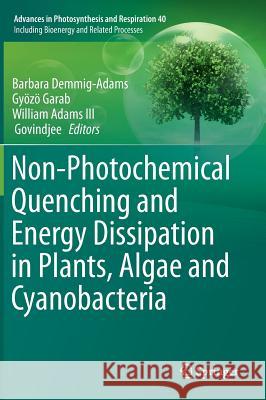
Barbara Demmig-Adams; William Adams III; Gyozo Garab
Non-Photochemical Quenching and Energy Dissipation in Plants, Algae and Cyanobacteria Demmig-Adams, Barbara 9789401790314 Springer - książkaWidoczna okładka, to zdjęcie poglądowe, a rzeczywista szata graficzna może różnić się od prezentowanej.

Non-Photochemical Quenching and Energy Dissipation in Plants, Algae and Cyanobacteria

ISBN-13: 9789401790314 / Angielski / Twarda / 2014 / 649 str.

Barbara Demmig-Adams; William Adams III; Gyozo Garab
cena 1129,80
(netto: 1076,00 VAT:  5%)

Najniższa cena z 30 dni: 1079,53
Termin realizacji zamówienia:
ok. 22 dni roboczych
Bez gwarancji dostawy przed świętami

Darmowa dostawa!

Harnessing the sun s energy via photosynthesis is at the core of sustainable production of food, fuel, and materials by plants, algae, and cyanobacteria. Photosynthesis depends on photoprotection against intense sunlight, starting with the safe removal of excess excitation energy from the light-harvesting system, which can be quickly and non-destructively assessed via non-photochemical quenching of chlorophyll fluorescence (NPQ). By placing NPQ into the context of whole-organism function, this book aims to contribute towards identification of plant and algal lines with superior stress resistance and productivity. By addressing agreements and open questions concerning photoprotection s molecular mechanisms, this book contributes towards development of artificial photosynthetic systems. A comprehensive picture from single molecules to organisms in ecosystems, and from leading expert s views to practical information for non-specialists on NPQ measurement and terminology is presented."


Kategorie:
Nauka, Biologia i przyroda
Kategorie BISAC:
Science > Botanika
Science > Cytologia
Science > Spectroscopy & Spectrum Analysis
Wydawca:
Springer
Seria wydawnicza:
Advances in Photosynthesis and Respiration
Język:
Angielski
ISBN-13:
9789401790314
Rok wydania:
2014
Wydanie:
2014
Numer serii:
000266451
Ilość stron:
649
Wymiary:
25.4 x 17.8
Oprawa:
Twarda
Wolumenów:
01

"The editors are to be complimented now for compiling such a comprehensive collection of wisdom on energy dissipation in photosynthetic organisms. ... the library of any institution committed to teaching frontline plant biology provide access to this book for graduate students, postdocs, and research leaders. Moreover, it is indispensible for any laboratory engaged in next generation research in photosynthesis ... ." (Barry Osmond, Photosynthesis Research, Vol. 24, 2015)

From the Series Editors.- Preface.- 1. The Non-Photochemical Quenching of the Electronically Excited State of Chlorophyll a in Plants:  Definitions, Timelines, Viewpoints, Open Questions; George C. Papageorgiou, Govindjee.- 2. Lessons from Nature:  A Personal Perspective; William W. Adams III, Barbara Demmig-Adams.- 3. Developments in Non-Photochemical Quenching Research – Emergence of Key Ideas, Theories and Experimental Approaches; Peter Horton.- 4. Photophysics of Photosynthetic Pigment-Protein Complexes; Evgeny E. Ostroumov et al.- 5. Non-Photochemical Quenching Mechanisms in Intact Organisms as Derived from Ultrafast-Fluorescence Kinetic Studies; Alfred R. Holzwarth, Peter Jahns.- 6. How Protein Disorder Controls Non-Photochemical Fluorescence Quenching; Tjaart P. J. Krüger et al.- 7. Context, Quantification, and Measurement Guide for Non-Photochemical Quenching of Chlorophyll Fluorescence; Barry A. Logan et al.- 8. Spectroscopic Investigation of Carotenoids Involved in Non-Photochemical Fluorescence Quenching; Tomáš Polívka, Harry A. Frank.- 9. Electronic Carotenoid-Chlorophyll Interactions Regulating Photosynthetic Light Harvesting of Higher Plants and Green Algae; P. Jomo Walla et al.- 10. Antenna Protein Conformational Changes Revealed by Resonance Raman Spectroscopy; Andrew A. Pascal et al.- 11. Fucoxanthin-Chlorophyll-Proteins and Non-Photochemical Fluorescence Quenching in Diatoms;

Claudia Büchel.- 12. Involvement of a Second Xanthophyll Cycle in Non-Photochemical Quenching of Chlorophyll Fluorescence: the Lutein Epoxide Story; Raquel Esteban, José I. García-Plazaola.- 13. PsbS-dependent Non-Photochemical Fluorescence Quenching; Matthew D. Brooks et al.- 14. Molecular Mechanisms for Activation of Non-Photochemical Fluorescence Quenching: From Unicellular Algae to Mosses and Higher Plants; Tomas Morosinotto, Roberto Bassi.- 15. Are Chlorophyll-Carotenoid Interactions Responsible for Rapidly Reversible Non-Photochemical Fluorescence Quenching?; Herbert van Amerongen.- 16. Structural Changes and Non-Photochemical Quenching of Chlorophyll a Fluorescence in Oxygenic Photosynthetic Organisms; Győző Garab.- 17. Non-Photochemical Fluorescence Quenching and the Dynamics of Photosystem II Structure; Alexander V. Ruban, Conrad W. Mullineaux.- 18. Control of Non-Photochemical Exciton Quenching by the Proton Circuit of Photosynthesis; Deserah D. Strand, David M. Kramer.- 19. Desiccation-Induced Quenching of Chlorophyll Fluorescence in Cryptogams; Wolfgang Bilger.- 20. The Peculiar Features of Non-Photochemical Fluorescence Quenching in Diatoms and Brown Algae; Johann Lavaud, Reimund Goss.- 21. High Light Acclimation in Green Microalgae; Giovanni Finazzi, Jun Minagawa.- 22. Mechanisms Modulating Energy Arriving at Reaction Centers in Cyanobacteria; Diana Kirilovsky et al.- 23. Photosystem II Efficiency and Non-Photochemical Fluorescence Quenching in the Context of Source-Sink Balance; William W. Adams III et al.- 24. Non-Photochemical Fluorescence Quenching in Contrasting Plant Species and Environments; Barbara Demmig-Adams et al.- 25. Non-Photochemical Fluorescence Quenching Across Scales: from Chloroplasts to Plants to Communities; Erik H. Murchie, Jeremy Harbinson.- 26. Beyond Non-Photochemical Fluorescence Quenching: the Overlapping Antioxidant Functions of Zeaxanthin and Tocopherols; Michel Havaux, José I. García-Plazaola.- 27. Thermal Energy Dissipation in Plants under Unfavorable Soil Conditions; Fermín Morales et al.- 28. Chloroplast Photoprotection and the Trade-Off Between Abiotic and Biotic Defense; Barbara Demmig-Adams et al.- Subject Index.


Harnessing the sun’s energy via photosynthesis is at the core of sustainable production of food, fuel, and materials by plants, algae, and cyanobacteria. Photosynthesis depends on protection (photoprotection) against the perils of intense sunlight.  The first line of defense among a cascade of photoprotective mechanisms is the safe removal of excess excitation energy within the light-harvesting system. The widely used indicator for photoprotective energy dissipation (thermal de-excitation of excited-state chlorophyll) is the quick, facile, and non-destructive assessment of non-photochemical quenching of chlorophyll fluorescence (NPQ). By placing light harvesting and photoprotection into the context of whole-organism function, this book directs the use of NPQ to aid in the identification of plant and algal lines with superior stress resistance and productivity. Furthermore, this volume addresses open questions in the interpretation of the molecular mechanisms of light harvesting and energy dissipation, the resolution of which should aid in the development of artificial photosynthetic systems. A comprehensive picture – from theory to practice, and from single molecules to organisms in ecosystems – is presented. In addition to providing current views of the leading specialists in this area, this book includes basic and practical information for non-specialists. For example, this book critically examines uses and misuses of the term NPQ and of advantages and pitfalls of NPQ measurements, and presents concrete recommendations for all concerned.


Udostępnij

Facebook - konto krainaksiazek.pl


Opinie o Krainaksiazek.pl na Opineo.pl

Partner Mybenefit

Krainaksiazek.pl w programie rzetelna firma Krainaksiaze.pl - płatności przez paypal

Czytaj nas na:

Facebook - krainaksiazek.pl
  • książki na zamówienie
  • granty
  • książka na prezent
  • kontakt
  • pomoc
  • opinie
  • regulamin
  • polityka prywatności

Zobacz:

  • Księgarnia czeska

  • Wydawnictwo Książkowe Klimaty

1997-2025 DolnySlask.com Agencja Internetowa

© 1997-2022 krainaksiazek.pl
     
KONTAKT | REGULAMIN | POLITYKA PRYWATNOŚCI | USTAWIENIA PRYWATNOŚCI
Zobacz: Księgarnia Czeska | Wydawnictwo Książkowe Klimaty | Mapa strony | Lista autorów
KrainaKsiazek.PL - Księgarnia Internetowa

Polityka prywatnosci - link
Krainaksiazek.pl - płatnośc Przelewy24
Przechowalnia Przechowalnia






