• Wyszukiwanie zaawansowane
  • Kategorie
  • Kategorie BISAC
  • Książki na zamówienie
  • Promocje
  • Granty
  • Książka na prezent
  • Opinie
  • Pomoc
  • Załóż konto
  • Zaloguj się

Next-Generation Ftth Passive Optical Networks: Research Towards Unlimited Bandwidth Access » książka


zaloguj się | załóż konto
Logo Krainaksiazek.pl

koszyk

konto

szukaj
topmenu
Księgarnia internetowa
Szukaj
Książki na zamówienie
Promocje
Granty
Książka na prezent
Moje konto
Pomoc
 
 
Wyszukiwanie zaawansowane
Pusty koszyk
Bezpłatna dostawa dla zamówień powyżej 20 złBezpłatna dostawa dla zamówień powyżej 20 zł

Kategorie główne

• Nauka
 [2949965]
• Literatura piękna
 [1857847]

  więcej...
• Turystyka
 [70818]
• Informatyka
 [151303]
• Komiksy
 [35733]
• Encyklopedie
 [23180]
• Dziecięca
 [617748]
• Hobby
 [139972]
• AudioBooki
 [1650]
• Literatura faktu
 [228361]
• Muzyka CD
 [398]
• Słowniki
 [2862]
• Inne
 [444732]
• Kalendarze
 [1620]
• Podręczniki
 [167233]
• Poradniki
 [482388]
• Religia
 [509867]
• Czasopisma
 [533]
• Sport
 [61361]
• Sztuka
 [243125]
• CD, DVD, Video
 [3451]
• Technologie
 [219309]
• Zdrowie
 [101347]
• Książkowe Klimaty
 [123]
• Zabawki
 [2362]
• Puzzle, gry
 [3791]
• Literatura w języku ukraińskim
 [253]
• Art. papiernicze i szkolne
 [7933]
Kategorie szczegółowe BISAC

Next-Generation Ftth Passive Optical Networks: Research Towards Unlimited Bandwidth Access

ISBN-13: 9781402084690 / Angielski / Twarda / 2008 / 188 str.
Prat, Josep
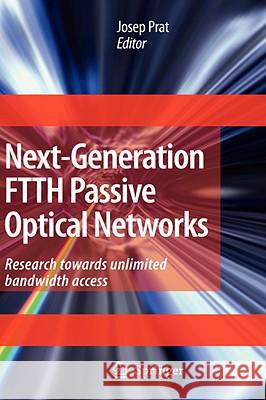
Next-Generation Ftth Passive Optical Networks: Research Towards Unlimited Bandwidth Access Prat, Josep 9781402084690 KLUWER ACADEMIC PUBLISHERS GROUP - książkaWidoczna okładka, to zdjęcie poglądowe, a rzeczywista szata graficzna może różnić się od prezentowanej.

Next-Generation Ftth Passive Optical Networks: Research Towards Unlimited Bandwidth Access

ISBN-13: 9781402084690 / Angielski / Twarda / 2008 / 188 str.

Prat, Josep
cena 403,47 zł
(netto: 384,26 VAT:  5%)

Najniższa cena z 30 dni: 385,52 zł
Termin realizacji zamówienia:
ok. 22 dni roboczych
Bez gwarancji dostawy przed świętami

Darmowa dostawa!

Fibre-to-the-Home networks constitute a fundamental telecom segment with the required potential to match the huge capacity of transport networks with the new user communication demands. Huge investments in access network infrastructure are expected for the next decade, with many initiatives already launched around the globe recently, driven by the new broadband service demands and the necessity by operators to deploy a future-proof infrastructure in the field. Dense FTTH Passive Optical Networks (PONs) is a cost-efficient way to build fibre access, and international standards (G/E-PON) have been already launched, leading to new set of telecom products for mass deployment. However, these systems only make use of less than 1% of the optical bandwidth; thus, relevant research is taking place to maximize the capacity of these systems, with the latest opto-electronic technologies, demonstrating that the huge bandwidth available through the fibre access can be exploited in a cost-efficient and reliable manner. Next-Generation FTTH Passive Optical Networks gathers and analyzes the most relevant techniques developed recently on technologies for the next generation FTTH networks, trying to answer the question: what's after G/E-PONs?


Kategorie:
Technologie
Kategorie BISAC:
Science > Optyka
Technology & Engineering > Telecommunications
Technology & Engineering > Optics
Wydawca:
KLUWER ACADEMIC PUBLISHERS GROUP
Język:
Angielski
ISBN-13:
9781402084690
Rok wydania:
2008
Wydanie:
2008
Ilość stron:
188
Waga:
1.11 kg
Wymiary:
23.5 x 15.5
Oprawa:
Twarda
Wolumenów:
01
Dodatkowe informacje:
Wydanie ilustrowane

Preface. Acknowledgements. Contributors. Abbrevations. List of Figures. List of Tables. References. 1 Introduction. 1.1 Organization of the Document. 2 Architecture of Future Access Networks. 2.1 Multiplexing level. 2.2 WDM – Passive Optical Network. 2.2.1 Wavelength allocation strategies. 2.2.2 Dynamic network reconfiguration using flexible WDM. 2.2.3 Static WDM PONs. 2.2.4 Wavelength routed PON. 2.2.5 Reconfigurable WDM PONs. 2.2.6 Wavelength broadcast-and-select access network. 2.2.7 Wavelength routing access network. 2.3 Geographical, optical and virtual topologies: star, tree, bus, ring and combined. 2.3.1 Tree topology. 2.3.2 Bus topology. 2.3.3 Ring topology. 2.3.4 Tree with redundant trunk. 2.3.5 Arrayed Waveguide Grating based single hop WDM/TDM PON. 2.4 Compatibility with Radio applications UWB, UMTS, WiFi. 2.5 Radio-over-Fibre. 2.6 Next Generation G/E-PON standards development process. 2.6.1 Development of 10G EPON. 2.6.2 Next generation GPON systems. 2.6.3 Summary. 3 Components for Future Access Networks. 3.1 Tuneable Optical Network Unit. 3.2 Fast-tunable laser at the Optical Line Terminal. 3.3 Arrayed Waveguide Gratings. 3.3.1 Wavelength router functionality.3.3.2 Applications in access networks.3.3.3 Arrayed Waveguide Grating characterization.3.4 Reflective receivers and modulators. 3.4.1 Electroabsorption Modulator. 3.4.2 Semiconductor Optical Amplifiers. 3.4.3 Reflective Semiconductor Optical Amplifier. 3.4.4 Erbium Doped Waveguide Amplifiers and integration with RSOA and REAM for high performance colourless ONT. 4 Enhanced Transmission Techniques. 4.1 Advanced functionalities in Ethernet PONs. 4.1.1 Wavelength conversion. 4.1.2 Tolerance to wavelength conversion range. 4.2 Bidirectional single fibre transmission with colourless Optical Network Unit. 4.2.1 Remodulation by using Reflective Semiconductor Optical Amplifiers. 4.2.2 Fabry Perot InjectionLocking with high bandwidth and low optical power for locking. 4.2.3 Characterization of Rayleigh Backscattering. 4.2.4 Strategies to mitigate Rayleigh Backscattering. 4.2.5 ASK-ASK configuration using time division multiplexing. 4.2.6 FSK-ASK configuration using modulation format multiplexing. 4.2.7 Subcarrier Multiplexing by electrical frequency multiplexing. 4.2.8 Rayleigh Scattering Reduction by means of Optical Frequency Dithering. 4.3 Spectral slicing. 4.4 Alternative modulation formats to NRZ ASK. 4.5 Bidirectional Very high rate DSL transmission over PON. 4.5.1 Heterodyning systems. 4.5.2 Optical frequency multiplying systems. 4.5.3 Coherent systems. 4.6 Active and remotely-pumped optical amplification. 4.6.1 Burst traffic. 4.6.2 Raman amplification in Ethernet PONs. 4.6.3 Remote powering. 4.7 Variable splitter, variable multiplexer. 5 Network Protection. 5.1 Definitions. 5.2 Protection schemes. 5.2.1 Standard schemes. 5.2.2 Novel schemes. 5.3 Reliability performance evaluation. 5.3.1 Reliability requirements and reliability data. 5.3.2 Reliability models. 5.3.3 Results. 5.3.4 Power supply. 5.4 Conclusions. 6 Traffic Studies. 6.1 Dynamic Bandwith Allocation, QoS and priorization in TDMA PONs. 6.1.1 Implementation of a Dynamic Bandwidth Allocation mechanism. 6.1.2 Definition and state of art. 6.1.3 Migration toward a dynamic bandwidth allocated BPON and selection criteria. 6.2 WDMA/TDMA Medium Access Control. 6.2.1 Access Protocol for Arrayed Waveguide Grating based TDMA/WDMA PONs for Metropolitan Area Networks. 6.2.2 Geographical Bandwidth Allocation. 6.3 Access Protocols for WDM Rings with QoS Support. 6.3.1 Analytical Model. 6.3.2 Numerical Results. 6.3.3 Access Protocol Supporting QoS Differentiated Services. 6.3.4 Performance Study. 6.3.5 Summary. 6.4 Efficient Support for Multicast and Peer-to-peer traffic. 6.4.1 Multicast Traffic.6.4.2 Peer-to-Peer Traffic. 7 Metro-Access Convergence.

Fibre-to-the-Home networks constitute a fundamental telecom segment with the required potential to match the huge capacity of transport networks with the new user communication demands. Major investments in access network infrastructure are expected for the next decade, with many initiatives already launched around the globe recently, driven by the new broadband services and the necessity by operators to deploy a future-proof infrastructure in the field. Dense FTTH Passive Optical Networks (PONs) is a cost efficient way to build fibre access, and international standards (G/E-PON) have been already launched, leading to new set of telecom products for mass deployment. However, these systems only make use of less than 1% of the optical bandwidth; thus, relevant research is taking place to maximize the capacity of these systems, with the latest opto-electronic technologies, demonstrating that the huge bandwidth available through the fibre access can be exploited in a cost efficient and reliable manner. Next-Generation FTTH Passive Optical Networks gathers and analyzes the most relevant techniques developed recently on technologies for the next generation FTTH networks, trying to answer the question: what’s after G/E-PONs?


Udostępnij

Facebook - konto krainaksiazek.pl


Opinie o Krainaksiazek.pl na Opineo.pl

Partner Mybenefit

Krainaksiazek.pl w programie rzetelna firma Krainaksiaze.pl - płatności przez paypal

Czytaj nas na:

Facebook - krainaksiazek.pl
  • książki na zamówienie
  • granty
  • książka na prezent
  • kontakt
  • pomoc
  • opinie
  • regulamin
  • polityka prywatności

Zobacz:

  • Księgarnia czeska

  • Wydawnictwo Książkowe Klimaty

1997-2025 DolnySlask.com Agencja Internetowa

© 1997-2022 krainaksiazek.pl
     
KONTAKT | REGULAMIN | POLITYKA PRYWATNOŚCI | USTAWIENIA PRYWATNOŚCI
Zobacz: Księgarnia Czeska | Wydawnictwo Książkowe Klimaty | Mapa strony | Lista autorów
KrainaKsiazek.PL - Księgarnia Internetowa

Polityka prywatnosci - link
Krainaksiazek.pl - płatnośc Przelewy24
Przechowalnia Przechowalnia





