• Wyszukiwanie zaawansowane
  • Kategorie
  • Kategorie BISAC
  • Książki na zamówienie
  • Promocje
  • Granty
  • Książka na prezent
  • Opinie
  • Pomoc
  • Załóż konto
  • Zaloguj się

Newton's Physics and the Conceptual Structure of the Scientific Revolution » książka


zaloguj się | załóż konto
Logo Krainaksiazek.pl

koszyk

konto

szukaj
topmenu
Księgarnia internetowa
Szukaj
Książki na zamówienie
Promocje
Granty
Książka na prezent
Moje konto
Pomoc
 
 
Wyszukiwanie zaawansowane
Pusty koszyk
Bezpłatna dostawa dla zamówień powyżej 20 złBezpłatna dostawa dla zamówień powyżej 20 zł

Kategorie główne

• Nauka
 [2944077]
• Literatura piękna
 [1814251]

  więcej...
• Turystyka
 [70679]
• Informatyka
 [151074]
• Komiksy
 [35590]
• Encyklopedie
 [23169]
• Dziecięca
 [611005]
• Hobby
 [136031]
• AudioBooki
 [1718]
• Literatura faktu
 [225599]
• Muzyka CD
 [379]
• Słowniki
 [2916]
• Inne
 [443741]
• Kalendarze
 [1187]
• Podręczniki
 [166463]
• Poradniki
 [469211]
• Religia
 [506887]
• Czasopisma
 [481]
• Sport
 [61343]
• Sztuka
 [242115]
• CD, DVD, Video
 [3348]
• Technologie
 [219293]
• Zdrowie
 [98602]
• Książkowe Klimaty
 [124]
• Zabawki
 [2385]
• Puzzle, gry
 [3504]
• Literatura w języku ukraińskim
 [260]
• Art. papiernicze i szkolne
 [7151]
Kategorie szczegółowe BISAC

Newton's Physics and the Conceptual Structure of the Scientific Revolution

ISBN-13: 9789401054461 / Angielski / Miękka / 2012 / 588 str.
Z. Bechler
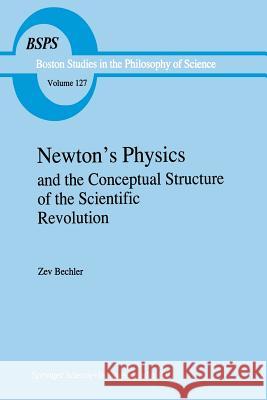
Newton's Physics and the Conceptual Structure of the Scientific Revolution Z. Bechler 9789401054461 Springer - książkaWidoczna okładka, to zdjęcie poglądowe, a rzeczywista szata graficzna może różnić się od prezentowanej.

Newton's Physics and the Conceptual Structure of the Scientific Revolution

ISBN-13: 9789401054461 / Angielski / Miękka / 2012 / 588 str.

Z. Bechler
cena 1207,67
(netto: 1150,16 VAT:  5%)

Najniższa cena z 30 dni: 1156,64
Termin realizacji zamówienia:
ok. 22 dni roboczych.

Darmowa dostawa!

Three events, which happened all within the same week some ten years ago, set me on the track which the book describes. The first was a reading of Emile Meyerson works in the course of a prolonged research on Einstein's relativity theory, which sent me back to Meyerson's Ident- ity and Reality, where I read and reread the striking chapter on "Ir- rationality". In my earlier researches into the origins of French Conven- tionalism I came to know similar views, all apparently deriving from Emile Boutroux's doctoral thesis of 1874 De fa contingence des lois de la nature and his notes of the 1892-3 course he taught at the Sorbonne De ['idee de fa loi naturelle dans la science et la philosophie contempo- raines. But never before was the full effect of the argument so suddenly clear as when I read Meyerson. On the same week I read, by sheer accident, Ernest Moody's two- parts paper in the JHIof 1951, "Galileo and Avempace". Put near Meyerson's thesis, what Moody argued was a striking confirmation: it was the sheer irrationality of the Platonic tradition, leading from A vem- pace to Galileo, which was the working conceptual force behind the notion of a non-appearing nature, active all the time but always sub- merged, as it is embodied in the concept of void and motion in it.


Kategorie:
Nauka, Filozofia
Kategorie BISAC:
Science > Philosophy & Social Aspects
Philosophy > Filozofia
Political Science > History & Theory - General
Wydawca:
Springer
Seria wydawnicza:
Boston Studies in the Philosophy and History of Science
Język:
Angielski
ISBN-13:
9789401054461
Rok wydania:
2012
Wydanie:
Softcover Repri
Numer serii:
000454060
Ilość stron:
588
Waga:
0.93 kg
Wymiary:
23.5 x 15.5
Oprawa:
Miękka
Wolumenów:
01

I: The Tradition.- One: Aristotelian and Platonic Conceptions of Explanation.- 1. Introduction.- 2. Aristotle’s Notorious Blunder.- 3. The Accepted Explanation and its Distortion of Aristotle’s Physics.- 4. The Accepted Explanation and the Dissolution of the Scientific Revolution.- 5. The Essence of the Scientific Revolution.- 6. Informative and Non-Informative Concepts of Explanation.- 7. The Irrationality of Informative Explanation.- 8. The Rationality of Non-Informative Explanation: Aristotle’s Example.- 9. Some Paradoxes of the New Empiricism: Forces, God, Souls and Space and Time.- 10. The Place of God in Informative Science.- 11. The Place of Spirit in Informative Science.- 12. Absoluteness of Space and Time in Informative Science.- Two: Aristotle’s Philosophy of Nature and Theory of Potentiality.- 1. The Two Potentialities.- 2. The Nature of Consistency Potentiality.- 3. The Nature of Genuine Potentiality.- 4. The Nullity of Potentiality.- 5. Potentiality, Lack and the Coincidental.- 6. The Priority of the Actual.- 7. The Rationality of Genuine Potentiality.- 8. Potentiality and the Theory of Motion.- 9. “Form” is not “Another” and Cannot Be Moved by Another.- 10. What, Then, Moves the Five Elements?.- 11. Can Potentiality Be the Mover?.- 12. The Ontology of the Two Potentialities in Action.- 13. First Movers and the Physics.- 14. The Ontology of the Syllogism.- 15. The Physics of the Syllogism.- 16. The Potentiality of the Infinite and the Non-Informativity of Mathematics.- Three: Plato’s Concept of the Actual and His Philosophy of Nature.- 1. Socrates’ Search for Scientific Explanation.- 1.1. Socrates’ Puzzles and his View of Explanation.- 1.2. Socrates’ Attack on Anaxagoras.- 1.3. The Informativity of the Forms.- 1.4. Teleology and Aristotle’s Critique of Plato’s Forms.- 2. Causality, Invisibility and Plato’s Informative Explanation.- 2.1. Explanation and the Invisibility of Real Causes.- 2.2. Mixture, Necessity and the New Explanation.- 2.3. Soul, Motion and Medial Entities.- 2.4. Medial Entities, Bastard Knowledge and the Inherence of Paradox.- 2.5. Circular Reasoning and the Discovery of Bastard Knowledge.- II: The Logical Revolution.- Four: The Copernican Harmony.- 1. Copernicus’ Harmony and the Copernican Revolution.- 2. The Monster: Ptolemaic Astronomy.- 3. Regularities and Regularities of Regularities.- 4. Error and Hypothesis: The Platonic Connection.- 5. Copernicus’ Harmony.- 6. Harmony and the Informativity of Copernicus’ Astronomy.- Five: Bacon’s Informative Logic.- 1. Inductive Logic and Informativity.- 2. The Meaning of Forms.- 3. Latent Configuration and Latent Process.- 4. Prediction and Informativity.- 5. Bacon’s Platonism and Final Circularity.- Six: Informativity and Paradox: Galileo’s Conception of the Nature of Physical Reality.- 1. Galileo’s Method and his Fallacia Consequentis.- 2. Ex Suppositione Argument as Demonstrative: Free Fall and Parabolic Motion.- 3. Attempts to Rescue Galileo: (1) Wallace.- 4. Attempts to Rescue Galileo: (2) Wisan.- 5. The Solution: When do Phenomena Entail their Hidden Essentia?.- 6. The Ontology of the Zero and the Void: The Clash with Aristotle.- 7. Galileo’s Platonic Ontology: the Actuality of the Potential, the Nature of the Resultant, and the “Book of Nature”.- 8. Galileo on the Actual Infinite and the Method of Paradox.- 9. The Structure of Acceleration.- 10. Koyré’s Conception of Platonism and Galileo’s Inertial Motion.- 11. Galileo’s Conception of Inertial Motion.- 12. Galileo’s Concept of Permanent Impetus.- 13. Galileo’s Rejection of Natural Motion.- 14. Galileo’s Inertial Motion as a Process.- 15. Galileo’s Circular Arguments.- 16. Attempts to Rescue Galileo: (3) Drake and Mertz.- 17. Limbo Entities, Mixed Science, and Circularity.- Seven: Descartes’ Informative Logic.- 1. Descartes’ Conception of Deduction.- 2. Descartes’ Logical Revolt and the Cogito.- 3. Two Novel Circularities?.- 4. Distinctness, Adequacy and Completeness — Circularity is Definitely In.- 5. Descartes’ Ontology of Essences: Dispute Against the Nominalists.- 6. The Inevitability of Separate Essences in Descartes’s Ontology.- 7. Cartesian Platonism: A Note on Malebranche’s Interpretation of Descartes.- 8. Cartesian Orthodoxy — Arnauld’s Interpretation and its Failure.- 9. The Absoluteness of Motion and of Conatus.- 10. The Internality of Conatus and its Counteractuality.- 11. Motion and Shape as Modes and the Essence of Matter.- 12. The Identity of Motion: Extension and the Absoluteness of Motion.- 13. Why is Motion a “Mere Mode”?.- 14. The Paradoxality of Motion.- 15. The Invisibility of Nature, Law and the Conservation of State.- 16. Inertia, State and Existence in an Instant.- 17. Inertial Motion as an Actual Potentiality.- 18. Componential vs. Resultant Entities.- 19. The Nature of Time and the Principle of Inertia.- 20. The Paradox of Analysis.- 21. Informativity and the Heterogeneity of Analysis and Synthesis.- 22. Informativity and Causality.- 23. Informativity and Circularity.- III: Newton’s Physics and its Critics.- Eight: Actual Infinity and Newton’s Calculus.- 1. The Platonic Presuppositions of Newton’s Limit Theory.- 2. The Aristotelian Character of Greek Exhaustion Theory.- 3. The “Ultimate Ratio” as a New Category of Existence.- 4. The Structure of a Point: Process during an Instant and the Infinitesimal Nature of the Limit.- 5. Newton’s Implicit Acceptance of the Infinitesimal and his Explicit Acceptance of Actual Infinity.- Nine: Newton’s Logic of Space and Time.- 1. Newton’s Principle of the Distinctness of Indiscernibles.- 2. The Actuality of Space and its Medial Ontology.- 3. The Actuality of Geometric Forms in Space.- 4. The Platonic Logic of Newton’s Inertial Motion.- Ten: Modern Newtonian Historiography and the Puzzle of Newton’s Absolute Space.- 1. The Aristotelian Foundation of Westfall’s Interpretation of Newton.- 2. The Aristotelian Foundation of Herivel’s Interpretation.- 3. The Aristotelian Foundation of Cohen’s Interpretation.- 4. Cohen’s Concept of “Newtonian Style”.- Eleven: Absolute Motion and the Nature of Inertial Forces.- 1. Newton’s Bucket is Not an Attempt to Prove the Reality of Motion or of Space.- 2. The Bucket Intends to Prove that Absolute Motion Can Be Observed Even in a Single Body.- 3. The Bucket Presupposes Absolute Form and Space.- 4. The “Effects” of Motion and Newton’s Inertial Forces.- 5. The Distinctness of Inertial Force from Body and from Motion.- 6. The Splitting of the Force of Inertia.- 7. Curved Motion as an Equilibrium.- 8. Inertial Force as a Causal Agent and the Transformation of Internal and External Forces.- 9. The Laws of Motion and the Classification of Forces.- 10. Inertial Force as Cause and the Mechanism of Inertial Deformation.- 11. Force and Essence: The Separability of Inertial Force.- 12. Two Kinds of Essentiality and the Bentley Correspondence.- 13. Primary, Essential and Universal Forces.- 14. Inertial Force as a Force at a Distance.- Twelve: Locke and the Meaning of “Empiricism”.- 1. Locke’s Conception of Essence.- 2. Locke on the Impossibility of Real Science and the Existence of Necessary Yet Informative Truths.- 3. Locke’s So Called Empiricism and God’s Superaddition.- 4. The Merge of Logic and Physics.- 5. Association of Ideas and Inconceivability.- 6. Inconceivability and the Necessity of Mathematical Truths.- 7. The Necessity of Essential Links.- 8. Locke’s Presupposition of Inborn Associations.- Thirteen: Newton’s Invention of the Problem of Induction.- 1. The Triviality of the Problem of Induction.- 2. Newton’s Abolishment of the Hypothetico-Deductive Method.- 3. The Search for an Uncertainty Element: Correspondence with Cotes and the First Appearance of the Problem of Induction.- 4. “If Cotes Had Lived” Cotes’ Preface 1713.- 5. The Conceptual Content of Law III and the Logic of its Applicability.- 6. Some Modern Attitudes to the Cotes Affair.- 7. The Emergence of Restricted Universality: The Leibniz-Clarke Dispute 1715-6.- 8. The Final Resolution: The Uncertainty of Future Exceptions — the 1717 Opticks and the 1726 Principia.- 9. The Meaning and Role of the Fourth Rule of Philosophising, 1726.- 10. Platonic and Aristotelian Problems of Induction.- Fourteen: Circularity and Newton’s Philosophy of Nature.- 1. The Duhem-Popper Argument and Other Puzzles.- 1.1. The Importance of Duhem’s Arguments.- 1.2. A Scheme of Newton’s Derivation in the Principia and the Formal Arguments of Duhem and Popper.- 1.3. Three New Puzzles and the Letter to Halley.- 1.4. Split Reference and a Primary Interpretation of the Halley Letter.- 1.5. Splitting the Unobserved Reality Realm: Componential and Resultant Denotations in the Principia Proofs and Further Interpretation of the Halley Letter.- 1.6. Resolution of the Irrationality Puzzle: The Different Referential Import of the Premises and Consequences of the Principia, and the Double Functionality of the Premises.- 1.7. Resolution of the Second Puzzle by the Double Function of the Premises: In What Sense Newton Did Not Guess Kepler’s Ellipse.- 1.8. Some Further Textual Evidence.- 2. The Vicious Circle Principle of Newton’s Physics, and the Empirical Philosophy of the Scientific Revolution.- 2.1. Summary and Introduction to the Vicious Circle Argument: The First Example: Kepler Motion.- 2.2. The Second Example of Circular Proof: The Inverse Square Law.- 2.3. The Third Example of Circular Proof: Absolute Space.- 2.4. The Fourth Example of Circular Proof: The Copernican System.- 2.5. The Fifth Example of Circular Proof: The Sine Law for Monochromatic Light.- 2.6. The First Critique of Newton’s Circular Argument: George Gordon.- 2.7. Circularity and Deviant Logic.- Fifteen: Leibniz’s Aristotelian Philosophy of Nature.- 1. Equivalent Explanations and the Nature of Forces.- 2. Leibniz’ Aristotelian Theory of Space and Time.- 3. The Identity of the Subject and its Predicate-Sequence.- 4. Divine Conceptualism.- 5. The Sea-Battle and Leibniz' Apologetics.- 6. Entelechies, Souls, Natures and Analyticity.- 7. Leibniz’ Response to the Platonic Attacks and the Aristotelian Structure of the Theodicy Apology.- 8. Natural Motion and the Automaton.- 9. Leibniz’ Aristotelianism and his Critique of Gravitation.- 10. Leibniz’ Concept of Actual Infinity.- 11. Equivalence and Leibniz’s Conventionalism.- Sixteen: Berkeley’s Aristotelian Critique of Newton’s Physics.- 1. Berkeley’s Aristotelian Critique of the Calculus.- 2. Berkeley’s Aristotelian Foundation for the Calculus: (1) The Compensation of Errors.- 3. Berkeley’s Aristotelian Foundation for the Calculus: (2) The Analytico-Geometrical Equation.- 4. The Ineffectivity of Berkeley’s Critique.- 5. Berkeley’s Rejection of Heterogeneous Ratios and the Critique of Fluxions.- 6. Berkeley’s Late Critique of Newtonian Forces as Potentialities and his Identification of Force and Motion.- 7. Berkeley’s Non-Dynamic Conception of Nature.- 8. Berkeley’s Ontology and his View of Scientific Explanation.- 9. The Failure of Berkeley’s Relativism.- Epilogue.- Appendix: Some Basic Ideas in Newton’s Physics.- Notes.


Udostępnij

Facebook - konto krainaksiazek.pl


Opinie o Krainaksiazek.pl na Opineo.pl

Partner Mybenefit

Krainaksiazek.pl w programie rzetelna firma Krainaksiaze.pl - płatności przez paypal

Czytaj nas na:

Facebook - krainaksiazek.pl
  • książki na zamówienie
  • granty
  • książka na prezent
  • kontakt
  • pomoc
  • opinie
  • regulamin
  • polityka prywatności

Zobacz:

  • Księgarnia czeska

  • Wydawnictwo Książkowe Klimaty

1997-2026 DolnySlask.com Agencja Internetowa

© 1997-2022 krainaksiazek.pl
     
KONTAKT | REGULAMIN | POLITYKA PRYWATNOŚCI | USTAWIENIA PRYWATNOŚCI
Zobacz: Księgarnia Czeska | Wydawnictwo Książkowe Klimaty | Mapa strony | Lista autorów
KrainaKsiazek.PL - Księgarnia Internetowa

Polityka prywatnosci - link
Krainaksiazek.pl - płatnośc Przelewy24
Przechowalnia Przechowalnia






