• Wyszukiwanie zaawansowane
  • Kategorie
  • Kategorie BISAC
  • Książki na zamówienie
  • Promocje
  • Granty
  • Książka na prezent
  • Opinie
  • Pomoc
  • Załóż konto
  • Zaloguj się

New Directions for Computing Education: Embedding Computing Across Disciplines » książka


zaloguj się | załóż konto
Logo Krainaksiazek.pl

koszyk

konto

szukaj
topmenu
Księgarnia internetowa
Szukaj
Książki na zamówienie
Promocje
Granty
Książka na prezent
Moje konto
Pomoc
 
 
Wyszukiwanie zaawansowane
Pusty koszyk
Bezpłatna dostawa dla zamówień powyżej 20 złBezpłatna dostawa dla zamówień powyżej 20 zł

Kategorie główne

• Nauka
 [2946912]
• Literatura piękna
 [1852311]

  więcej...
• Turystyka
 [71421]
• Informatyka
 [150889]
• Komiksy
 [35717]
• Encyklopedie
 [23177]
• Dziecięca
 [617324]
• Hobby
 [138808]
• AudioBooki
 [1671]
• Literatura faktu
 [228371]
• Muzyka CD
 [400]
• Słowniki
 [2841]
• Inne
 [445428]
• Kalendarze
 [1545]
• Podręczniki
 [166819]
• Poradniki
 [480180]
• Religia
 [510412]
• Czasopisma
 [525]
• Sport
 [61271]
• Sztuka
 [242929]
• CD, DVD, Video
 [3371]
• Technologie
 [219258]
• Zdrowie
 [100961]
• Książkowe Klimaty
 [124]
• Zabawki
 [2341]
• Puzzle, gry
 [3766]
• Literatura w języku ukraińskim
 [255]
• Art. papiernicze i szkolne
 [7810]
Kategorie szczegółowe BISAC

New Directions for Computing Education: Embedding Computing Across Disciplines

ISBN-13: 9783319542256 / Angielski / Twarda / 2017 / 308 str.
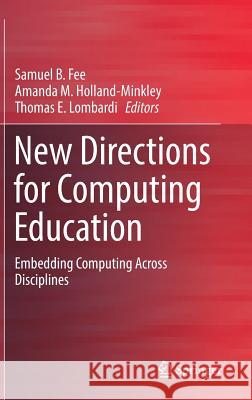
Samuel Fee; Amanda Holland-Minkley; Tom Lombardi
New Directions for Computing Education: Embedding Computing Across Disciplines Fee, Samuel B. 9783319542256 Springer - książkaWidoczna okładka, to zdjęcie poglądowe, a rzeczywista szata graficzna może różnić się od prezentowanej.

New Directions for Computing Education: Embedding Computing Across Disciplines

ISBN-13: 9783319542256 / Angielski / Twarda / 2017 / 308 str.

Samuel Fee; Amanda Holland-Minkley; Tom Lombardi
cena 201,24
(netto: 191,66 VAT:  5%)

Najniższa cena z 30 dni: 192,74
Termin realizacji zamówienia:
ok. 22 dni roboczych
Bez gwarancji dostawy przed świętami

Darmowa dostawa!

Why should every student take a computing course? What should be the content of these courses? How should they be taught, and by whom? This book addresses these questions by identifying the broader reaches of computing education, problem-solving and critical thinking as a general approach to learning.The book discusses new approaches to computing education, and considers whether the modern ubiquity of computing requires an educational approach that is inherently interdisciplinary and distinct from the traditional computer science perspective. The alternative approach that the authors advocate derives its mission from an intent to embed itself within an interdisciplinary arts and science context.An interdisciplinary approach to computing is compellingly valuable for students and educational institutions alike. Its goal is to support the educational and intellectual needs of students with interests in the entire range of academic disciplines. It capitalizes on students' focus on career development and employers' demand for technical, while also engaging a diverse student body that may not possess a pre-existing interest in computing for computing's sake. This approach makes directly evident the applicability of computer science topics to real-world interdisciplinary problems beyond computing and recognizes that technical and computational abilities are essential within every discipline. The book offers a valuable resource for computer science and computing education instructors who are presently re-thinking their curricula and pedagogical approaches and are actively trying new methods in the classroom. It will also benefit graduate students considering a future of teaching in the field, as well as administrators (in both higher education and high schools) interested in becoming conversant in the discourse surrounding the future of computing education.


Kategorie:
Podręczniki
Kategorie BISAC:
Education > Computers & Technology
Education > Administration - General
Wydawca:
Springer
Język:
Angielski
ISBN-13:
9783319542256
Rok wydania:
2017
Wydanie:
2017
Ilość stron:
308
Waga:
6.03 kg
Wymiary:
23.5 x 15.5
Oprawa:
Twarda
Wolumenów:
01
Dodatkowe informacje:
Wydanie ilustrowane

Introduction. Re-envisioning Computing Across Disciplines (Samuel B. Fee, Amanda M. Holland-Minkley and Thomas E. Lombardi).- Part I. The Case for Interdisciplinary Computing Education.-Chapter 1. Good (and Bad) Reasons to Teach All Students Computer Science (Colleen M. Lewis).- Chapter 2. Approaching Computer Science Education Through Making (Michael Eisenberg).- Chapter 3. Computer Science and the Liberal Arts: Hidden Synergies and Boundless Opportunities (Gary R. Skuse, Daniel A. Walzer, Kathryn Tomasek, Douglas Baldwin and Mark Bailey).- Chapter 4. Task-driven Programming Pedagogy in the Digital Humanities (David J. Birnbaum and Alison Langmead). Chapter 5. Macroanalysis in the Arts and Sciences (Thomas E. Lombardi).- Part II. Pedagogical & Curricular Approaches.- Chapter 6. An Unnamed Intersection: Where Computing Meets Liberal Arts (Enid Arbelo Bryant).- Chapter 7. Adapting the Studio Based Learning Methodology to Computer Science Education (Paula Alexandra Silva, Blanca J. Polo, and Martha E. Crosby).- Chapter 8. The Curricular Soundtrack: Designing Interdisciplinary Music Technology Degrees Through Cognitive Apprenticeship and Situated Learning (Daniel A. Walzer).- Chapter 9. An Interdisciplinary Model for Liberal Arts Computing Curricula (Amanda M. Holland-Minkley and Samuel B. Fee).- Part III. Case Studies and Examples.- Chapter 10. The Development of a B.A. in Computer Science and Computational Thinking (Kathie A. Yerion, Robert L. Bryant, and Shawn Bowers).- Chapter 11. Disciplinary Thinking, Computational Doing: Collaborating for Mutual Enrichment (Valerie Barr).- Chapter 12. A Capstone Experience in Information Technology (William H. Thomas, Loren K. Rhodes, and Gerald W. Kruse).- Chapter 13. Trial by a Many-Colored Flame: A Multi-Disciplinary, Community-Centric Approach to Digital Media and Computing Education (Adrienne Decker, Andrew Phelps, and Christopher A. Egert).- Chapter 14. A GitHub Garage for a Digital Humanities Course (Elisa E. Beshero-Bondar and Rebecca J. Parker).- Chapter 15. Educators as Clinicians: Small Data for Education Research (Thomas E. Lombardi and Amanda M. Holland-Minkley).- Chapter 16. Common Threads: Directions for Computing Education (Samuel B. Fee, Amanda M. Holland-Minkley and Thomas E. Lombardi).- About the Editors.- About the Authors.- Index.-

Samuel B. Fee is a Professor and Chair of Computing & Information Studies at Washington & Jefferson College. His research interests extend into the realms of computing, education, and digital media production. His inquiries within these areas are aimed at better answering a few specific questions, including: How can we best learn and conduct research within the broader realm of computing? How does technology change the way we interact with one another? How do visuals and interfaces impact our abilities to communicate and learn? And, beyond the quantitative methodologies of current Social Science research, how do we reinvigorate the discourse concerning the Art of teaching? He previously co-edited the volume The Role of Criticism in Understanding Problem Solving. He publishes regularly on the topics of computing pedagogies and educational research as well as software development and digital media.

Amanda M. Holland-Minkley is an Associate Professor of Computing & Information Studies at Washington & Jefferson College. Her research explores novel applications of problem-based and hands-on pedagogies to computer science education, both at the course and the curricular level. These applications strive to transform computer science content into forms useful and accessible to students from a diversity of disciplines. She is also highly engaged in undergraduate research, with recent projects falling at the intersection of information security, data management, and machine learning.

Thomas E. Lombardi is an Assistant Professor of Computer Information Systems in the School of Business at the University of the Virgin Islands. His research focuses on the application of data science and interdisciplinary computing to a wide range of subjects such as digital humanities, networking and bioinformatics. He is particularly interested in developing pedagogies for teaching data-oriented concepts to a broad audience for the purpose of improving civic education. Most recently his theoretical research has addressed the potential role of computation in the analysis of iconography. Specifically, this project applies data mining and machine learning techniques to large repositories of artwork.

Why should every student take a computing course? What should be the content of these courses? How should they be taught, and by whom? This book addresses these questions by identifying the broader reaches of computing education, problem-solving and critical thinking as a general approach to learning.

The book discusses new approaches to computing education, and considers whether the modern ubiquity of computing requires an educational approach that is inherently interdisciplinary and distinct from the traditional computer science perspective. The alternative approach that the authors advocate derives its mission from an intent to embed itself within an interdisciplinary arts and science context.

An interdisciplinary approach to computing is compellingly valuable for students and educational institutions alike. Its goal is to support the educational and intellectual needs of students with interests in the entire range of academic disciplines. It capitalizes on students’ focus on career development and employers’ demand for technical, while also engaging a diverse student body that may not possess a pre-existing interest in computing for computing’s sake. This approach makes directly evident the applicability of computer science topics to real-world interdisciplinary problems beyond computing and recognizes that technical and computational abilities are essential within every discipline.

The book offers a valuable resource for computer science and computing education instructors who are presently re-thinking their curricula and pedagogical approaches and are actively trying new methods in the classroom. It will also benefit graduate students considering a future of teaching in the field, as well as administrators (in both higher education and high schools) interested in becoming conversant in the discourse surrounding the future of computing education.




Udostępnij

Facebook - konto krainaksiazek.pl


Opinie o Krainaksiazek.pl na Opineo.pl

Partner Mybenefit

Krainaksiazek.pl w programie rzetelna firma Krainaksiaze.pl - płatności przez paypal

Czytaj nas na:

Facebook - krainaksiazek.pl
  • książki na zamówienie
  • granty
  • książka na prezent
  • kontakt
  • pomoc
  • opinie
  • regulamin
  • polityka prywatności

Zobacz:

  • Księgarnia czeska

  • Wydawnictwo Książkowe Klimaty

1997-2025 DolnySlask.com Agencja Internetowa

© 1997-2022 krainaksiazek.pl
     
KONTAKT | REGULAMIN | POLITYKA PRYWATNOŚCI | USTAWIENIA PRYWATNOŚCI
Zobacz: Księgarnia Czeska | Wydawnictwo Książkowe Klimaty | Mapa strony | Lista autorów
KrainaKsiazek.PL - Księgarnia Internetowa

Polityka prywatnosci - link
Krainaksiazek.pl - płatnośc Przelewy24
Przechowalnia Przechowalnia



