• Wyszukiwanie zaawansowane
  • Kategorie
  • Kategorie BISAC
  • Książki na zamówienie
  • Promocje
  • Granty
  • Książka na prezent
  • Opinie
  • Pomoc
  • Załóż konto
  • Zaloguj się

New Developments in the Bioarchaeology of Care: Further Case Studies and Expanded Theory » książka


zaloguj się | załóż konto
Logo Krainaksiazek.pl

koszyk

konto

szukaj
topmenu
Księgarnia internetowa
Szukaj
Książki na zamówienie
Promocje
Granty
Książka na prezent
Moje konto
Pomoc
 
 
Wyszukiwanie zaawansowane
Pusty koszyk
Bezpłatna dostawa dla zamówień powyżej 20 złBezpłatna dostawa dla zamówień powyżej 20 zł

Kategorie główne

• Nauka
 [2946912]
• Literatura piękna
 [1852311]

  więcej...
• Turystyka
 [71421]
• Informatyka
 [150889]
• Komiksy
 [35717]
• Encyklopedie
 [23177]
• Dziecięca
 [617324]
• Hobby
 [138808]
• AudioBooki
 [1671]
• Literatura faktu
 [228371]
• Muzyka CD
 [400]
• Słowniki
 [2841]
• Inne
 [445428]
• Kalendarze
 [1545]
• Podręczniki
 [166819]
• Poradniki
 [480180]
• Religia
 [510412]
• Czasopisma
 [525]
• Sport
 [61271]
• Sztuka
 [242929]
• CD, DVD, Video
 [3371]
• Technologie
 [219258]
• Zdrowie
 [100961]
• Książkowe Klimaty
 [124]
• Zabawki
 [2341]
• Puzzle, gry
 [3766]
• Literatura w języku ukraińskim
 [255]
• Art. papiernicze i szkolne
 [7810]
Kategorie szczegółowe BISAC

New Developments in the Bioarchaeology of Care: Further Case Studies and Expanded Theory

ISBN-13: 9783319399003 / Angielski / Twarda / 2016 / 385 str.
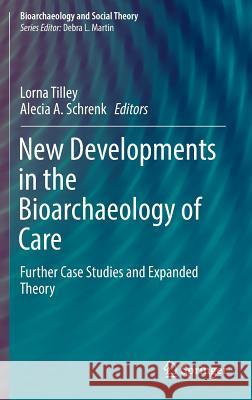
Lorna Tilley; Alecia A. Schrenk
New Developments in the Bioarchaeology of Care: Further Case Studies and Expanded Theory Tilley, Lorna 9783319399003 Springer - książkaWidoczna okładka, to zdjęcie poglądowe, a rzeczywista szata graficzna może różnić się od prezentowanej.

New Developments in the Bioarchaeology of Care: Further Case Studies and Expanded Theory

ISBN-13: 9783319399003 / Angielski / Twarda / 2016 / 385 str.

Lorna Tilley; Alecia A. Schrenk
cena 484,18
(netto: 461,12 VAT:  5%)

Najniższa cena z 30 dni: 462,63
Termin realizacji zamówienia:
ok. 22 dni roboczych
Bez gwarancji dostawy przed świętami

Darmowa dostawa!

New Developments in the Bioarchaeology of Care evaluates, refines and expands existing concepts and practices in the developing field of bioarchaeological research into health-related care provision in the past.
Evidence in human remains that indicates an individual survived with, or following, a serious pathology suggests this person most likely received some form of care from others. This observation was first made half a century ago, but it is only in the last five years that health-related caregiving has been accepted as a topic for bioarchaeology research. In this time, interest has grown exponentially. A focus on care provides a dynamic framework for examining the experiences of disease and disability in the past - at the level of the individual receiving care, and that of the community providing it. When caregiving can be identified in the archaeological record, bioarchaeologists may be able to offer unique insights into aspects of past lifeways.
This volume represents the work of an international, diverse, cross-disciplinary group of contributors, each bringing their own particular focus, style and expertise to analyzing past health-related care. Nineteen chapters offer content that ranges from an introduction to the basic 'bioarchaeology of care' approach, through original case studies of care provision, to new theoretical perspectives in this emerging area of scholarship. This book creates a synergy that challenges our thinking about past health-related care behaviors and about the implications of these behaviors for understanding the social environment in which they took place.


Kategorie:
Nauka, Ekonomia i biznes
Kategorie BISAC:
Social Science > Archaeology
Social Science > Antropologia
Medical > Zdrowie publiczne
Wydawca:
Springer
Seria wydawnicza:
Bioarchaeology and Social Theory
Język:
Angielski
ISBN-13:
9783319399003
Rok wydania:
2016
Wydanie:
2017
Numer serii:
000779488
Ilość stron:
385
Waga:
0.74 kg
Wymiary:
23.39 x 15.6 x 2.39
Oprawa:
Twarda
Wolumenów:
01
Dodatkowe informacje:
Wydanie ilustrowane

"The book is well structured and there is a good balance of case studies applying the approaches developed within the Bioarchaeology of Care. ... The book presents new research in the Bioarchaeology of Care ... . Not only does this book serve as a reference for the application of the Bioarchaeology of Care methodology but it also demonstrates that the discipline is in good shape." (Marta Díaz-Zorita Bonilla, European Journal of Archaeology, Vol. 23 (2), 2020)
"This edited volume demonstrates a maturing of the bioarchaeology of care paradigm, highlighting nuanced, careful theorizing and new avenues of exploration. ... these chapters demonstrate that when this perspective is applied cross-culturally, bioarchaeologists will bring a critical, self-reflexive approach to the analysis and interpretation of results, thereby deepening the intellectual rigor and the value of this paradigm. This edited volume claims a space for this approach in bioarchaeology, and it is a welcome addition to the literature on this topic." (Gwen Robbins Schug, Journal of Anthropological Research, Vol. 74 (3), 2018)
"Perhaps the most interesting bioarchaeological session to come out of a recent Society for American Archaeology conference symposium has now been published as an edited volume. ... the collection lays bare the methodology behind the case studies in a way that encourages other researchers to employ it as well. ... this volume represents an extremely successful collection of essays that should be on any archaeologist's bookshelf." (Kristina Killgrove, American Antiquity, Vol. 83 (2), 2018)

"I found this book to be a wonderful contribution to not only paleopathology, but the broader discipline of bioarchaeology and anthropology. It offers new depth to the bioarchaeology of care by providing diverse case studies ... . It examines case studies from across the globe and addresses groups that bioarchaeologists often find challenging. ... Tilley and A. Schrenk's volume is well-organized and effectively contributes to and expands on the bioarchaeology of care." (Carlina de la Cova, International Journal of Paleopathology, Vol. 17, 2017)
"This book, with its range of chapters, wealth of evidence and the Index of Care material, sits well beyond the obvious archaeological/biological readership ... . this is an important and timely addition to the literature on the individual in prehistoric and early historic societies. Many new approaches and techniques are being deployed to illuminate the human past through the remains of the actors themselves. ... Here is a volume that clearly documents the relevance of this approach to the past." (Beatrice Hale, Ageing & Society, Vol.  37, 2017)
"The 19 chapters cover topics including the explanation of the 'bioarchaeology of care' approach, case studies of care from different parts of the world and over time, and new theoretical developments in the field and the ethical dimensions of such research. ... will be required reading for any academic or postgraduate in the field." (Siân E. Halcrow, Antiquity, Vol. 91 (358), August, 2017) 

Introduction: Building a Bioarchaeology of Care.- 1. Providing a context: thinking and theory in the bioarchaeology of care.- SECTION ONE :Case studies of caregiving: testing the boundaries of bioarchaeology of care research.- 2. Using the Index of Care on a Bronze-Age teenager with poliomyelitis or cerebral palsy: from speculation to strong inference.- 3. Cared for or outcast? A case for continuous care in pre-contact U.S. Southwest.- 4. The potential and challenges of constructing a bioarchaeology of care for a person with leprosy in the Late Medieval Period.- 5. Dealing with difference: the osteobiographies of two health-challenged women from medieval Poland.- 6. Surviving trepanation: approaching the relationship of violence and the care of war wounds through a case study from prehistoric Peru.- 7. Inferring disability and care provision in late prehistoric Tennessee.- 8. A post-mortem evaluation of the degree of mobility in an individual with severe kyphoscoliosis using direct digital radiography (DR) and multi-detector computed tomography (MDCT).- SECTION TWO:New horizons in bioarchaeology of care theory and practice.- 9. Mummy studies and the soft tissue evidence of care.- 10. The bioarchaeological evidence for elder care in Roman Britain.- 11. Caring for bodies or simply saving souls: The emergence of institutional care in Spanish Colonial America.- 12. Potential applications of the bioarchaeology of care methodological approach for historic institutionalized populations.- 13. Modeling care in prehistory through an analysis of hunter-gatherer social systems.- 14. Digitised Diseases: seeing beyond the specimen, understanding disease and disability in the past.- 15. What moral and ethical considerations should inform bioarchaeology of care analysis?.- 16. Highlighting the importance of the past: public engagement and communication from a bioarchaeology of care perspective.- CONCLUSION.- 17. The bioarchaeology of care: current status and future directions.

Lorna Tilley came to archaeology with an honours degree in psychology and work experience in areas of health practice, health status and health outcomes assessment, and health policy development.  She she was awarded a Graduate Diploma in Archaeology from the Australian National University in 2006, and a PhD from the same institution in 2013.  She has been sole or primary author of several articles on the bioarchaeology of care approach; the first of these (Tilley and Oxenham 2011) was awarded Most Influential Paper (2011-2015) by the International Journal of Paleopathology in April 2015.  Her book Theory and Practice in the Bioarchaeology of Care (based on her PhD dissertation) was published by Springer in September 2015.


Alecia Schrenk has a MA in Bioarchaeology and is currently a Ph.D. student at the University of Nevada, Las Vegas Department of Anthropology. She has co-organized a symposium focusing on the Index of Care and furthering Bioarchaeology of Care methodology at the Society for American Archaeology 2015 Annual Meeting. She has recently published research on an 18-20 year old female with paraplegia from Bronze Age Tell Abraq, using isotopic analysis to give a perspective on the role that immigration and mobility may have on increased risk of disease and healthcare (Differential diagnosis of a progressive neuromuscular disorder using bioarchaeological and biogeochemical evidence from a bronze age skeleton in the UAE). Her research interests include paleopathology, bioarchaeology of care, the Index of Care, subadult health, and mortuary practices.

New Developments in the Bioarchaeology of Care evaluates, refines and expands existing concepts and practices in the developing field of bioarchaeological research into health-related care provision in the past.
Evidence in human remains that indicates an individual survived with, or following, a serious pathology suggests this person most likely received some form of care from others. This observation was first made half a century ago, but it is only in the last five years that health-related caregiving has been accepted as a topic for bioarchaeology research. In this time, interest has grown exponentially. A focus on care provides a dynamic framework for examining the experiences of disease and disability in the past - at the level of the individual receiving care, and that of the community providing it. When caregiving can be identified in the archaeological record, bioarchaeologists may be able to offer unique insights into aspects of past lifeways.
This volume represents the work of an international, diverse, cross-disciplinary group of contributors, each bringing their own particular focus, style and expertise to analyzing past health-related care. Nineteen chapters offer content that ranges from an introduction to the basic 'bioarchaeology of care' approach, through original case studies of care provision, to new theoretical perspectives in this emerging area of scholarship. This book creates a synergy that challenges our thinking about past health-related care behaviors and about the implications of these behaviors for understanding the social environment in which they took place.




Udostępnij

Facebook - konto krainaksiazek.pl


Opinie o Krainaksiazek.pl na Opineo.pl

Partner Mybenefit

Krainaksiazek.pl w programie rzetelna firma Krainaksiaze.pl - płatności przez paypal

Czytaj nas na:

Facebook - krainaksiazek.pl
  • książki na zamówienie
  • granty
  • książka na prezent
  • kontakt
  • pomoc
  • opinie
  • regulamin
  • polityka prywatności

Zobacz:

  • Księgarnia czeska

  • Wydawnictwo Książkowe Klimaty

1997-2025 DolnySlask.com Agencja Internetowa

© 1997-2022 krainaksiazek.pl
     
KONTAKT | REGULAMIN | POLITYKA PRYWATNOŚCI | USTAWIENIA PRYWATNOŚCI
Zobacz: Księgarnia Czeska | Wydawnictwo Książkowe Klimaty | Mapa strony | Lista autorów
KrainaKsiazek.PL - Księgarnia Internetowa

Polityka prywatnosci - link
Krainaksiazek.pl - płatnośc Przelewy24
Przechowalnia Przechowalnia




