• Wyszukiwanie zaawansowane
  • Kategorie
  • Kategorie BISAC
  • Książki na zamówienie
  • Promocje
  • Granty
  • Książka na prezent
  • Opinie
  • Pomoc
  • Załóż konto
  • Zaloguj się

Neuropeptide Systems as Targets for Parasite and Pest Control » książka


zaloguj się | załóż konto
Logo Krainaksiazek.pl

koszyk

konto

szukaj
topmenu
Księgarnia internetowa
Szukaj
Książki na zamówienie
Promocje
Granty
Książka na prezent
Moje konto
Pomoc
 
 
Wyszukiwanie zaawansowane
Pusty koszyk
Bezpłatna dostawa dla zamówień powyżej 20 złBezpłatna dostawa dla zamówień powyżej 20 zł

Kategorie główne

• Nauka
 [2946912]
• Literatura piękna
 [1852311]

  więcej...
• Turystyka
 [71421]
• Informatyka
 [150889]
• Komiksy
 [35717]
• Encyklopedie
 [23177]
• Dziecięca
 [617324]
• Hobby
 [138808]
• AudioBooki
 [1671]
• Literatura faktu
 [228371]
• Muzyka CD
 [400]
• Słowniki
 [2841]
• Inne
 [445428]
• Kalendarze
 [1545]
• Podręczniki
 [166819]
• Poradniki
 [480180]
• Religia
 [510412]
• Czasopisma
 [525]
• Sport
 [61271]
• Sztuka
 [242929]
• CD, DVD, Video
 [3371]
• Technologie
 [219258]
• Zdrowie
 [100961]
• Książkowe Klimaty
 [124]
• Zabawki
 [2341]
• Puzzle, gry
 [3766]
• Literatura w języku ukraińskim
 [255]
• Art. papiernicze i szkolne
 [7810]
Kategorie szczegółowe BISAC

Neuropeptide Systems as Targets for Parasite and Pest Control

ISBN-13: 9781489998606 / Angielski / Miękka / 2014 / 230 str.
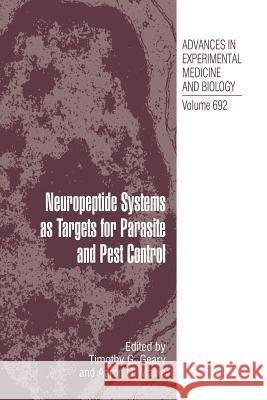
Timothy G. Geary; Aaron Maule
Neuropeptide Systems as Targets for Parasite and Pest Control Timothy G. Geary Aaron Maule 9781489998606 Springer - książkaWidoczna okładka, to zdjęcie poglądowe, a rzeczywista szata graficzna może różnić się od prezentowanej.

Neuropeptide Systems as Targets for Parasite and Pest Control

ISBN-13: 9781489998606 / Angielski / Miękka / 2014 / 230 str.

Timothy G. Geary; Aaron Maule
cena 602,40
(netto: 573,71 VAT:  5%)

Najniższa cena z 30 dni: 578,30
Termin realizacji zamówienia:
ok. 22 dni roboczych
Dostawa w 2026 r.

Darmowa dostawa!
inne wydania

The need to continually discover new agents for the control or treatment of invertebrate pests and pathogens is undeniable. Agriculture, both animal and plant, succeeds only to the extent that arthropod and helminth consumers, vectors and pathogens can be kept at bay. Humans and their companion animals are also plagued by invertebrate parasites. The deployment of chemical agents for these purposes inevitably elicits the selection of resistant populations of the targets of control, necessitating a regular introduction of new kinds of molecules. Experience in other areas of chemotherapy has shown that a thorough understanding of the biology of disease is an essential platform upon which to build a discovery program. Unfortunately, investment of research resources into understanding the basic physiology of invertebrates as a strategy to illuminate new molecular targets for pesticide and parasiticide discovery has been scarce, and the pace of introduction of new molecules for these indications has been slowed as a result. An exciting and so far unexploited area to explore in this regard is invertebrate neuropeptide physiology. This book was assembled to focus attention on this promising field by compiling a comprehensive review of recent research on neuropeptides in arthropods and helminths, with contributions from many of the leading laboratories working on these systems.


Kategorie:
Nauka, Medycyna
Kategorie BISAC:
Medical > Fizjologia
Medical > Parazytologia medyczna
Science > Biologia człowieka
Wydawca:
Springer
Język:
Angielski
ISBN-13:
9781489998606
Rok wydania:
2014
Wydanie:
2010
Ilość stron:
230
Waga:
0.39 kg
Wymiary:
23.5 x 15.5
Oprawa:
Miękka
Wolumenów:
01
Dodatkowe informacje:
Wydanie ilustrowane

1. Receptor?Based Discovery Strategies for Insecticides and Parasiticides: A Review Debra Woods, Cheryl Butler, Tracey Williams and Karen Greenwood Abstract Introduction Mechanistic Receptor?Based Screens Selection of Compounds for Screening‘Hit?to?Lead’: Converting a Mechanistic Screen Active into a Lead Molecule Lead?to?Candidate: Identification of Molecules for Progressionto Market Conclusion and Discussion 2. Nonpeptide Ligands for Peptidergic G Protein?Coupled Receptors Timothy G. Geary Abstract Introduction Druggable Targets in Neuropeptidergic Signaling Neuropeptide?Targeted Drugs: Basic Features Historical Perspectives Screening for Novel Nonpeptide Ligands Discovery of Novel Nonpeptide Ligands through Screening Design Current Status Applications in Invertebrate Systems: General Considerations Conclusion 3. Interaction of Mimetic Analogs of Insect Kinin Neuropeptides with Arthropod Receptors Ronald J. Nachman and Patricia V. Pietrantonio Abstract Introduction Functional Analysis of Arthropod Receptors Selective for Insect Kinins Chemical, Conformational and Stereochemical Aspects of Receptor Interaction Interaction of Biostable Insect Kinin Analogs with Receptors and Activity in In Vitro and In Vivo Bioassays C?Terminal Aldehyde Analogs of Insect Kinins Nonpeptide Mimetic Agonists/Antagonists of Expressed Insect Kinin Receptors Prospects for Enhanced Topical and/or Oral Bioavailability Conclusion 4. Neuropeptides in Helminths: Ocurrence and Distribution Nikki J. Marks and Aaron G. Maule Abstract Introduction Nematode Neuropeptides Platyhelminth Neuropeptides Targets for Parasite Control Conclusion Note Added in Proof 5. Neuropeptide Physiology in Helminths Angela Mousley, Ekaterina Novozhilova, Michael J. Kimber and Tim A. Day Abstract Introduction Neuropeptide Function in Nematodes Neuropeptide Function in Platyhelminths Conclusion 6. Neuropeptide Gene Fa milies in Caenorhabditis elegans Chris Li and KyuhyungKim Abstract Identification of Neuropeptide Genes in C. elegans Expression of Neuropeptide Genes Cleavage and Processing of Neuropeptides Biochemical Isolation of Neuropeptides Neuropeptide Function Behaviors Affected by Multiple Classes of Neuropeptides Neuropeptide Receptors Pharmacology of FLP Neuropeptides Conclusion 7. Control of Nematode Parasites with Agents Acting on Neuro?Musculature Systems: Lessons for Neuropeptide Ligand Discovery Richard J. Martin and Alan P. Robertson Abstract The Existing Anti?Nematodal Drugs with Effects on Neuromuscular Systems Resistance Is Predicted Broad Spectrum or Narrow Spectrum Potential Problems Associated with Neuropeptide Receptors as Target Sites for Anthelmintics High?Throughput Screens for Neuropeptide Ligands Toxicity and Safety Conclusion 8. Neuropeptide signaling in insects Miriam Altstein and Dick R. Nässel Abstract Introduction Neuropeptides: Their biosynthesis, processing and expression Neuropeptides families, GPCRs and peptide functions Insect neuropeptides as potential targets for pest management Conclusion Addendum 9. Neuropeptide Physiology in Insects William G. Bendena Abstract Introduction Neuropeptide Biosynthesis and Action Potential Physiological Targets for Pest Control Future Developments Conclusion 10. Neuropeptide Biology in Drosophila Elke Clynen, Ank Reumer, Geert Baggerman, Inge Mertens and Liliane Schoofs Abstract Introduction: Drosophila as a Model to Study Neuropeptide Signaling Bioinformatics Neuropeptidomics Deorphanization of Drosophila Neuropeptide GPCRs Functional Role of Neuropeptides: Localization, Reverse Genetics and Bioassays Other Neuronal Molecules as Potential Targets for Insecticides Conclusion 11. Neuropeptide Receptors as Possible Targets for Development of Insect Pest Control Agents Matthias B. Van Hiel, Tom Van Loy, Jeroen Poels, Hans Peter Vandersmissen,Heleen Verlinden, Liesbeth Badisco and Jozef Vanden Broeck Abstract Introduction Receptors Controlling Insect

TIMOTHY G. GEARY is a Tier I Canada Research Chair and is Professor and Director of the Institute of Parasitology at McGill University in Montréal, Québec, Canada. Geary received a BSc degree from the University of Notre Dame in South Bend, IN (USA) and a PhD in Pharmacology from the University of Michigan in Ann Arbor, MI (USA, 1980). He worked on malaria chemotherapy at Michigan State University in East Lansing, MI (USA) until 1985, when he joined The Upjohn Company in Kalamazoo, MI (USA) as a staff scientist working on discovery of antiparasitic drugs. Geary joined the Faculty at McGill in 2005; research interests include proteomics and genomics analyses of the host-parasite interface, discovery of anthelmintics and the pharmacology of antiparasitic drugs. AARON G. MAULE is a Director of Research for Molecular Biosciences and Professor of Molecular Parasitology at Queen’s University Belfast, Northern Ireland. Maule was awarded a BSc(Hons) in Biology (1986) and a PhD in Experimental Parasitology (1989) at Queen’s where he began working on parasite neuromuscular systems. He focused on molecular aspects of parasite neurobiology during postdoctoral positions at Queen’s and at The Upjohn Company in Kalamazoo, MI (USA). Maule returned to Queen’s as a member of academic staff in 1995 to pursue the basic biology of helminth signaling systems. Research interests include parasite neurobiology and the development and exploitation of gene silencing platforms for target validation and parasite control.


Udostępnij

Facebook - konto krainaksiazek.pl


Opinie o Krainaksiazek.pl na Opineo.pl

Partner Mybenefit

Krainaksiazek.pl w programie rzetelna firma Krainaksiaze.pl - płatności przez paypal

Czytaj nas na:

Facebook - krainaksiazek.pl
  • książki na zamówienie
  • granty
  • książka na prezent
  • kontakt
  • pomoc
  • opinie
  • regulamin
  • polityka prywatności

Zobacz:

  • Księgarnia czeska

  • Wydawnictwo Książkowe Klimaty

1997-2025 DolnySlask.com Agencja Internetowa

© 1997-2022 krainaksiazek.pl
     
KONTAKT | REGULAMIN | POLITYKA PRYWATNOŚCI | USTAWIENIA PRYWATNOŚCI
Zobacz: Księgarnia Czeska | Wydawnictwo Książkowe Klimaty | Mapa strony | Lista autorów
KrainaKsiazek.PL - Księgarnia Internetowa

Polityka prywatnosci - link
Krainaksiazek.pl - płatnośc Przelewy24
Przechowalnia Przechowalnia





