• Wyszukiwanie zaawansowane
  • Kategorie
  • Kategorie BISAC
  • Książki na zamówienie
  • Promocje
  • Granty
  • Książka na prezent
  • Opinie
  • Pomoc
  • Załóż konto
  • Zaloguj się

Neurodynamics: An Applied Mathematics Perspective » książka


zaloguj się | załóż konto
Logo Krainaksiazek.pl

koszyk

konto

szukaj
topmenu
Księgarnia internetowa
Szukaj
Książki na zamówienie
Promocje
Granty
Książka na prezent
Moje konto
Pomoc
 
 
Wyszukiwanie zaawansowane
Pusty koszyk
Bezpłatna dostawa dla zamówień powyżej 20 złBezpłatna dostawa dla zamówień powyżej 20 zł

Kategorie główne

• Nauka
 [2946600]
• Literatura piękna
 [1856966]

  więcej...
• Turystyka
 [72221]
• Informatyka
 [151456]
• Komiksy
 [35826]
• Encyklopedie
 [23190]
• Dziecięca
 [619653]
• Hobby
 [140543]
• AudioBooki
 [1577]
• Literatura faktu
 [228355]
• Muzyka CD
 [410]
• Słowniki
 [2874]
• Inne
 [445822]
• Kalendarze
 [1744]
• Podręczniki
 [167141]
• Poradniki
 [482898]
• Religia
 [510455]
• Czasopisma
 [526]
• Sport
 [61590]
• Sztuka
 [243598]
• CD, DVD, Video
 [3423]
• Technologie
 [219201]
• Zdrowie
 [101638]
• Książkowe Klimaty
 [124]
• Zabawki
 [2473]
• Puzzle, gry
 [3898]
• Literatura w języku ukraińskim
 [254]
• Art. papiernicze i szkolne
 [8170]
Kategorie szczegółowe BISAC

Neurodynamics: An Applied Mathematics Perspective

ISBN-13: 9783031219153 / Angielski / Twarda / 2023 / 514 str.
Stephen Coombes; Kyle C. a. Wedgwood
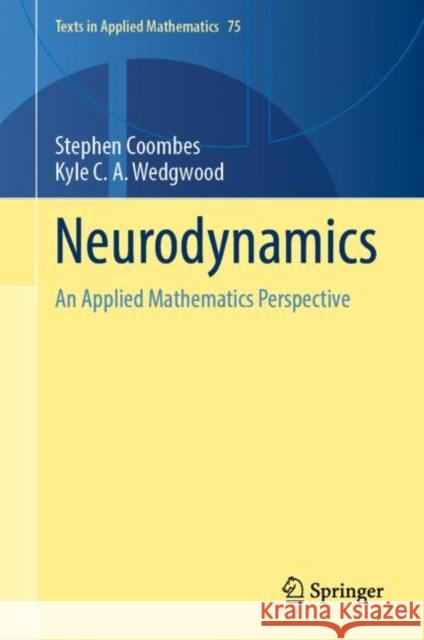
Neurodynamics: An Applied Mathematics Perspective Stephen Coombes Kyle C. a. Wedgwood 9783031219153 Springer - książkaWidoczna okładka, to zdjęcie poglądowe, a rzeczywista szata graficzna może różnić się od prezentowanej.

Neurodynamics: An Applied Mathematics Perspective

ISBN-13: 9783031219153 / Angielski / Twarda / 2023 / 514 str.

Stephen Coombes; Kyle C. a. Wedgwood
cena 322,77 zł
(netto: 307,40 VAT:  5%)

Najniższa cena z 30 dni: 308,41 zł
Termin realizacji zamówienia:
ok. 22 dni roboczych
Bez gwarancji dostawy przed świętami

Darmowa dostawa!
inne wydania

This book is about the dynamics of neural systems and should be suitable for those with a background in mathematics, physics, or engineering who want to see how their knowledge and skill sets can be applied in a neurobiological context. No prior knowledge of neuroscience is assumed, nor is advanced understanding of all aspects of applied mathematics! Rather, models and methods are introduced in the context of a typical neural phenomenon and a narrative developed that will allow the reader to test their understanding by tackling a set of mathematical problems at the end of each chapter. The emphasis is on mathematical- as opposed to computational-neuroscience, though stresses calculation above theorem and proof. The book presents necessary mathematical material in a digestible and compact form when required for specific topics. The book has nine chapters, progressing from the cell to the tissue, and an extensive set of references. It includes Markov chain models for ions, differential equations for single neuron models, idealised phenomenological models, phase oscillator networks, spiking networks, and integro-differential equations for large scale brain activity, with delays and stochasticity thrown in for good measure. One common methodological element that arises throughout the book is the use of techniques from nonsmooth dynamical systems to form tractable models and make explicit progress in calculating solutions for rhythmic neural behaviour, synchrony, waves, patterns, and their stability. This book was written for those with an interest in applied mathematics seeking to expand their horizons to cover the dynamics of neural systems. It is suitable for a Masters level course or for postgraduate researchers starting in the field of mathematical neuroscience.


This book is about the dynamics of neural systems and should be suitable for those with a background in mathematics, physics, or engineering who want to see how their knowledge and skill sets can be applied in a neurobiological context. No prior knowledge of neuroscience is assumed, nor is advanced understanding of all aspects of applied mathematics! Rather, models and methods are introduced in the context of a typical neural phenomenon and a narrative developed that will allow the reader to test their understanding by tackling a set of mathematical problems at the end of each chapter. The emphasis is on mathematical- as opposed to computational-neuroscience, though stresses calculation above theorem and proof. The book presents necessary mathematical material in a digestible and compact form when required for specific topics. The book has nine chapters, progressing from the cell to the tissue, and an extensive set of references. It includes Markov chain models for ions, differential equations for single neuron models, idealised phenomenological models, phase oscillator networks, spiking networks, and integro-differential equations for large scale brain activity, with delays and stochasticity thrown in for good measure. One common methodological element that arises throughout the book is the use of techniques from nonsmooth dynamical systems to form tractable models and make explicit progress in calculating solutions for rhythmic neural behaviour, synchrony, waves, patterns, and their stability. This book was written for those with an interest in applied mathematics seeking to expand their horizons to cover the dynamics of neural systems. It is suitable for a Masters level course or for postgraduate researchers starting in the field of mathematical neuroscience.

Kategorie:
Nauka, Matematyka
Kategorie BISAC:
Mathematics > Matematyka stosowana
Technology & Engineering > Engineering (General)
Science > System Theory
Wydawca:
Springer
Seria wydawnicza:
Texts in Applied Mathematics
Język:
Angielski
ISBN-13:
9783031219153
Rok wydania:
2023
Dostępne języki:
Numer serii:
000023702
Ilość stron:
514
Oprawa:
Twarda

Overview.- Single neuron models-. Phenomenological models and their analysis.- Axons, dendrites, and synapses.- Response properties of single neurons.- Weakly coupled oscillator networks.- Strongly coupled spiking networks.- Population models.- Firing rate tissue models.- Stochastic calculus.- Model Details.- References.

Stephen Coombes is a Professor of Applied Mathematics at the University of Nottingham, UK.  His research interest is in the use of nonlinear dynamics to understand aspects of the human central nervous system. He has co-edited two books and authored over 120 peer-reviewed journal articles.  He has supervised 22 PhD students and 8 postdoctoral fellows.Together with colleagues in Mathematics and Neuroscience he is actively pursuing research projects ranging from single cell dynamics to neuronal circuits to whole-brain dynamics with applications in psychology, neuroimaging, medicine, and psychiatry.


Kyle Wedgwood is a Lecturer in Mathematics in the Living Systems Institute at the University of Exeter, UK. He applies techniques from dynamical systems theory to understand how electrically excitable cells produce coherent rhythms in networks and has authored 22 peer-reviewed journal articles. He currently supervises 4 PhD students and 2 postdoctoral fellows. In his current research, he is exploring how mathematics can be embedded in neuroscience experiments.

This book is about the dynamics of neural systems and should be suitable for those with a background in mathematics, physics, or engineering who want to see how their knowledge and skill sets can be applied in a neurobiological context. No prior knowledge of neuroscience is assumed, nor is advanced understanding of all aspects of applied mathematics! Rather, models and methods are introduced in the context of a typical neural phenomenon and a narrative developed that will allow the reader to test their understanding by tackling a set of mathematical problems at the end of each chapter. The emphasis is on mathematical- as opposed to computational-neuroscience, though stresses calculation above theorem and proof. The book presents necessary mathematical material in a digestible and compact form when required for specific topics. The book has nine chapters, progressing from the cell to the tissue, and an extensive set of references. It includes Markov chain models for ions, differential equations for single neuron models, idealised phenomenological models, phase oscillator networks, spiking networks, and integro-differential equations for large scale brain activity, with delays and stochasticity thrown in for good measure. One common methodological element that arises throughout the book is the use of techniques from nonsmooth dynamical systems to form tractable models and make explicit progress in calculating solutions for rhythmic neural behaviour, synchrony, waves, patterns, and their stability. This book was written for those with an interest in applied mathematics seeking to expand their horizons to cover the dynamics of neural systems. It is suitable for a Masters level course or for postgraduate researchers starting in the field of mathematical neuroscience.




Udostępnij

Facebook - konto krainaksiazek.pl


Opinie o Krainaksiazek.pl na Opineo.pl

Partner Mybenefit

Krainaksiazek.pl w programie rzetelna firma Krainaksiaze.pl - płatności przez paypal

Czytaj nas na:

Facebook - krainaksiazek.pl
  • książki na zamówienie
  • granty
  • książka na prezent
  • kontakt
  • pomoc
  • opinie
  • regulamin
  • polityka prywatności

Zobacz:

  • Księgarnia czeska

  • Wydawnictwo Książkowe Klimaty

1997-2025 DolnySlask.com Agencja Internetowa

© 1997-2022 krainaksiazek.pl
     
KONTAKT | REGULAMIN | POLITYKA PRYWATNOŚCI | USTAWIENIA PRYWATNOŚCI
Zobacz: Księgarnia Czeska | Wydawnictwo Książkowe Klimaty | Mapa strony | Lista autorów
KrainaKsiazek.PL - Księgarnia Internetowa

Polityka prywatnosci - link
Krainaksiazek.pl - płatnośc Przelewy24
Przechowalnia Przechowalnia



