• Wyszukiwanie zaawansowane
  • Kategorie
  • Kategorie BISAC
  • Książki na zamówienie
  • Promocje
  • Granty
  • Książka na prezent
  • Opinie
  • Pomoc
  • Załóż konto
  • Zaloguj się

Neural Networks for Conditional Probability Estimation: Forecasting Beyond Point Predictions » książka


zaloguj się | załóż konto
Logo Krainaksiazek.pl

koszyk

konto

szukaj
topmenu
Księgarnia internetowa
Szukaj
Książki na zamówienie
Promocje
Granty
Książka na prezent
Moje konto
Pomoc
 
 
Wyszukiwanie zaawansowane
Pusty koszyk
Bezpłatna dostawa dla zamówień powyżej 20 złBezpłatna dostawa dla zamówień powyżej 20 zł

Kategorie główne

• Nauka
 [2946600]
• Literatura piękna
 [1856966]

  więcej...
• Turystyka
 [72221]
• Informatyka
 [151456]
• Komiksy
 [35826]
• Encyklopedie
 [23190]
• Dziecięca
 [619653]
• Hobby
 [140543]
• AudioBooki
 [1577]
• Literatura faktu
 [228355]
• Muzyka CD
 [410]
• Słowniki
 [2874]
• Inne
 [445822]
• Kalendarze
 [1744]
• Podręczniki
 [167141]
• Poradniki
 [482898]
• Religia
 [510455]
• Czasopisma
 [526]
• Sport
 [61590]
• Sztuka
 [243598]
• CD, DVD, Video
 [3423]
• Technologie
 [219201]
• Zdrowie
 [101638]
• Książkowe Klimaty
 [124]
• Zabawki
 [2473]
• Puzzle, gry
 [3898]
• Literatura w języku ukraińskim
 [254]
• Art. papiernicze i szkolne
 [8170]
Kategorie szczegółowe BISAC

Neural Networks for Conditional Probability Estimation: Forecasting Beyond Point Predictions

ISBN-13: 9781852330958 / Angielski / Miękka / 1999 / 302 str.
Dirk Husmeier; J. G. Taylor
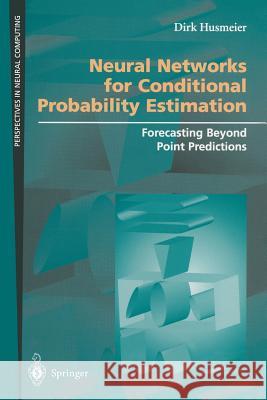
Neural Networks for Conditional Probability Estimation: Forecasting Beyond Point Predictions Husmeier, Dirk 9781852330958 Springer - książkaWidoczna okładka, to zdjęcie poglądowe, a rzeczywista szata graficzna może różnić się od prezentowanej.

Neural Networks for Conditional Probability Estimation: Forecasting Beyond Point Predictions

ISBN-13: 9781852330958 / Angielski / Miękka / 1999 / 302 str.

Dirk Husmeier; J. G. Taylor
cena 201,72 zł
(netto: 192,11 VAT:  5%)

Najniższa cena z 30 dni: 192,74 zł
Termin realizacji zamówienia:
ok. 22 dni roboczych
Bez gwarancji dostawy przed świętami

Darmowa dostawa!

Conventional applications of neural networks usually predict a single value as a function of given inputs. In forecasting, for example, a standard objective is to predict the future value of some entity of interest on the basis of a time series of past measurements or observations. Typical training schemes aim to minimise the sum of squared deviations between predicted and actual values (the 'targets'), by which, ideally, the network learns the conditional mean of the target given the input. If the underlying conditional distribution is Gaus sian or at least unimodal, this may be a satisfactory approach. However, for a multimodal distribution, the conditional mean does not capture the relevant features of the system, and the prediction performance will, in general, be very poor. This calls for a more powerful and sophisticated model, which can learn the whole conditional probability distribution. Chapter 1 demonstrates that even for a deterministic system and 'be nign' Gaussian observational noise, the conditional distribution of a future observation, conditional on a set of past observations, can become strongly skewed and multimodal. In Chapter 2, a general neural network structure for modelling conditional probability densities is derived, and it is shown that a universal approximator for this extended task requires at least two hidden layers. A training scheme is developed from a maximum likelihood approach in Chapter 3, and the performance ofthis method is demonstrated on three stochastic time series in chapters 4 and 5."


Kategorie:
Nauka, Fizyka
Kategorie BISAC:
Computers > Data Science - Neural Networks
Computers > Artificial Intelligence - Computer Vision & Pattern Recognition
Wydawca:
Springer
Seria wydawnicza:
Perspectives in Neural Computing
Język:
Angielski
ISBN-13:
9781852330958
Rok wydania:
1999
Wydanie:
Softcover Repri
Numer serii:
000018044
Ilość stron:
302
Waga:
0.46 kg
Wymiary:
23.52 x 15.6 x 1.8
Oprawa:
Miękka
Wolumenów:
01
Dodatkowe informacje:
Bibliografia
Wydanie ilustrowane

1. Introduction.- 1.1 Conventional forecasting and Takens’ embedding theorem.- 1.2 Implications of observational noise.- 1.3 Implications of dynamic noise.- 1.4 Example.- 1.5 Conclusion.- 1.6 Objective of this book.- 2. A Universal Approximator Network for Predicting Conditional Probability Densities.- 2.1 Introduction.- 2.2 A single-hidden-layer network.- 2.3 An additional hidden layer.- 2.4 Regaining the conditional probability density.- 2.5 Moments of the conditional probability density.- 2.6 Interpretation of the network parameters.- 2.7 Gaussian mixture model.- 2.8 Derivative-of-sigmoid versus Gaussian mixture model.- 2.9 Comparison with other approaches.- 2.9.1 Predicting local error bars.- 2.9.2 Indirect method.- 2.9.3 Complete kernel expansion: Conditional Density Estimation Network (CDEN) and Mixture Density Network (MDN).- 2.9.4 Distorted Probability Mixture Network (DPMN).- 2.9.5 Mixture of Experts (ME) and Hierarchical Mixture of Experts (HME).- 2.9.6 Soft histogram.- 2.10 Summary.- 2.11 Appendix: The moment generating function for the DSM network.- 3. A Maximum Likelihood Training Scheme.- 3.1 The cost function.- 3.2 A gradient-descent training scheme.- 3.2.1 Output weights.- 3.2.2 Kernel widths.- 3.2.3 Remaining weights.- 3.2.4 Interpretation of the parameter adaptation rules.- 3.2.5 Deficiencies of gradient descent and their remedy.- 3.3 Summary.- 3.4 Appendix.- 4. Benchmark Problems.- 4.1 Logistic map with intrinsic noise.- 4.2 Stochastic combination of two stochastic dynamical systems.- 4.3 Brownian motion in a double-well potential.- 4.4 Summary.- 5. Demonstration of the Model Performance on the Benchmark Problems.- 5.1 Introduction.- 5.2 Logistic map with intrinsic noise.- 5.2.1 Method.- 5.2.2 Results.- 5.3 Stochastic coupling between two stochastic dynamical systems.- 5.3.1 Method.- 5.3.2 Results.- 5.3.3 Auto-pruning.- 5.4 Brownian motion in a double-well potential.- 5.4.1 Method.- 5.4.2 Results.- 5.4.3 Comparison with other approaches.- 5.5 Conclusions.- 5.6 Discussion.- 6. Random Vector Functional Link (RVFL) Networks.- 6.1 The RVFL theorem.- 6.2 Proof of the RVFL theorem.- 6.3 Comparison with the multilayer perceptron.- 6.4 A simple illustration.- 6.5 Summary.- 7. Improved Training Scheme Combining the Expectation Maximisation (EM) Algorithm with the RVFL Approach.- 7.1 Review of the Expectation Maximisation (EM) algorithm.- 7.2 Simulation: Application of the GM network trained with the EM algorithm.- 7.2.1 Method.- 7.2.2 Results.- 7.2.3 Discussion.- 7.3 Combining EM and RVFL.- 7.4 Preventing numerical instability.- 7.5 Regularisation.- 7.6 Summary.- 7.7 Appendix.- 8. Empirical Demonstration: Combining EM and RVFL.- 8.1 Method.- 8.2 Application of the GM-RVFL network to predicting the stochastic logistic-kappa map.- 8.2.1 Training a single model.- 8.2.2 Training an ensemble of models.- 8.3 Application of the GM-RVFL network to the double-well problem.- 8.3.1 Committee selection.- 8.3.2 Prediction.- 8.3.3 Comparison with other approaches.- 8.4 Discussion.- 9. A simple Bayesian regularisation scheme.- 9.1 A Bayesian approach to regularisation.- 9.2 A simple example: repeated coin flips.- 9.3 A conjugate prior.- 9.4 EM algorithm with regularisation.- 9.5 The posterior mode.- 9.6 Discussion.- 10. The Bayesian Evidence Scheme for Regularisation.- 10.1 Introduction.- 10.2 A simple illustration of the evidence idea.- 10.3 Overview of the evidence scheme.- 10.3.1 First step: Gaussian approximation to the probability in parameter space.- 10.3.2 Second step: Optimising the hyperparameters.- 10.3.3 A self-consistent iteration scheme.- 10.4 Implementation of the evidence scheme.- 10.4.1 First step: Gaussian approximation to the probability in parameter space.- 10.4.2 Second step: Optimising the hyperparameters.- 10.4.3 Algorithm.- 10.5 Discussion.- 10.5.1 Improvement over the maximum likelihood estimate.- 10.5.2 Justification of the approximations.- 10.5.3 Final remark.- 11. The Bayesian Evidence Scheme for Model Selection.- 11.1 The evidence for the model.- 11.2 An uninformative prior.- 11.3 Comparison with MacKay’s work.- 11.4 Interpretation of the model evidence.- 11.4.1 Ockham factors for the weight groups.- 11.4.2 Ockham factors for the kernel widths.- 11.4.3 Ockham factor for the priors.- 11.5 Discussion.- 12. Demonstration of the Bayesian Evidence Scheme for Regularisation.- 12.1 Method and objective.- 12.1.1 Initialisation.- 12.1.2 Different training and regularisation schemes.- 12.1.3 Pruning.- 12.2 Large Data Set.- 12.3 Small Data Set.- 12.4 Number of well-determined parameters and pruning.- 12.4.1 Automatic self-pruning.- 12.4.2 Mathematical elucidation of the pruning scheme.- 12.5 Summary and Conclusion.- 13. Network Committees and Weighting Schemes.- 13.1 Network committees for interpolation.- 13.2 Network committees for modelling conditional probability densities.- 13.3 Weighting Schemes for Predictors.- 13.3.1 Introduction.- 13.3.2 A Bayesian approach.- 13.3.3 Numerical problems with the model evidence.- 13.3.4 A weighting scheme based on the cross-validation performance.- 14. Demonstration: Committees of Networks Trained with Different Regularisation Schemes.- 14.1 Method and objective.- 14.2 Single-model prediction.- 14.3 Committee prediction.- 14.3.1 Best and average single-model performance.- 14.3.2 Improvement over the average single-model performance.- 14.3.3 Improvement over the best single-model performance.- 14.3.4 Robustness of the committee performance.- 14.3.5 Dependence on the temperature.- 14.3.6 Dependence on the temperature when including biased models.- 14.3.7 Optimal temperature.- 14.3.8 Model selection and evidence.- 14.3.9 Advantage of under-regularisation and over-fitting.- 14.4 Conclusions.- 15. Automatic Relevance Determination (ARD).- 15.1 Introduction.- 15.2 Two alternative ARD schemes.- 15.3 Mathematical implementation.- 15.4 Empirical demonstration.- 16. A Real-World Application: The Boston Housing Data.- 6.1 A real-world regression problem: The Boston house-price data.- 16.2 Prediction with a single model.- 16.2.1 Methodology.- 16.2.2 Results.- 16.3 Test of the ARD scheme.- 16.3.1 Methodology.- 16.3.2 Results.- 16.4 Prediction with network committees.- 16.4.1 Objective.- 16.4.2 Methodology.- 16.4.3 Weighting scheme and temperature.- 16.4.4 ARD parameters.- 16.4.5 Comparison between the two ARD schemes.- 16.4.6 Number of kernels.- 16.4.7 Bayesian regularisation.- 16.4.8 Network complexity.- 16.4.9 Cross-validation.- 16.5 Discussion: How overfitting can be useful.- 16.6 Increasing diversity.- 16.6.1 Bagging.- 16.6.2 Nonlinear Preprocessing.- 16.7 Comparison with Neal’s results.- 16.8 Conclusions.- 17. Summary.- 18. Appendix: Derivation of the Hessian for the Bayesian Evidence Scheme.- 18.1 Introduction and notation.- 18.2 A decomposition of the Hessian using EM.- 18.3 Explicit calculation of the Hessian.- 18.4 Discussion.- References.

Husmeier, Dirk Husmeier, Imperial College, London, UK.... więcej >


Udostępnij

Facebook - konto krainaksiazek.pl


Opinie o Krainaksiazek.pl na Opineo.pl

Partner Mybenefit

Krainaksiazek.pl w programie rzetelna firma Krainaksiaze.pl - płatności przez paypal

Czytaj nas na:

Facebook - krainaksiazek.pl
  • książki na zamówienie
  • granty
  • książka na prezent
  • kontakt
  • pomoc
  • opinie
  • regulamin
  • polityka prywatności

Zobacz:

  • Księgarnia czeska

  • Wydawnictwo Książkowe Klimaty

1997-2025 DolnySlask.com Agencja Internetowa

© 1997-2022 krainaksiazek.pl
     
KONTAKT | REGULAMIN | POLITYKA PRYWATNOŚCI | USTAWIENIA PRYWATNOŚCI
Zobacz: Księgarnia Czeska | Wydawnictwo Książkowe Klimaty | Mapa strony | Lista autorów
KrainaKsiazek.PL - Księgarnia Internetowa

Polityka prywatnosci - link
Krainaksiazek.pl - płatnośc Przelewy24
Przechowalnia Przechowalnia





