• Wyszukiwanie zaawansowane
  • Kategorie
  • Kategorie BISAC
  • Książki na zamówienie
  • Promocje
  • Granty
  • Książka na prezent
  • Opinie
  • Pomoc
  • Załóż konto
  • Zaloguj się

Neural Assemblies: An Alternative Approach to Classical Artificial Intelligence » książka


zaloguj się | załóż konto
Logo Krainaksiazek.pl

koszyk

konto

szukaj
topmenu
Księgarnia internetowa
Szukaj
Książki na zamówienie
Promocje
Granty
Książka na prezent
Moje konto
Pomoc
 
 
Wyszukiwanie zaawansowane
Pusty koszyk
Bezpłatna dostawa dla zamówień powyżej 20 złBezpłatna dostawa dla zamówień powyżej 20 zł

Kategorie główne

• Nauka
 [2949965]
• Literatura piękna
 [1857847]

  więcej...
• Turystyka
 [70818]
• Informatyka
 [151303]
• Komiksy
 [35733]
• Encyklopedie
 [23180]
• Dziecięca
 [617748]
• Hobby
 [139972]
• AudioBooki
 [1650]
• Literatura faktu
 [228361]
• Muzyka CD
 [398]
• Słowniki
 [2862]
• Inne
 [444732]
• Kalendarze
 [1620]
• Podręczniki
 [167233]
• Poradniki
 [482388]
• Religia
 [509867]
• Czasopisma
 [533]
• Sport
 [61361]
• Sztuka
 [243125]
• CD, DVD, Video
 [3451]
• Technologie
 [219309]
• Zdrowie
 [101347]
• Książkowe Klimaty
 [123]
• Zabawki
 [2362]
• Puzzle, gry
 [3791]
• Literatura w języku ukraińskim
 [253]
• Art. papiernicze i szkolne
 [7933]
Kategorie szczegółowe BISAC

Neural Assemblies: An Alternative Approach to Classical Artificial Intelligence

ISBN-13: 9783031003103 / Angielski / Twarda / 2022
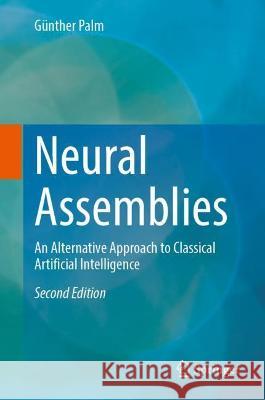
Günther Palm
Neural Assemblies: An Alternative Approach to Classical Artificial Intelligence Palm, Günther 9783031003103 Springer International Publishing - książkaWidoczna okładka, to zdjęcie poglądowe, a rzeczywista szata graficzna może różnić się od prezentowanej.

Neural Assemblies: An Alternative Approach to Classical Artificial Intelligence

ISBN-13: 9783031003103 / Angielski / Twarda / 2022

Günther Palm
cena 605,23 zł
(netto: 576,41 VAT:  5%)

Najniższa cena z 30 dni: 578,30 zł
Termin realizacji zamówienia:
ok. 22 dni roboczych
Bez gwarancji dostawy przed świętami

Darmowa dostawa!
inne wydania

You can't tell how deep a puddle is until you step in it. When I am asked about my profession, I have two ways of answering. If I want a short discussion, I say that I am a mathematician; if I want a long discussion, I say that I try to understand how the human brain works. A long discussion often leads to further questions: What does it mean to understand "how the brain works"? Does it help to be trained in mathematics when you try to understand the brain, and what kind of mathematics can help? What makes a mathematician turn into a neuroscientist? This may lead into a metascientific discussion which I do not like par­ ticularly because it is usually too far off the ground. In this book I take quite a different approach. I just start explaining how I think the brain works. In the course of this explanation my answers to the above questions will become clear to the reader, and he will perhaps learn some facts about the brain and get some insight into the construc­ tions of artificial intelligence.

Kategorie:
Nauka, Medycyna
Kategorie BISAC:
Medical > Neuroscience
Computers > Computer Science
Computers > Artificial Intelligence - General
Wydawca:
Springer International Publishing
Język:
Angielski
ISBN-13:
9783031003103
Rok wydania:
2022
Waga:
0.58 kg
Wymiary:
23.5 x 15.5
Oprawa:
Twarda
Dodatkowe informacje:
Wydanie ilustrowane

Part 1

Chapter 1: The brain is an organ for information processing

Chapter 2: The organization and improvement of behavior

Chapter 3: A neuronal realization of the survival algorithm

Chapter4: On the structure and function of cortical areas


Part 2

Chapter 5: Cognitive mental processes realized by cell assemblies in the cortex

Chapter 6: A Model of Language Understanding by Interacting Cortical Areas

Chapter 7: Can we accept a mechanistic description of our mental processes?


Part 3

Chapter 8: Developments in Computer Science and Technical Applications

Chapter 9: New Results from Brain Research and Neuroscience

Chapter 10: Development of Brain Theory

Chapter 11: Do we need Cognitive Neuroscience?


Prof Dr Günther Palm

Professor Palm began his studies of mathematics at the University of Hamburg and graduated at the Eberhard-Karls-University of Tübingen with a PhD thesis on “Entropie und Generatoren in dynamischen Verbänden“ supervised by Prof. Dr. Rainer Nagel in 1975. He then worked as a research assistant at the Max Planck Institute for Biological Cybernetics, Tübingen, on topics of quantitative neuroanatomy, information theory, nonlinear systems theory, associative memory and brain theory from 1975 to 1988. During that time he spent one year (1983/1984) in Berlin as a fellow of the Wissenschaftskolleg. In 1988 he became professor for theoretical brain research at the University of Düsseldorf. Since 1991 he is director of the Institute of Neural Information Processing at Ulm University. He retired in 2016 and is working part-time on neural data analysis at the Forschungszentrum Jülich since 2017.

Professor Palm's research focus is on information theory, neural networks, associative memory, and specifically on Hebbian cell assemblies. By 2015, he has published more than 300 peer-reviewed articles in international journals, 60 invited contributions, and (co-)edited 8 books. He is author of the monographs “Neural Assemblies. An Alternative Approach to Artificial Intelligence” (1982), and “Novelty, Information and Surprise” (2012).


In the new edition of Neural Assemblies, the author places his original ideas and motivations within the framework of modern and cognitive neuroscience and gives a short and focused overview of the development of computational neuroscience and artificial neural networks over the last 40 years. 

In this book the author develops a theory of how the human brain might function. Starting with a motivational introduction to the brain as an organ of information processing, he presents a computational perspective on the basic concepts and ideas of neuroscience research on the underlying principles of brain function. In addition, the reader is introduced to the most important methods from computer science and mathematical modeling that are required for a computational understanding of information processing in the brain.

Written by an expert in the field of neural information processing, this book offers a personal historical view of the development of artificial intelligence, artificial neural networks, and computational cognitive neuroscience over the last 40 years, with a focus on the realization of higher cognitive functions rather than more peripheral sensory or motor organization. The book is therefore aimed at students and researchers who want to understand how the basic neuroscientific and computational concepts in the study of brain function have changed over the last decades.


Udostępnij

Facebook - konto krainaksiazek.pl


Opinie o Krainaksiazek.pl na Opineo.pl

Partner Mybenefit

Krainaksiazek.pl w programie rzetelna firma Krainaksiaze.pl - płatności przez paypal

Czytaj nas na:

Facebook - krainaksiazek.pl
  • książki na zamówienie
  • granty
  • książka na prezent
  • kontakt
  • pomoc
  • opinie
  • regulamin
  • polityka prywatności

Zobacz:

  • Księgarnia czeska

  • Wydawnictwo Książkowe Klimaty

1997-2025 DolnySlask.com Agencja Internetowa

© 1997-2022 krainaksiazek.pl
     
KONTAKT | REGULAMIN | POLITYKA PRYWATNOŚCI | USTAWIENIA PRYWATNOŚCI
Zobacz: Księgarnia Czeska | Wydawnictwo Książkowe Klimaty | Mapa strony | Lista autorów
KrainaKsiazek.PL - Księgarnia Internetowa

Polityka prywatnosci - link
Krainaksiazek.pl - płatnośc Przelewy24
Przechowalnia Przechowalnia






