• Wyszukiwanie zaawansowane
  • Kategorie
  • Kategorie BISAC
  • Książki na zamówienie
  • Promocje
  • Granty
  • Książka na prezent
  • Opinie
  • Pomoc
  • Załóż konto
  • Zaloguj się

Network Algebra » książka


zaloguj się | załóż konto
Logo Krainaksiazek.pl

koszyk

konto

szukaj
topmenu
Księgarnia internetowa
Szukaj
Książki na zamówienie
Promocje
Granty
Książka na prezent
Moje konto
Pomoc
 
 
Wyszukiwanie zaawansowane
Pusty koszyk
Bezpłatna dostawa dla zamówień powyżej 20 złBezpłatna dostawa dla zamówień powyżej 20 zł

Kategorie główne

• Nauka
 [2946600]
• Literatura piękna
 [1856966]

  więcej...
• Turystyka
 [72221]
• Informatyka
 [151456]
• Komiksy
 [35826]
• Encyklopedie
 [23190]
• Dziecięca
 [619653]
• Hobby
 [140543]
• AudioBooki
 [1577]
• Literatura faktu
 [228355]
• Muzyka CD
 [410]
• Słowniki
 [2874]
• Inne
 [445822]
• Kalendarze
 [1744]
• Podręczniki
 [167141]
• Poradniki
 [482898]
• Religia
 [510455]
• Czasopisma
 [526]
• Sport
 [61590]
• Sztuka
 [243598]
• CD, DVD, Video
 [3423]
• Technologie
 [219201]
• Zdrowie
 [101638]
• Książkowe Klimaty
 [124]
• Zabawki
 [2473]
• Puzzle, gry
 [3898]
• Literatura w języku ukraińskim
 [254]
• Art. papiernicze i szkolne
 [8170]
Kategorie szczegółowe BISAC

Network Algebra

ISBN-13: 9781852331955 / Angielski / Miękka / 2000 / 402 str.
Gheorghe Stefanescu
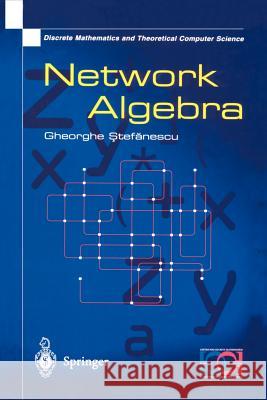
Network Algebra Gheorghe Stefanescu 9781852331955 Springer - książkaWidoczna okładka, to zdjęcie poglądowe, a rzeczywista szata graficzna może różnić się od prezentowanej.

Network Algebra

ISBN-13: 9781852331955 / Angielski / Miękka / 2000 / 402 str.

Gheorghe Stefanescu
cena 201,72 zł
(netto: 192,11 VAT:  5%)

Najniższa cena z 30 dni: 192,74 zł
Termin realizacji zamówienia:
ok. 22 dni roboczych
Bez gwarancji dostawy przed świętami

Darmowa dostawa!

Network Algebra considers the algebraic study of networks and their behaviour. It contains general results on the algebraic theory of networks, recent results on the algebraic theory of models for parallel programs, as well as results on the algebraic theory of classical control structures. The results are presented in a unified framework of the calculus of flownomials, leading to a sound understanding of the algebraic fundamentals of the network theory. The term 'network' is used in a broad sense within this book, as consisting of a collection of interconnecting cells, and two radically different specific interpretations of this notion of networks are studied. One interpretation is additive, when only one cell is active at a given time - this covers the classical models of control specified by finite automata or flowchart schemes. The second interpretation is multiplicative, where each cell is always active, covering models for parallel computation such as Petri nets or dataflow networks. More advanced settings, mixing the two interpretations are included as well. Network Algebra will be of interest to anyone interested in network theory or its applications and provides them with the results needed to put their work on a firm basis. Graduate students will also find the material within this book useful for their studies.


Kategorie:
Informatyka, Bazy danych
Kategorie BISAC:
Computers > Networking - Hardware
Mathematics > Matematyka stosowana
Mathematics > Algebra - General
Wydawca:
Springer
Seria wydawnicza:
Discrete Mathematics and Theoretical Computer Science
Język:
Angielski
ISBN-13:
9781852331955
Rok wydania:
2000
Wydanie:
Softcover Repri
Numer serii:
000148686
Ilość stron:
402
Waga:
0.63 kg
Wymiary:
23.42 x 15.62 x 2.62
Oprawa:
Miękka
Wolumenów:
01
Dodatkowe informacje:
Bibliografia
Wydanie ilustrowane

"Interesting exercises and problems accompany most of sections. Also some open questions related to this subject are present." (Daniela Marinescu, zbMATH 0956.68002, 2022)

I. An introduction to Network Algebra.- Brief overview of the key results.- Regular expressions.- Iteration theories.- Flownomials.- Basic results.- Mixed calculi.- Structure of the book.- Acknowledgments.- 1. Network Algebra and its applications.- 1.1 Algebra of finite relations.- 1.2 Basic Network Algebra, BNA.- 1.3 Flownomial expressions.- 1.4 Concrete vs. abstract networks.- 1.5 Network algebra, NA.- 1.6 Control, space, time: 3 faces of NA models.- 1.7 Feedback, iteration, and repetition.- 1.8 Network behaviours as xy-flows.- 1.9 Mixed Network Algebra, MixNA.- * Comments, problems, bibliographic remarks.- II. Relations, flownomials, and abstract networks.- 2. Networks modulo graph isomorphism.- 2.1 Symocats.- 2.2 Bijections in symocats.- 2.3 Bijections in BNAs.- 2.4 Semantic models: I. BNA structure.- 2.5 Other presentations of BNAs.- 2.6 Network representation; model [X,T]a?.- 2.7 Working with flownomials.- 2.8 BNA soundness.- 2.9 BNA completeness.- 2.10 Networks as a?-flownomials.- * Comments, problems, bibliographic remarks.- 3. Algebraic models for branching constants.- 3.1 xy-symocats (xy-weak rules).- 3.2 Angelic vs. demonic operators.- 3.3 Semantic models: II. NA structure.- 3.4 Normal form for relations.- 3.5 Axioms for relations.- 3.6 Simplification.- 3.7 Relations in xy-symocats.- 3.8 Relations in xy-symocats with feedback.- 3.9 Networks with branching constants.- * Comments, problems, bibliographic remarks.- 4. Network behaviour.- 4.1 Strong xy-symocats (xy-strong rules).- 4.2 Algebraic theories.- 4.3 Matrix theories.- 4.4 Enzymatic rule (xy-enzymatic rules).- 4.5 Strong axioms: from cells to networks.- 4.6 xy-flows.- 4.7 Semantic models: III. xy-flow structure.- 4.8 Simulation.- 4.9 Enzymatic rule: from connections to networks.- 4.10 Duality: I. Reversing arrows.- * Comments, problems, bibliographic remarks.- 5. Elgot theories.- 5.1 Input behaviour; regular trees.- 5.2 Elgot theories (a?-flows).- 5.3 Structural Theorem, case a?.- 5.4 Soundness for a?-flow.- 5.5 Completeness for a?-flow.- 5.6 Working with a?-flownomials.- 5.7 Output behaviour.- 5.8 Bisimulation: two-way simulation.- 5.9 Milner theories.- * Comments, problems, bibliographic remarks.- 6. Kleene theories.- 6.1 IO behaviour, deterministic case.- 6.2 Park theories (b?-flow).- 6.3 Structural Theorem, case b?.- 6.4 Soundness for b? -flow.- 6.5 Completeness for b?-flow.- 6.6 Working with b?-flownomials.- 6.7 IO behaviour, nondeterministic case.- 6.8 Kleene theories (d?-flow).- 6.9 Structural Theorem, case d?.- 6.10 Soundness for d?-flow.- 6.11 Completeness for d?-flow.- 6.12 Working with d?-flownomials.- * Comments, problems, bibliographic remarks.- III. Algebraic theory of special networks.- 7. Flowchart schemes.- 7.1 Structural programs.- 7.2 Flowchart representation.- 7.3 Floyd-Hoare logic.- 7.4 Soundness of Floyd-Hoare logic.- 7.5 Completeness of Floyd-Hoare logic.- 7.6 Duality: II. Control-Space.- 7.7 Iteration and feedback in (co)algebraic theories.- * Comments, problems, bibliographic remarks.- 8. Automata.- 8.1 Finite automata.- 8.2 Simulation.- 8.3 From nondeterministic to deterministic automata.- 8.4 Minimization: I. Accessibility.- 8.5 Minimization: II. Reduction.- 8.6 Minimization: III. Deterministic automata.- 8.7 Regular expressions and Kleene algebras.- 8.8 Kleene Theorem: I. From automata to regular expressions.- 8.9 Kleene Theorem: II. From regular expressions to automata.- 8.10 Axiomatization, regular expressions.- 8.11 Repetition, iteration, and feedback in matrix theories.- * Comments, problems, bibliographic remarks.- 9. Process algebra.- 9.1 An overview on parallel processes.- 9.2 Transition systems.- 9.3 Nondeterministic sequential processes; BPA plus recursion.- 9.4 Coloured traces.- 9.5 Communicating processes; ACP.- 9.6 Soundness and completeness of ACP.- 9.7 Abstraction.- 9.8 A case study: Alternating Bit Protocol.- * Comments, problems, bibliographic remarks.- 10. Data-flow networks.- 10.1 Data-flow networks; general presentation.- 10.2 Synchronous networks.- 10.3 Asynchronous networks.- 10.4 Axiomatization: asynchronous, deterministic case.- 10.5 Time anomaly for nondeterministic networks.- 10.6 Axiomatization: asynchronous, nondeterministic case.- 10.7 Fully abstract models.- 10.8 Network algebra on top of process algebra.- * Comments, problems, bibliographic remarks.- 11. Petri nets.- 11.1 Introducing the model.- 11.2 Concurrent regular expressions (CRegExp).- 11.3 Decomposed Petri nets.- 11.4 From Petri net languages to CRegExp.- 11.5 From CRegExp to Petri net languages.- 11.6 Equivalence of CRegExp and Petri net languages.- * Comments, problems, bibliographic remarks.- IV. Towards an algebraic theory for software components.- 12. Mixed Network Algebra.- 12.1 Why mixed network algebra models?.- 12.2 Mixing control, space, and time.- 12.3 Acyclic models.- 12.3.1 Sysecats.- 12.3.2 Mixed relations.- 12.3.3 Distributive categories (discats).- 12.3.4 Mixalgebras.- 12.3.5 Plans.- 12.4 Compilers, code generation.- 12.5 Duality: III. Space—time.- 12.6 Object-oriented programs/software components.- * Comments, problems, bibliographic remarks.- Related calculi, closing remarks.- Appendix B: Lifting BNA from connections to networks.- Appendix C: Demonic relation operators.- Appendix D. Generating congruences.- Appendix E: Automata, complements.- Appendix F: Data-flow networks; checking NA axioms.- Appendix G: Axiomatizing mixed relations.- Appendix H: Discats as sysecats.- Appendix I: Decomposing morphisms in discats.- Appendix J: Plans as free discats.- List of tables.- List of figures.


Udostępnij

Facebook - konto krainaksiazek.pl


Opinie o Krainaksiazek.pl na Opineo.pl

Partner Mybenefit

Krainaksiazek.pl w programie rzetelna firma Krainaksiaze.pl - płatności przez paypal

Czytaj nas na:

Facebook - krainaksiazek.pl
  • książki na zamówienie
  • granty
  • książka na prezent
  • kontakt
  • pomoc
  • opinie
  • regulamin
  • polityka prywatności

Zobacz:

  • Księgarnia czeska

  • Wydawnictwo Książkowe Klimaty

1997-2025 DolnySlask.com Agencja Internetowa

© 1997-2022 krainaksiazek.pl
     
KONTAKT | REGULAMIN | POLITYKA PRYWATNOŚCI | USTAWIENIA PRYWATNOŚCI
Zobacz: Księgarnia Czeska | Wydawnictwo Książkowe Klimaty | Mapa strony | Lista autorów
KrainaKsiazek.PL - Księgarnia Internetowa

Polityka prywatnosci - link
Krainaksiazek.pl - płatnośc Przelewy24
Przechowalnia Przechowalnia





