• Wyszukiwanie zaawansowane
  • Kategorie
  • Kategorie BISAC
  • Książki na zamówienie
  • Promocje
  • Granty
  • Książka na prezent
  • Opinie
  • Pomoc
  • Załóż konto
  • Zaloguj się

Nerve Cells and Nervous Systems: An Introduction to Neuroscience » książka


zaloguj się | załóż konto
Logo Krainaksiazek.pl

koszyk

konto

szukaj
topmenu
Księgarnia internetowa
Szukaj
Książki na zamówienie
Promocje
Granty
Książka na prezent
Moje konto
Pomoc
 
 
Wyszukiwanie zaawansowane
Pusty koszyk
Bezpłatna dostawa dla zamówień powyżej 20 złBezpłatna dostawa dla zamówień powyżej 20 zł

Kategorie główne

• Nauka
 [2948695]
• Literatura piękna
 [1824038]

  więcej...
• Turystyka
 [70868]
• Informatyka
 [151073]
• Komiksy
 [35227]
• Encyklopedie
 [23181]
• Dziecięca
 [621575]
• Hobby
 [138961]
• AudioBooki
 [1642]
• Literatura faktu
 [228651]
• Muzyka CD
 [371]
• Słowniki
 [2933]
• Inne
 [445341]
• Kalendarze
 [1243]
• Podręczniki
 [164416]
• Poradniki
 [479493]
• Religia
 [510449]
• Czasopisma
 [502]
• Sport
 [61384]
• Sztuka
 [243086]
• CD, DVD, Video
 [3417]
• Technologie
 [219673]
• Zdrowie
 [100865]
• Książkowe Klimaty
 [124]
• Zabawki
 [2168]
• Puzzle, gry
 [3372]
• Literatura w języku ukraińskim
 [260]
• Art. papiernicze i szkolne
 [7838]
Kategorie szczegółowe BISAC

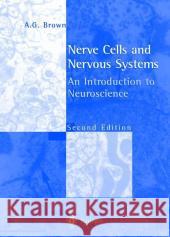
Nerve Cells and Nervous Systems: An Introduction to Neuroscience

ISBN-13: 9783540760900 / Angielski / Miękka / 2001 / 253 str.
A. G. Brown; Alan G. Brown
Nerve Cells and Nervous Systems: An Introduction to Neuroscience Brown, A. G. 9783540760900 Springer - książkaWidoczna okładka, to zdjęcie poglądowe, a rzeczywista szata graficzna może różnić się od prezentowanej.

Nerve Cells and Nervous Systems: An Introduction to Neuroscience

ISBN-13: 9783540760900 / Angielski / Miękka / 2001 / 253 str.

A. G. Brown; Alan G. Brown
cena 341,34
(netto: 325,09 VAT:  5%)

Najniższa cena z 30 dni: 327,68
Termin realizacji zamówienia:
ok. 22 dni roboczych.

Darmowa dostawa!

It is now about 10 years since the first edition of Nerve Cells and Nervous Systems was published. There have been many important advances across the whole field of neuro science since 1990 and it was obvious that the first edition had become much less useful than when it was published. Hence this new edition. I have attempted to keep to the aims of the first edition by presenting the general principles of neuroscience in the context of experimental evidence. As with the first edition, the selection of material to include, or exclude, has been difficult and invariably reflects my personal biases. I hope that not too many readers will be disappointed with the selections. I have unashamedly retained material, and, in particular, illustrations where I think they remain of importance to an understanding of the field and to its historical development. As before, I have attempted as reasonable a coverage as possible within the confines of a book that should be easy to carry around, to handle and, I hope, to read. The book should be useful for anyone studying the nervous system at both undergraduate and immediate postgraduate levels. In particular, under graduates reading neuroscience or any course containing a neuroscience component, such as physiology, pharmacology, biomedical sciences or psychology, as well as medicine and veterinary medicine should find the book helpful."


Kategorie:
Nauka, Medycyna
Kategorie BISAC:
Social Science > Antropologia - Fizyczna
Medical > Neurologia i neurofizjologia kliniczna
Science > Biologia człowieka
Wydawca:
Springer
Język:
Angielski
ISBN-13:
9783540760900
Rok wydania:
2001
Wydanie:
2001
Ilość stron:
253
Waga:
0.73 kg
Wymiary:
26.87 x 19.41 x 1.4
Oprawa:
Miękka
Wolumenów:
01
Dodatkowe informacje:
Wydanie ilustrowane

1 Introduction to Nerve Cells and Nervous Systems.- The Nervous System and Control.- The Nervous System and Communication.- Nerve Cells.- The Generalised Neuron.- The Anatomy of Neurons.- The Neuroglia.- The General Plan of Nervous Systems.- Regulation of the External Environment of Neurons.- Summary.- 2 The Cell Membrane: Ionic Permeability and Electrotonic Properties.- The Structure of Cell Membranes.- Non-gated Channels and the Resting Membrane Potential.- Resting Potential of an Ideal Cell.- Electrotonic Properties of Nerve Cells.- Summary.- 3 The Action Potential and the Nerve Impulse.- Electrically Excitable Cells.- Ionic Basis of Action Potentials in Nerve Fibres.- Voltage-Clamp Experiments.- The Initial Inward Current Is Due To Movement of Na+.- The Later Outward Current Is Due To Movement of K+.- The Inward and Outward Currents Can Be Separated by Drugs.- The Separate Na+ and K+ Conductances Can Be Determined.- Na+ Inactivation Is a Distinct Process.- Action Potential Shape and Propagation Can Be Predicted on a Theoretical Basis.- Changes in Internal Ion Concentrations Due to the Action Potential.- Summary of the Action Potential.- The Nerve Impulse.- Local Circuits.- Effect of Axon Diameter on Conduction Velocity.- Myelination and Saltatory Conduction.- Voltage-Gated Channels and Impulse Propagation.- The Length of Axon Involved in a Nerve Impulse.- Extracellular Field Potentials.- Extracellular Recording from a Single Axon.- Extracellular Recording from a Nerve Bundle — The Compound Action Potential.- Classification of Nerve Fibres.- Summary.- 4 Voltage-Gated Ion Channels in Excitable Membranes.- Voltage-Gated Na+ Channels.- The Voltage-Gated Na+ Channel Responsible for INa,t, the Transient Rapidly Activating and Inactivating Na+ Current.- A Voltage-Gated Na+ Channel Responsible for a Persistent Na+ Current (INa,p).- Voltage-Gated K+ Channels.- The Voltage-Gated K+ Channel Responsible for the Delayed Rectifying Current (IK).- Voltage-Gated K+ Channels Responsible for the A Current (IA).- Voltage-Gated K+ Channel Responsible for the M Current (IM).- Voltage-Gated Ca2+ Channels.- Summary.- 5 General Properties of Intercellular Communication in the Nervous System.- Electrical Synaptic Transmission.- Excitatory Electrical Transmission.- Inhibitory Electrical Transmission.- Chemical Synaptic Transmission.- General Outline of Chemical Synaptic Transmission.- Summary.- 6 The Presynaptic Neuron I: Release of Neurotransmitter.- Role of Ca2+ in Transmitter Release.- Release of Transmitter in Packets or Quanta.- Quantal Content.- Molecular Mechanisms Involved in Transmitter Release.- Vesicle Manufacture.- Transmitter Release: Vesicle Docking, Fusion and Exocytosis.- Vesicle Endocytosis and Recycling.- Role of Ca2+ in Molecular Mechanisms of Release.- Changes in Synaptic Efficacy Due to Presynaptic Mechanisms.- Presynaptic Inhibition.- Summary.- 7 The Presynaptic Neuron II: Neurotransmitters.- Definition and Identification of Transmitters.- Classification of Transmitters.- Low-molecular-weight Transmitters.- Neuroactive Peptides.- Adenosine triphosphate (ATP).- Unconventional Transmitters.- Some General Principles About Transmitters.- Some Transmitters Appear To Be Either Excitatory or Inhibitory but Not Both.- Some Transmitters May Have Either Excitatory or Inhibitory Actions.- Many Neurons Contain Several Transmitters.- A Single Neuron May Release More Than One Transmitter.- Some Neuronal Systems Containing Particular Transmitters Have Very Wide-ranging Actions in the Brain.- Summary.- 8 The Postsynaptic Neuron I: Actions of Neurotransmitters.- Postsynaptic Receptors.- Ionotropic Receptors.- Metabotropic Receptors.- Consequences of Transmitter-Receptor Combination.- Actions at Ionotropic Receptors.- Actions at Metabotropic Receptors.- Summary.- 9 The Postsynaptic Neuron II: The Neuron as an Integrative Device.- Neuron Doctrine and the Law of Dynamic Polarisation.- The Generalised Neuron Concept.- The Generalised Neuron as a Model for the Mammalian Motoneuron.- The Generalised Neuron as a Model for Other Neurons.- Synapses on Axon Terminals — Axo-axonic Synapses.- Impulses in Dendrites.- Dendritic Spines.- The Importance of Synaptic Location.- Excitatory Synaptic Location on Motoneurons.- Inhibitory Synapses.- Consequences of Synaptic Location Specificity.- Summary.- 10 Transmission Between Pairs of Identified Neurons.- Transmission Between la Afferent Fibres from Muscle Spindles and Spinal a-Motoneurons.- Anatomy of the Ia-oc-Motoneuron System.- Ia Afferent Fibres.- Ia Afferent Contacts upon Motoneurons.- Actions of Ia Afferent Fibres on a-Motoneurons.- Transmission Between Cutaneous Afferent Fibres and Neurons of Somatosensory Pathways.- Transmission Between Hair Follicle Afferent Fibres and Spinocervical Tract Neurons.- Transmission Between Cutaneous Afferent Fibres and Neurons of the Dorsal Column Nuclei.- Summary.- 11 Sense Organ Mechanisms.- Sense Organ Specificity.- Sensory Transduction Mechanisms.- Mechanoreceptors.- Vertebrate Photoreceptors.- Adaptation of Sensory Signals.- Stimulus Encoding.- Dynamic and Static Components of the Response.- Centrifugal Control of Sense Organs.- Mammalian Muscle Spindles and their Centrifugal Control.- Summary.- 12 Functional Organisation in Groups of Neurons.- Properties of Small Neuronal Circuits.- The Two-Neuron Reflex Arc.- Addition of Interneurons to the Two-Neuron Arc.- The Mammalian Spinal Segmental Motor Apparatus — An Example of the Operation of Small Groups of Neurons.- Spinal Monosynaptic Reflex.- Reciprocal Inhibition of Motoneurons from Ia Afferent Fibres.- Group II Afferent Fibres from Spindle Secondary Endings and the Monosynaptic Reflex Arc.- Reflex Actions of Group Ib Afferent Fibres from Golgi Tendon Organs.- Flexion Reflex and Crossed Extension Reflex.- ?-Motoneurons and the Control of Muscle Spindle Sensitivity.- Other Influences on the Segmental Motor Apparatus.- The Modular Design of Nervous Systems.- Modular Design of the Cerebellum.- Modular Organisation in the Cerebral Cortex.- Summary.- 13 Structural Organisation of Sensory and Motor Systems.- Sensory Systems.- Hierarchical Organisation.- Parallel Pathways.- Descending (Centrifugal) Loops in the Ascending Sensory Systems.- Motor Systems.- Hierarchical Pathways.- Parallel Pathways.- Systems Controlling the Motor Hierarchy.- Summary.- 14 Functional Properties of Specific Sensory and Motor Systems.- Functional Properties of Specific Sensory Systems.- Modality Specificity.- Place Specificity.- The Concept of Receptive Field.- Receptive Field Organisation for Feature Extraction.- Submodality Convergence.- Centrifugal Control in Sensory Systems.- Functional Properties of Specific Motor Systems.- Motoneurons, Motor Units and Motoneuron Recruitment.- Stimulus-Triggered Reactions.- Centrally Programmed Movements.- Voluntary Movement.- Maps in the Brain.- Why are there maps?.- Why are there several maps at each level?.- What is being mapped?.- Summary.- 15 The Nervous System and the Internal and External Environments — Homeostasis and Interactions.- The Neuroendocrine System.- The Magnocellular Neurosecretory System.- The Parvocellular Neurosecretory System.- Circadian Rhythms.- The Photoreceptive System.- The Suprachiasmatic Nucleus.- Output Systems from the Suprachiasmatic Nucleus.- Behavioural State — Sleeping and Waking.- Sleeping and Waking.- Motivational Behaviour.- Non-Specific Activation.- Homeostasis and Motivational Behaviour.- Control of Nociception.- Segmental Control of Nociceptive Input.- Descending Control of Nociception.- Interactions with Other Organisms.- Animal Communication.- Human Language.- Summary.- 16 Formation, Maintenance and Plasticity of Synapses.- Development of the Nervous System.- Determination of Nervous Tissue.- Cell Differentiation.- Synapse Formation and the Maintenance of Connections.- Formation of the Neuromuscular Junction.- Synapse Elimination.- Formation of Synaptic Connections in the Visual System.- Matching of Neuronal Populations.- Programmed Cell Death and Nerve Growth Factor.- Effects of Denervation in the Adult Central Nervous System.- Abnormal Experience and the Formation of Synaptic Connections — Critical Periods.- Summary.- 17 Learning and Memory.- Forms of Learning and Memory.- Cellular Mechanisms of Learning and Memory in Invertebrates.- Non-associative Learning: Habituation and Sensitisation.- Associative Learning in Invertebrates: Classical Conditioning.- Cellular Mechanisms of Learning in Vertebrates.- Mechanisms Underlying Long-Term Potentiation in the Hippocampus.- Long-Term Depression in the Cerebellum.- Learning and Memory in Humans.- The Major Memory Systems.- Summary.- References.

Brown, Alan G. Alan has been writing since 1993 and won writing c... więcej >


Udostępnij

Facebook - konto krainaksiazek.pl


Opinie o Krainaksiazek.pl na Opineo.pl

Partner Mybenefit

Krainaksiazek.pl w programie rzetelna firma Krainaksiaze.pl - płatności przez paypal

Czytaj nas na:

Facebook - krainaksiazek.pl
  • książki na zamówienie
  • granty
  • książka na prezent
  • kontakt
  • pomoc
  • opinie
  • regulamin
  • polityka prywatności

Zobacz:

  • Księgarnia czeska

  • Wydawnictwo Książkowe Klimaty

1997-2026 DolnySlask.com Agencja Internetowa

© 1997-2022 krainaksiazek.pl
     
KONTAKT | REGULAMIN | POLITYKA PRYWATNOŚCI | USTAWIENIA PRYWATNOŚCI
Zobacz: Księgarnia Czeska | Wydawnictwo Książkowe Klimaty | Mapa strony | Lista autorów
KrainaKsiazek.PL - Księgarnia Internetowa

Polityka prywatnosci - link
Krainaksiazek.pl - płatnośc Przelewy24
Przechowalnia Przechowalnia





