• Wyszukiwanie zaawansowane
  • Kategorie
  • Kategorie BISAC
  • Książki na zamówienie
  • Promocje
  • Granty
  • Książka na prezent
  • Opinie
  • Pomoc
  • Załóż konto
  • Zaloguj się

Neighborhood Semantics for Modal Logic » książka


zaloguj się | załóż konto
Logo Krainaksiazek.pl

koszyk

konto

szukaj
topmenu
Księgarnia internetowa
Szukaj
Książki na zamówienie
Promocje
Granty
Książka na prezent
Moje konto
Pomoc
 
 
Wyszukiwanie zaawansowane
Pusty koszyk
Bezpłatna dostawa dla zamówień powyżej 20 złBezpłatna dostawa dla zamówień powyżej 20 zł

Kategorie główne

• Nauka
 [2952079]
• Literatura piękna
 [1850969]

  więcej...
• Turystyka
 [71058]
• Informatyka
 [151066]
• Komiksy
 [35579]
• Encyklopedie
 [23181]
• Dziecięca
 [620496]
• Hobby
 [139036]
• AudioBooki
 [1646]
• Literatura faktu
 [228729]
• Muzyka CD
 [379]
• Słowniki
 [2932]
• Inne
 [445708]
• Kalendarze
 [1409]
• Podręczniki
 [164793]
• Poradniki
 [480107]
• Religia
 [510956]
• Czasopisma
 [511]
• Sport
 [61267]
• Sztuka
 [243299]
• CD, DVD, Video
 [3411]
• Technologie
 [219640]
• Zdrowie
 [100984]
• Książkowe Klimaty
 [124]
• Zabawki
 [2281]
• Puzzle, gry
 [3363]
• Literatura w języku ukraińskim
 [258]
• Art. papiernicze i szkolne
 [8020]
Kategorie szczegółowe BISAC

Neighborhood Semantics for Modal Logic

ISBN-13: 9783319671482 / Angielski / Miękka / 2017 / 154 str.
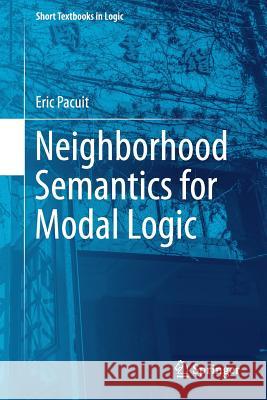
Eric Pacuit
Neighborhood Semantics for Modal Logic Eric Pacuit 9783319671482 Springer - książkaWidoczna okładka, to zdjęcie poglądowe, a rzeczywista szata graficzna może różnić się od prezentowanej.

Neighborhood Semantics for Modal Logic

ISBN-13: 9783319671482 / Angielski / Miękka / 2017 / 154 str.

Eric Pacuit
cena 160,99
(netto: 153,32 VAT:  5%)

Najniższa cena z 30 dni: 146,48
Termin realizacji zamówienia:
ok. 22 dni roboczych
Dostawa w 2026 r.

Darmowa dostawa!

This book offers a state-of-the-art introduction to the basic techniques and results of neighborhood semantics for modal logic. In addition to presenting the relevant technical background, it highlights both the pitfalls and potential uses of neighborhood models - an interesting class of mathematical structures that were originally introduced to provide a semantics for weak systems of modal logic (the so-called non-normal modal logics) and can be fruitfully studied using modal logic.
In addition, the book discusses a broad range of topics, including standard modal logic results (i.e., completeness, decidability and definability); bisimulations for neighborhood models and other model-theoretic constructions; comparisons with other semantics for modal logic (e.g., relational models, topological models, plausibility models); neighborhood semantics for first-order modal logic, applications in game theory (coalitional logic and game logic); applications in epistemic logic (logics of evidence and belief); and non-normal modal logics with dynamic modalities.
The book can be used as the primary text for seminars on philosophical logic focused on non-normal modal logics; as a supplemental text for courses on modal logic, logic in AI, or philosophical logic (either at the undergraduate or graduate level); or as the primary source for researchers interested in learning about the uses of neighborhood semantics in philosophical logic and game theory.t-family: Helvetica, Arial


Kategorie:
Nauka, Filozofia
Kategorie BISAC:
Philosophy > Logic
Computers > Data Science - General
Mathematics > Logic
Wydawca:
Springer
Seria wydawnicza:
Short Textbooks in Logic
Język:
Angielski
ISBN-13:
9783319671482
Rok wydania:
2017
Wydanie:
2017
Numer serii:
000821552
Ilość stron:
154
Waga:
0.24 kg
Wymiary:
23.39 x 15.6 x 0.91
Oprawa:
Miękka
Wolumenów:
01
Dodatkowe informacje:
Wydanie ilustrowane

"Neighbourhood frames offer an interpretation to systems of modal logic that generalises the more traditional relational frames. ... Complemented with the numerous pointers to the literature that it provides, the book will be a valuable source of information and practice for PhD students." (Éric Martin, zbMATH 1390.03001, 2018)
"Reading and writing a review of this wonderful book has been a pleasure. Knowing the basics of propositional modal logic may explain why I enjoyed reading it. The author has gathered and surveyed many papers in writing this book. This is a must-read for those who want to do research on neighborhood semantics--after having acquired a basic knowledge of modal logic." (Manoj K. Raut, Computing Reviews, February, 2019)

1. Introduction and Motivation

1.1 Subset Spaces
1.2 Language and Semantics
1.3 Why Non-Normal Modal Logic?
1.4 Why Neighborhood Structures? 
2. Core Theory
2.1 Expressive Power and Invariance
2.2 Alternative Semantics for Non-Normal Modal Logic
2.3 The Landscape of Non-Normal Modal Logic
2.4 Computational Issues
2.5 Frame Correspondence
2.6 Translations
3. Richer Languages
3.1 Universal Modality and Nominals
3.2 First-Order Neighborhood Structures
3.3 Common Belief on Neighborhood Structures
3.4 Dynamics with Neighborhoods: Game Logic
3.5 Dynamics on Neighborhood Structures
A. Relational Semantics for Modal Logic
A.1 Definability
A.2 Normal Modal Logics

Eric Pacuit is an Assistant Professor of Philosophy at the University of Maryland, USA. Before coming to Maryland, Eric worked at Stanford University, USA; at the Institute for Logic, Language and Computation at the University of Amsterdam, Netherlands; and at the Tilburg Institute for Logic and Philosophy of Science at Tilburg University, Netherlands. His research primarily addresses issues in interactive epistemology and group decision-making – two interdisciplinary areas that make use of ideas and techniques from logic (especially modal logic), philosophy, game theory and social choice theory. His research has been generously supported by a grant from the National Science Foundation and a VIDI grant from the NWO (the Netherlands Organization for Scientific Research).

This book offers a state-of-the-art introduction to the basic techniques and results of neighborhood semantics for modal logic. In addition to presenting the relevant technical background, it highlights both the pitfalls and potential uses of neighborhood models – an interesting class of mathematical structures that were originally introduced to provide a semantics for weak systems of modal logic (the so-called non-normal modal logics).  

In addition, the book discusses a broad range of topics, including standard modal logic results (i.e., completeness, decidability and definability); bisimulations for neighborhood models and other model-theoretic constructions; comparisons with other semantics for modal logic (e.g., relational models, topological models, plausibility models); neighborhood semantics for first-order modal logic, applications in game theory (coalitional logic and game logic); applications in epistemic logic (logics of evidence and belief); and non-normal modal logics with dynamic modalities.

The book can be used as the primary text for seminars on philosophical logic focused on non-normal modal logics; as a supplemental text for courses on modal logic, logic in AI, or philosophical logic (either at the undergraduate or graduate level); or as the primary source for researchers interested in learning about the uses of neighborhood semantics in philosophical logic and game theory.


Udostępnij

Facebook - konto krainaksiazek.pl


Opinie o Krainaksiazek.pl na Opineo.pl

Partner Mybenefit

Krainaksiazek.pl w programie rzetelna firma Krainaksiaze.pl - płatności przez paypal

Czytaj nas na:

Facebook - krainaksiazek.pl
  • książki na zamówienie
  • granty
  • książka na prezent
  • kontakt
  • pomoc
  • opinie
  • regulamin
  • polityka prywatności

Zobacz:

  • Księgarnia czeska

  • Wydawnictwo Książkowe Klimaty

1997-2025 DolnySlask.com Agencja Internetowa

© 1997-2022 krainaksiazek.pl
     
KONTAKT | REGULAMIN | POLITYKA PRYWATNOŚCI | USTAWIENIA PRYWATNOŚCI
Zobacz: Księgarnia Czeska | Wydawnictwo Książkowe Klimaty | Mapa strony | Lista autorów
KrainaKsiazek.PL - Księgarnia Internetowa

Polityka prywatnosci - link
Krainaksiazek.pl - płatnośc Przelewy24
Przechowalnia Przechowalnia





