• Wyszukiwanie zaawansowane
  • Kategorie
  • Kategorie BISAC
  • Książki na zamówienie
  • Promocje
  • Granty
  • Książka na prezent
  • Opinie
  • Pomoc
  • Załóż konto
  • Zaloguj się

Near-Field Nano-Optics: From Basic Principles to Nano-Fabrication and Nano-Photonics » książka


zaloguj się | załóż konto
Logo Krainaksiazek.pl

koszyk

konto

szukaj
topmenu
Księgarnia internetowa
Szukaj
Książki na zamówienie
Promocje
Granty
Książka na prezent
Moje konto
Pomoc
 
 
Wyszukiwanie zaawansowane
Pusty koszyk
Bezpłatna dostawa dla zamówień powyżej 20 złBezpłatna dostawa dla zamówień powyżej 20 zł

Kategorie główne

• Nauka
 [2946350]
• Literatura piękna
 [1816154]

  więcej...
• Turystyka
 [70666]
• Informatyka
 [151172]
• Komiksy
 [35576]
• Encyklopedie
 [23172]
• Dziecięca
 [611458]
• Hobby
 [135995]
• AudioBooki
 [1726]
• Literatura faktu
 [225763]
• Muzyka CD
 [378]
• Słowniki
 [2917]
• Inne
 [444280]
• Kalendarze
 [1179]
• Podręczniki
 [166508]
• Poradniki
 [469467]
• Religia
 [507199]
• Czasopisma
 [496]
• Sport
 [61352]
• Sztuka
 [242330]
• CD, DVD, Video
 [3348]
• Technologie
 [219391]
• Zdrowie
 [98638]
• Książkowe Klimaty
 [124]
• Zabawki
 [2382]
• Puzzle, gry
 [3525]
• Literatura w języku ukraińskim
 [259]
• Art. papiernicze i szkolne
 [7107]
Kategorie szczegółowe BISAC

Near-Field Nano-Optics: From Basic Principles to Nano-Fabrication and Nano-Photonics

ISBN-13: 9781461371922 / Angielski / Miękka / 2012 / 386 str.
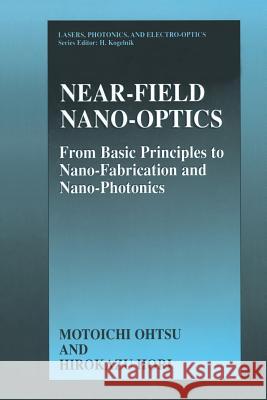
Motoichi Ohtsu; Hirokazu Hori
Near-Field Nano-Optics: From Basic Principles to Nano-Fabrication and Nano-Photonics Ohtsu, Motoichi 9781461371922 Springer - książkaWidoczna okładka, to zdjęcie poglądowe, a rzeczywista szata graficzna może różnić się od prezentowanej.

Near-Field Nano-Optics: From Basic Principles to Nano-Fabrication and Nano-Photonics

ISBN-13: 9781461371922 / Angielski / Miękka / 2012 / 386 str.

Motoichi Ohtsu; Hirokazu Hori
cena 201,24
(netto: 191,66 VAT:  5%)

Najniższa cena z 30 dni: 192,74
Termin realizacji zamówienia:
ok. 16-18 dni roboczych.

Darmowa dostawa!

Conventional optical science and technology have been restricted by the diffraction limit from reducing the sizes of optical and photoruc devices to nanometric dimensions. Thus, the size of optical integrated circuits has been incompatible with that of their counterpart, integrated electronic circuits, which have much smaller dimensions. This book provides potential ideas and methods to overcome this difficulty. Near-field optics has developed very rapidly from around the middle 1980s after preliminary trials in the microwave frequency region, as proposed as early as 1928. At the early stages of this development, most technical efforts were devoted to realizing super-high-resolution optical microscopy beyond the diffraction limit. However, the possibility of exploiting the optical near-field, phenomenon of quasistatic electromagnetic interaction at subwavelength distances between nanometric particles has opened new ways to nanometric optical science and technology, and many applications to nanometric fabrication and manipulation have been proposed and implemented. Building on this historical background, this book describes recent progress in near-field optical science and technology, mainly using research of the author's groups. The title of this book, Near-Field Nano-Optics-From Basic Principles to Nano-Fabrication and Nano-Photonics, implies capabilities of the optical near- field not only for imaging/microscopy, but also for fabrication/manipulation/proc- essing on a nanometric scale.


Kategorie:
Technologie
Kategorie BISAC:
Technology & Engineering > Electrical
Science > Optyka
Technology & Engineering > Materials Science - General
Wydawca:
Springer
Seria wydawnicza:
Lasers, Photonics, and Electro-Optics
Język:
Angielski
ISBN-13:
9781461371922
Rok wydania:
2012
Wydanie:
Softcover Repri
Numer serii:
000131648
Ilość stron:
386
Waga:
0.59 kg
Wymiary:
22.9 x 15.2
Oprawa:
Miękka
Wolumenów:
01

1. Introduction.- 1.1. Near-Field Optics and Photonics.- 1.1.1. Optical Processes and Electromagnetic Interactions.- 1.2. Ultra-High-Resolution Near-Field Optical Microscopy (NOM).- 1.2.1. From Interference- to Interaction-Type Optical Microscopy.- 1.2.2. Development of Near-Field Optical Microscopy and Related Techniques.- 1.3. General Features of Optical Near-Field Problems.- 1.3.1. Optical Processes and the Scale of Interest.- 1.3.2. Effective Fields and Interacting Subsystems.- 1.3.3. Electromagnetic Interaction in a Dielectric System.- 1.3.4. Optical Near-Field Measurements.- 1.4. Theoretical Treatment of Optical Near-Field Problems.- 1.4.1. Near-Field Optics and Inhomogeneous Waves.- 1.4.2. Field-Theoretic Treatment of Optical Near-Field Problems.- 1.4.3. Explicit Treatment of Field—Matter Interaction.- 1.5. Remarks on Near-Field Optics and Outline of This Book.- 1.5.1. Near-Field Optics and Related Problems.- 1.5.2. Outline of This Book.- 1.6. References.- 2. Principles of Near-Field Optical Microscopy.- 2.1. An Example of Near-Field Optical Microscopy.- 2.2. Construction of the NOM System.- 2.2.1. Building Blocks of the NOM System.- 2.2.2. Environmental Conditions.- 2.2.3. Functions of the Building Blocks.- 2.3. Theoretical Description of Near-Field Optical Microscopy.- 2.3.1. Basic Character of the NOM Process.- 2.3.3. Demonstration of Localization in the Near-Field Interaction.- 2.3.4. Representation of the Spatial Localization of an Electromagnetic Event.- 2.3.5. Model Description of a Local Electromagnetic Interaction.- 2.4. Near-Field Problems and the Tunneling Process.- 2.4.1. Bardeen’s Description of Tunneling Current in STM.- 2.4.2. Comparison of the Theoretical Aspects of NOM and STM.- 2.5. References.- 3. Instrumentation.- 3.1. Basic Systems of a Near-Field Optical Microscope.- 3.1.1. Modes of Operation.- 3.1.2. Position Control of the Probe.- 3.1.3. Mechanical Components.- 3.1.4. Noise Sources Internal to the NOM.- 3.1.5. Operation under Special Circumstances.- 3.2. Light Sources.- 3.2.1. Basic Properties of Lasers.- 3.2.2. Characteristics of CW Lasers.- 3.2.3. Additional Noise Properties of CW Lasers.- 3.2.4. Short-Pulse Generation.- 3.2.5. Nonlinear Optical Wavelength Conversion.- 3.3. Light Detection and Signal Amplification.- 3.3.1. Detector.- 3.3.2. Signal Detection and Amplification.- 3.4. References.- 4. Fabrication of Probes.- 4.1. Sharpening of Fibers by Chemical Etching.- 4.1.1. A Basic Sharpened Fiber.- 4.1.2. A Sharpened Fiber with Reduced-Diameter Cladding.- 4.1.3. A Pencil-Shaped Fiber.- 4.1.4. A Flattened-Top Fiber.- 4.1.5. A Double-Tapered Fiber.- 4.2. Metal Coating and Fabrication of a Protruded Probe.- 4.2.1. Removal of Metallic Film by Selective Resin Coating.- 4.2.2. Removal of Metallic Film by Nanometric Photolithography.- 4.3. Other Novel Probes.- 4.3.1. Functional Probes.- 4.3.2. Optically Trapped Probes.- 4.4. References.- 5. Imaging Experiments.- 5.1. Basic Features of the Localized Evanescent Field.- 5.1.1. Size-Dependent Decay Length of the Field Intensity.- 5.1.2. Manifestation of the Short-Range Electromagnetic Interaction.- 5.1.3. High Discrimination Sensitivity of the Evanescent Field Intensity Normal to the Surface.- 5.2. Imaging Biological Samples.- 5.2.1. Imaging by the C-Mode.- 5.2.2. Imaging by the I-Mode.- 5.3. Spatial Power Spectral Analysis of the NOM Image.- 5.4. References.- 6. Diagnostics and Spectroscopy of Photonic Devices and Materials.- 6.1. Diagnosing a Dielectric Optical Waveguide.- 6.2. Spatially Resolved Spectroscopy of Lateral p—n Junctions in Silicon-Doped Gallium Arsenide.- 6.2.1. Photoluminescence and Electroluminescence Spectroscopy.- 6.2.2. Photocurrent Measurement by Multiwavelength NOM.- 6.3. Photoluminescence Spectroscopy of a Semiconductor Quantum Dot.- 6.4. Imaging of Other Materials.- 6.4.1. Fluorescence Detection from Dye Molecules.- 6.4.2. Spectroscopy of Solid-State Materials.- 6.5. References.- 7. Fabrication and Manipulation.- 7.1. Fabrication of Photonic Devices.- 7.1.1. Development of a High-Efficiency Probe.- 7.1.2. Development of a Highly Sensitive Storage Medium.- 7.1.3. Fast Scanning of the Probe.- 7.2. Manipulating Atoms.- 7.2.1. Zero-Dimensional Manipulation.- 7.2.2. One-Dimensional Manipulation.- 7.3. References.- 8. Optical Near-Field Theory.- 8.1. Introduction.- 8.2. Electromagnetic Theory as the Basis of Treating Near-Field Problems.- 8.2.1. Microscopic Electromagnetic Interaction and Averaged Field.- 8.2.2. Optical Response of Macroscopic Matter.- 8.2.3. Optical Response of Small Objects and the Idea of System Susceptibility.- 8.2.4. Electromagnetic Boundary Value Problem.- 8.3. Optical Near-Field Theory as an Electromagnetic Scattering Problem.- 8.3.1. Self-Consistent Approach for Multiple Scattering Problems.- 8.3.2. Scattering Theory in the Near-Field Regime Based on Polarization Potential and Magnetic Current.- 8.4. Diffraction Theory in Near-Field Optics.- 8.4.1. Diffraction of Light from Subwavelength Aperture.- 8.4.2. Kirchhoff’s Diffraction Integral and Far-Field Theory.- 8.4.3. Small-Aperture Diffraction and Equivalent Problem.- 8.4.4. Magnetic Current Distribution and Self-Consistency.- 8.4.5. Leviatan’s “Exact” Solutions for the Aperture Problem.- 8.5. Intuitive Model of Optical Near-Field Processes.- 8.5.1. Short-Range Quasistatic Nature of Optical Near-Field Processes.- 8.5.2. Intuitive Model Based on Yukawa-Type Screened Potential.- 8.5.3. Application of Virtual Photon Model for Diffraction from a Small Aperture.- 8.5.4. Virtual Photon Model of NOM.- 8.5.5. Meaning of the Screened Potential Model and Physical Meaning of the Virtual Photon.- 8.6. References.- 9. Theoretical Description of Near-Field Optical Microscope.- 9.1. Electromagnetic Processes Involved in the Near-Field Optical Microscope.- 9.2. Representation of the Electromagnetic Field and the Interaction Propagator.- 9.2.1. Spherical Representation of Scalar Waves.- 9.2.2. Vector Nature of the Electromagnetic Field.- 9.3. States of Vector Fields and Their Representations.- 9.3.1. State of Vector Plane Waves.- 9.3.2. State of Vector Spherical Waves.- 9.3.3. State of Vector Cylindrical Waves.- 9.3.4. Spatial Fourier Representation of Electromagnetic Fields.- 9.3.5. Multipole Expansion of Vector Plane Waves.- 9.4. Angular Spectrum Representation of Electromagnetic Interactions.- 9.4.1. Angular Spectrum Representation of Scattering Problems.- 9.4.2. Meaning of the Angular Spectrum Representation.- 9.4.3. Angular Spectrum Representation of Scalar Multipole Field and Propagator.- 9.4.4. Angular Spectrum Representation of Vector Multipole Field and Propagator.- 9.4.5. Angular Spectrum Representation of Cylindrical Field and Propagator.- 9.4.6. Transformation between Spherical and Cylindrical Representations.- 9.4.7. Summary: Representations of Electromagnetic Fields and Transformations between Mode Functions.- 9.5. Near-Field Interaction of Dielectric Spheres Near a Planar Dielectric Surface.- 9.5.1. Sample—Probe Interaction at a Dielectric Surface.- 9.5.2. Mode Description of Evanescent Waves of Fresnel.- 9.5.3. Multipolar Representation of Evanescent Modes.- 9.5.4. Near-Field Interaction of Dielectric Spheres at a Planar Dielectric Surface.- 9.6. References.

Motoiochi Ohtsu was appointed a Research Associate, an Associate professor, a Professor at the Tokyo Institute of Technology. From 1986 to 1987, while on leave from the Tokyo Institute of Technology, he joined the Crawford Hill Laboratory, AT&T Bell Laboratories, Holmdel, NJ. In 2004, he moved to the University of Tokyo as a professor. He has written over 417 papers and received 87 patents. He is the author, co-author, and editor of 55 books, including 22 in English. In 2000, he was appointed as the President of the Tokyo Chapter, LEOS, IEEE. From 2000, He is an executive director of the Japan Society of Applied Physics. His main field of interests is nanophotonics.He is a Fellow of the Optical Society of America, and a Fellow of the Japan Society of Applied Physics. He is also a Tandem Member of the Science Council of Japan. Awards: 14 prizes from academic institutions, including the Distinguished Achievement Award from the Institute of Electronics, Information and Communication Engineering of Japan in 2007, the Julius Springer Prize for Applied Physics in 2009.

Ohtsu, Motoichi Dr. M. Ohtsu is currently a professor of Tokyo Ins... więcej >


Udostępnij

Facebook - konto krainaksiazek.pl


Opinie o Krainaksiazek.pl na Opineo.pl

Partner Mybenefit

Krainaksiazek.pl w programie rzetelna firma Krainaksiaze.pl - płatności przez paypal

Czytaj nas na:

Facebook - krainaksiazek.pl
  • książki na zamówienie
  • granty
  • książka na prezent
  • kontakt
  • pomoc
  • opinie
  • regulamin
  • polityka prywatności

Zobacz:

  • Księgarnia czeska

  • Wydawnictwo Książkowe Klimaty

1997-2026 DolnySlask.com Agencja Internetowa

© 1997-2022 krainaksiazek.pl
     
KONTAKT | REGULAMIN | POLITYKA PRYWATNOŚCI | USTAWIENIA PRYWATNOŚCI
Zobacz: Księgarnia Czeska | Wydawnictwo Książkowe Klimaty | Mapa strony | Lista autorów
KrainaKsiazek.PL - Księgarnia Internetowa

Polityka prywatnosci - link
Krainaksiazek.pl - płatnośc Przelewy24
Przechowalnia Przechowalnia





