Chapter 1. The emergence, evolution and neoliberal origins of biodiversity offsetting
1.1. Neoliberalism and nature
1.2. A brief history of the origins and evolution of biodiversity offsetting
1.3. Key definitions
1.4. Current distribution of biodiversity offsetting and compensation mechanisms across the globe
Chapter 2. Biodiversity offsetting and equivalent natures
2.1. Biodiversity offsetting and the construction of ecological equivalence: insights from the technical
literature
2.2. Biodiversity offsetting and the construction of ecological equivalence: insights from the critical
literature
2.3. Biodiversity offsetting and place
Chapter 3. Biodiversity offsetting: Value or Rent?
3.1. Nature, labor and value
3.2. Biodiversity offsetting, value and rent
5
3.3. Urbanization and biodiversity offsetting
Chapter 4. Biodiversity offsetting in England: Deepening neoliberal conservation
4.1. Introduction
4.2. Nature conservation in the UK after the 2008 financial crash: consolidating the hegemony of market
environmentalism
4.3. Biodiversity offsetting in the UK and neoliberal conservation
4.4. The Defra offset metric: The triumph of simplicity
4.5. Biodiversity offsetting and the role of experts
4.6. Biodiversity offsetting and habitat banking: buying biodiversity “off-the-self”
4.7. Against the framing of the social as irrelevant
4.8. Interregnum: A discussion with an offset metric designer on ecosystem services, biodiversity offsetting
and the economic valuation of nature
Chapter 5. Biodiversity offsetting, urbanization and the neoliberalization of nature in England
5.1. Offsetting, urbanization and deregulation: “A war on red tape” in post-crisis England
5.2. The convergence of offsetting and urbanization: Rendering conservation part of a development agenda
5.3. Austerity localism, neoliberal urbanization and offsetting
5.4. Biodiversity offsetting, urbanization, and the right to nature
5.4.1. The case of the Whitehouse Farm housing development
5.4.2. The case of the Lodge Hill housing development
5.4.3. The HS2 case: a voluntary adoption of offsetting to greenwash urban development
5.5. When the win-win rhetoric meets the TINA dogma: biodiversity offsetting, neoliberalism and the
tyranny of pragmatism
Chapter 6: Discussing with the supporters of biodiversity offsetting in England
6.1. Introduction
6.2. Interview with a conservation broker
6
6.3. Interview with a consultant (ecologist) working for the housing industry
Chapter 7. Discussing with the opponents of biodiversity offsetting in England
7.1. Interview with a conservationist
7.2. Interview with a local activist opposing a mega-project
Afterword
References
Elia Apostolopoulou is a senior research fellow at the University of Cambridge, UK and a visiting research fellow at Harokopio University of Athens, Greece. While writing a significant part of this book she was a lecturer at the Department of Geography, University of Cambridge, UK. She is also co-editor of The Right to Nature: Social Movements, Environmental Justice and Neoliberal Natures (2019).
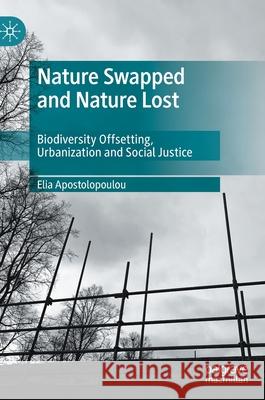
This book unravels the profound implications of biodiversity offsetting for nature-society relationships and its links to environmental and social inequality. Drawing on people’s resistance against its implementation in several urban and rural places across England, it explores how the production of equivalent natures, the core promise of offsetting, reframes socionatures both discursively and materially transforming places and livelihoods.
The book draws on theories and concepts from human geography, political ecology, and Marxist political economy, and aims to shift the trajectory of the current literature on the interplay between offsetting, urbanization and the neoliberal reconstruction of conservation and planning policies in the era following the 2008 financial crash. By shedding light on offsetting’s contested geographies, it offers a fundamental retheorization of offsetting capable of demonstrating how offsetting, and more broadly revanchist neoliberal policies, are increasingly used to support capitalist urban growth producing socially, environmentally and geographically uneven outcomes.
Nature Swapped and Nature Lost brings forward an understanding of environmental politics as class politics and sees environmental justice as inextricably linked to social justice. It effectively challenges the dystopia of offsetting’s ahistorical and asocial non-places and proposes a radically different pathway for gaining social control over the production of nature by linking struggles for the right to the city with struggles for the right to nature for all.
Elia Apostolopoulou is a senior research fellow at the University of Cambridge, UK and a visiting research fellow at Harokopio University of Athens, Greece. While writing a significant part of this book she was a lecturer at the Department of Geography, University of Cambridge, UK. She is also co-editor of The Right to Nature: Social Movements, Environmental Justice and Neoliberal Natures(2019).