• Wyszukiwanie zaawansowane
  • Kategorie
  • Kategorie BISAC
  • Książki na zamówienie
  • Promocje
  • Granty
  • Książka na prezent
  • Opinie
  • Pomoc
  • Załóż konto
  • Zaloguj się

Nanoalloys: Synthesis, Structure and Properties » książka


zaloguj się | załóż konto
Logo Krainaksiazek.pl

koszyk

konto

szukaj
topmenu
Księgarnia internetowa
Szukaj
Książki na zamówienie
Promocje
Granty
Książka na prezent
Moje konto
Pomoc
 
 
Wyszukiwanie zaawansowane
Pusty koszyk
Bezpłatna dostawa dla zamówień powyżej 20 złBezpłatna dostawa dla zamówień powyżej 20 zł

Kategorie główne

• Nauka
 [2952079]
• Literatura piękna
 [1850969]

  więcej...
• Turystyka
 [71058]
• Informatyka
 [151066]
• Komiksy
 [35579]
• Encyklopedie
 [23181]
• Dziecięca
 [620496]
• Hobby
 [139036]
• AudioBooki
 [1646]
• Literatura faktu
 [228729]
• Muzyka CD
 [379]
• Słowniki
 [2932]
• Inne
 [445708]
• Kalendarze
 [1409]
• Podręczniki
 [164793]
• Poradniki
 [480107]
• Religia
 [510956]
• Czasopisma
 [511]
• Sport
 [61267]
• Sztuka
 [243299]
• CD, DVD, Video
 [3411]
• Technologie
 [219640]
• Zdrowie
 [100984]
• Książkowe Klimaty
 [124]
• Zabawki
 [2281]
• Puzzle, gry
 [3363]
• Literatura w języku ukraińskim
 [258]
• Art. papiernicze i szkolne
 [8020]
Kategorie szczegółowe BISAC

Nanoalloys: Synthesis, Structure and Properties

ISBN-13: 9781447140139 / Angielski / Twarda / 2012 / 412 str.
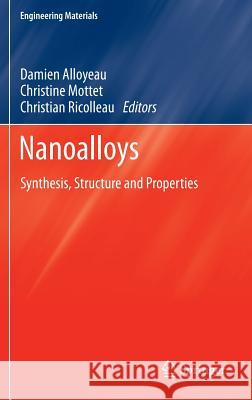
Damien Alloyeau; Christine Mottet; Christian Ricolleau
Nanoalloys: Synthesis, Structure and Properties Alloyeau, Damien 9781447140139 Springer - książkaWidoczna okładka, to zdjęcie poglądowe, a rzeczywista szata graficzna może różnić się od prezentowanej.

Nanoalloys: Synthesis, Structure and Properties

ISBN-13: 9781447140139 / Angielski / Twarda / 2012 / 412 str.

Damien Alloyeau; Christine Mottet; Christian Ricolleau
cena 402,53
(netto: 383,36 VAT:  5%)

Najniższa cena z 30 dni: 385,52
Termin realizacji zamówienia:
ok. 22 dni roboczych.

Darmowa dostawa!
inne wydania

Bimetallic nanoparticles, also called nanoalloys, are at the heart of nanoscience because of their ability to tune together composition and size for specific purposes. By approaching both their physical and chemical properties, Nanoalloys: Synthesis, Structure & Properties provides a comprehensive reference to this research field in nanoscience by addressing the subject from both experimental and theoretical points of view, providing chapters across three main topics:
Growth and structural properties
Thermodynamics and electronic structure of nanoalloys
Magnetic, optic and catalytic propertiesThe growth and elaboration processes which are the necessary and crucial part of any experimental approach are detailed in the first chapter. Three chapters are focused on the widely used characterization techniques sensitive to both the structural arrangements and chemistry of nanoalloys. The electronic structure of nanoalloys is described as a guide of useful concepts and theoretical tools. Chapters covering thermodynamics begin with bulk alloys, going to nanoalloys via surfaces in order to describe chemical order/disorder, segregation and phase transitions in reduced dimension. Finally, the optical, magnetic and catalytic properties are discussed by focusing on nanoparticles formed with one element to track the modifications which occur when forming nanoalloys. The range and detail of Nanoalloys: Synthesis, Structure & Properties makes it an ideal resource for postgraduates and researchers working in the field of nanoscience looking to expand and support their knowledge of nanoalloys.


Kategorie:
Technologie
Kategorie BISAC:
Technology & Engineering > Nanotechnology & MEMS
Science > Nanoscience
Science > Physics - Condensed Matter
Wydawca:
Springer
Seria wydawnicza:
Engineering Materials
Język:
Angielski
ISBN-13:
9781447140139
Rok wydania:
2012
Wydanie:
2012
Numer serii:
000089500
Ilość stron:
412
Waga:
0.79 kg
Wymiary:
23.5 x 15.5
Oprawa:
Twarda
Wolumenów:
01
Dodatkowe informacje:
Wydanie ilustrowane

1.Nucleation and growth of bimetallic nanoparticles.- 2.Bimetallic nanoparticles, grown under UHV on insulators, studied by scanning probe microscopy.- 3.Probing nanoalloy structure and morphology by X-ray scattering methods.- 4.Transmission electron microscopy: a multifunctional tool for the atomic-scale characterization of nanoalloys.- 5.Electronic structure of nanoalloys: a guide of useful concepts and tools.- 6.Chemical order and disorder in alloys.- 7.Segregation and phase transitions in reduced dimension: from bulk to clusters via surfaces.- 8.Computational methods for predicting the structures of nanoalloys.- 9.Magnetism of low-dimension alloys.- 10.Optical, structural and magneto-optical properties of metal clusters and nanoparticles.- 11.Surface studies of catalysis by metals: nanosize and alloying effects.

Damien Alloyeau is working at the Paris Diderot University in the Materials and Quantum Phenomena laboratory. His research focuses on both the synthesis of innovative nanomaterials and the development of electron microscopy techniques dedicated to the study of nano-objects. After his PhD thesis focused on the thermodynamical properties of CoPt nanoparticles in Paris, he obtained a post-doctoral position at the National Center for Electron Microscopy in Berkeley (LBNL, USA) where he became a specialist in aberration-corrected high-resolution TEM. He entered the CNRS as a permanent researcher in 2010. Recently, he has applied electron tomography and quantitative high-resolution electron microscopy to study the effect of the shape of CoPt nanoparticles on their order-disorder phase transition. This work, recently published in Nature Materials, is an important step forward in determining the origin of size effects in magnetic alloys nanoparticles.

Christine Mottet is a researcher of the department of Theory and Numerical Simulations of the Interdisciplinary Centre of Nanoscience in Marseille (France). After a thesis on metallic clusters and a post-doc at the University of Genova, Italy, in the group of the professor Ferrando on the growth of metallic surfaces, she enters the CNRS as researcher in the group of modelisation of Guy Tréglia in the Research Centre on Crystal Growth Mecanisms in Marseille. She works on the modelling by numerical simulations of the structure and dynamics of metallic nanoparticles. She has been member of the Council of the French Physical Society and of the National Council of the Universities. Since 2008, she has been co-director, with Christian Ricolleau, of a CNRS research network composed of 30 French laboratories working on nanoalloys.

Christian Ricolleau is the leader of the Advanced Transmission Electron Microscopy and Nanostructures group at the Material and Quantum Phenomena laboratory. He is a physicist in materials science with much experience in electron microscopy (mainly in high resolution, diffraction and energy filtered TEM techniques). He has extensive knowledge in the growth of metallic nanoparticles on oxide substrates since it has been, in addition to the new development in advanced TEM techniques, his main field of research since 1999. After his PhD thesis on the wetting phenomenon of antiphase boundaries in binary alloys, he got the position of assistant professor in Mineralogy Crystallography Lab in Paris Diderot University. In 2000, he participated in the creation of the Materials and Quantum Phenomena laboratory and, in 2004, he received the position of professor at the Paris Diderot University. Since 2008, he has been the director of the Nanoalloys Research Network of the CNRS.

From May 2010, Christine Mottet and Christian Ricolleau are French members of the Management Committee of the COST Action "Nanoalloys as advanced materials: from structure to properties and applications".

Contributing Authors:

Chapter 1. Christophe Petit and Vincent Repain

Chapter 2. Claude R. Henry and Clemens Barth

Chapter 3. Pascal Andreazza

Chapter 4. Damien Alloyeau

Chapter 5. G. Tréglia, C. Goyhenex, C. Mottet, B. Legrand and F. Ducastelle

Chapter 6. François Ducastelle

Chapter 7. J. Creuze, F. Berthier and B. Legrand

Chapter 8. Riccardo Ferrando

Chapter 9. V. Pierron-Bohnes, A. Tamion, F. Tournus and V. Dupuis

Chapter 10. E. Cottancin, N. Del Fatti and V. Halté

Chapter 11. Laurent Piccolo

Chapter 2. Claude R. Henry and Clemens Barth

Chapter 3. Pascal Andreazza

Chapter 4. Damien Alloyeau

Chapter 5. G. Tréglia, C. Goyhenex, C. Mottet, B. Legrand and F. Ducastelle

Chapter 6. François Ducastelle

Chapter 7. J. Creuze, F. Berthier and B. Legrand

Chapter 8. Riccardo Ferrando

Chapter 9. V. Pierron-Bohnes, A. Tamion, F. Tournus and V. Dupuis

Chapter 10. E. Cottancin, N. Del Fatti and V. Halté

Chapter 11. Laurent Piccolo

Chapter 6. François Ducastelle

Chapter 7. J. Creuze, F. Berthier and B. Legrand

Chapter 8. Riccardo Ferrando

Chapter 9. V. Pierron-Bohnes, A. Tamion, F. Tournus and V. Dupuis

Chapter 10. E. Cottancin, N. Del Fatti and V. Halté

Chapter 11. Laurent Piccolo

Bimetallic nanoparticles, also called nanoalloys, are at the heart of nanoscience because of their ability to tune together composition and size for specific purposes. By approaching both their physical and chemical properties, Nanoalloys: Synthesis, Structure & Properties provides a comprehensive reference to this research field in nanoscience by addressing the subject from both experimental and theoretical points of view, providing chapters across three main topics:
•Growth and structural properties
•Thermodynamics and electronic structure of nanoalloys
•Magnetic, optic and catalytic properties

The growth and elaboration processes which are the necessary and crucial part of any experimental approach are detailed in the first chapter. Three chapters are focused on the widely used characterization techniques sensitive to both the structural arrangements and chemistry of nanoalloys. The electronic structure of nanoalloys is described as a guide of useful concepts and theoretical tools.  Chapters covering thermodynamics begin with bulk alloys, going to nanoalloys via surfaces in order to describe chemical order/disorder, segregation and phase transitions in reduced dimension. Finally, the optical, magnetic and catalytic properties are discussed by focusing on nanoparticles formed with one element to track the modifications which occur when forming nanoalloys.

The range and detail of Nanoalloys: Synthesis, Structure & Properties makes it an ideal resource for postgraduates and researchers working in the field of nanoscience looking to expand and support their knowledge of nanoalloys.




Udostępnij

Facebook - konto krainaksiazek.pl


Opinie o Krainaksiazek.pl na Opineo.pl

Partner Mybenefit

Krainaksiazek.pl w programie rzetelna firma Krainaksiaze.pl - płatności przez paypal

Czytaj nas na:

Facebook - krainaksiazek.pl
  • książki na zamówienie
  • granty
  • książka na prezent
  • kontakt
  • pomoc
  • opinie
  • regulamin
  • polityka prywatności

Zobacz:

  • Księgarnia czeska

  • Wydawnictwo Książkowe Klimaty

1997-2026 DolnySlask.com Agencja Internetowa

© 1997-2022 krainaksiazek.pl
     
KONTAKT | REGULAMIN | POLITYKA PRYWATNOŚCI | USTAWIENIA PRYWATNOŚCI
Zobacz: Księgarnia Czeska | Wydawnictwo Książkowe Klimaty | Mapa strony | Lista autorów
KrainaKsiazek.PL - Księgarnia Internetowa

Polityka prywatnosci - link
Krainaksiazek.pl - płatnośc Przelewy24
Przechowalnia Przechowalnia




