• Wyszukiwanie zaawansowane
  • Kategorie
  • Kategorie BISAC
  • Książki na zamówienie
  • Promocje
  • Granty
  • Książka na prezent
  • Opinie
  • Pomoc
  • Załóż konto
  • Zaloguj się

Nano Enhanced Phase Change Materials » książka


zaloguj się | załóż konto
Logo Krainaksiazek.pl

koszyk

konto

szukaj
topmenu
Księgarnia internetowa
Szukaj
Książki na zamówienie
Promocje
Granty
Książka na prezent
Moje konto
Pomoc
 
 
Wyszukiwanie zaawansowane
Pusty koszyk
Bezpłatna dostawa dla zamówień powyżej 20 złBezpłatna dostawa dla zamówień powyżej 20 zł

Kategorie główne

• Nauka
 [2946912]
• Literatura piękna
 [1852311]

  więcej...
• Turystyka
 [71421]
• Informatyka
 [150889]
• Komiksy
 [35717]
• Encyklopedie
 [23177]
• Dziecięca
 [617324]
• Hobby
 [138808]
• AudioBooki
 [1671]
• Literatura faktu
 [228371]
• Muzyka CD
 [400]
• Słowniki
 [2841]
• Inne
 [445428]
• Kalendarze
 [1545]
• Podręczniki
 [166819]
• Poradniki
 [480180]
• Religia
 [510412]
• Czasopisma
 [525]
• Sport
 [61271]
• Sztuka
 [242929]
• CD, DVD, Video
 [3371]
• Technologie
 [219258]
• Zdrowie
 [100961]
• Książkowe Klimaty
 [124]
• Zabawki
 [2341]
• Puzzle, gry
 [3766]
• Literatura w języku ukraińskim
 [255]
• Art. papiernicze i szkolne
 [7810]
Kategorie szczegółowe BISAC

Nano Enhanced Phase Change Materials

ISBN-13: 9789819954742 / Angielski / Twarda / 2023
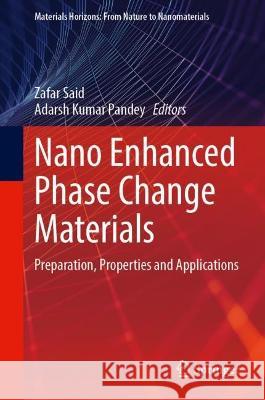
Nano Enhanced Phase Change Materials  9789819954742 Springer Nature Singapore - książkaWidoczna okładka, to zdjęcie poglądowe, a rzeczywista szata graficzna może różnić się od prezentowanej.

Nano Enhanced Phase Change Materials

ISBN-13: 9789819954742 / Angielski / Twarda / 2023

cena 524,53
(netto: 499,55 VAT:  5%)

Najniższa cena z 30 dni: 501,19
Termin realizacji zamówienia:
ok. 22 dni roboczych
Bez gwarancji dostawy przed świętami

Darmowa dostawa!

This book provides information on thermal energy storage systems incorporating phase change materials (PCMs) which are widely preferred owing to their immense energy storage capacity. The thermal energy storage (TES) potential of PCMs has been deeply explored for a wide range of applications, including solar/electrothermal energy storage, waste heat storage, and utilization, building energy-saving, and thermal regulations. The inherent shortcomings like leakage during phase transition and poor thermal conductivity hamper their extensive usage. Nevertheless, it has been addressed by their shape stabilization with porous materials and dispersing highly conductive nanoparticles. Nanoparticles suspended in traditional phase change materials enhance the thermal conductivity. The addition of these nanoparticles to the conventional PCM enhances the storage. In this book, the history of Nano Enhanced Phase Change Materials (NEPCM), preparation techniques, properties, theoretical modeling and correlations, and the effect of all these factors on the potential applications such as: solar energy, electronics cooling, heat exchangers, building, battery thermal management, thermal energy storage are discussed in detail. Future challenges and future work scope have been included. The information from this book can enable the readers to come up with novel techniques, resolve existing research limitations, and come up with novel NEPCM, that can be implemented for various applications.


Kategorie:
Nauka, Fizyka
Wydawca:
Springer Nature Singapore
Seria wydawnicza:
Materials Horizons: From Nature to Nanomaterials
Język:
Angielski
ISBN-13:
9789819954742
Rok wydania:
2023
Waga:
0.58 kg
Wymiary:
23.5 x 15.5
Oprawa:
Twarda
Dodatkowe informacje:
Wydanie ilustrowane

  1. Introduction to Nano Enhanced Phase Change Materials (Dr. Zafar & Dr. Pandey)

1.1. Introduction

1.2.  Nano Enhanced Phase Change Materials

1.3. Scope


  • Overview of PCMs (Dr. Muhammad Farooq, Department of Mechanical Engineering, University of Engineering and Technology, 39161 Lahore, Pakistan, &Dr. Zafar Said)
  • 2.1. Classification of PCMs

    2.2. PCM selection criteria

    2.3. Improvement of the thermal performance of PCMs


    1. Synthesis, characterization, and stability of NEPCM (Dr. Syam, Dr. Feroz (ferozs2005@gmail.com), Affiliation: Department of Mechanical Engineering, Prince Mohammad bin Fahd University, AlKhobar, Saudi Arabia, & Dr. Zafar Said)
    2.1 Preparation of NEPCM

    2.2. NEPCM preparation techniques


    1. Influence of nanoparticles on thermophysical properties of PCMs (Dr. Arun & Amit)

    4.1. Melting point

    4.2. Thermal conductivity

    4.3. Latent heat capacity

    4.4. Phase change temperature

    4.5. Effect of thermal cycles

    4.6. Thermal diffusivity

    4.7. Density

    4.8. Viscosity

    4.9. Thermo-physical properties after thermal cycles

    4.10.          Interaction between different properties


    1. Nanostructure–based colloidal suspension for thermal enhancement for NEPCM (Dr. Syam, Dr. Feroz (ferozs2005@gmail.com), and Dr. Essam ejassim@pmu.edu.sa, Affiliation: Department of Mechanical Engineering, Prince Mohammad bin Fahd University, AlKhobar, Saudi Arabia, & Dr. Zafar Said)

    5.1. Nanoparticle–based colloidal suspensions

    5.2. Nanotube–based colloidal suspensions

    5.3. Nanofibre–based colloidal suspensions


    1. Theoretical Analysis and correlations for predicting properties and Evaluation methods for NEPCMs (Jeeja Jacob, Jeyraj Selvaraj,UM Power Energy Dedicated Advanced Research Centre, University of Malaya, Malaysia)


    1. Application of nano-enhanced PCMs in Solar Energy (Dr. Arun, Amit Kumar, Mechanical Engineering Department, Institute of Engineering & Technology, Dr. A.P.J. Abdul Kalam Technical University, Uttar Pradesh, Lucknow, India and & Dr. Zafar Said)

    7.1. Solar applications

    7.1.1.        Solar water heaters

    7.1.2.        Solar air heaters

    7.1.3.        Solar thermal power exchanger

    7.1.4.        Solar cooker

    7.1.5.        Solar collectors

    1. Application of nano-enhanced PCMs in Buildings (Praveen Kumar Tyagi, Rajan Kumar, Department of Mechanical Engineering, Dr B R Ambedkar National Institute of Technology, Jalandhar, Punjab 144011, India & Dr. Zafar Said)


    1. Application of nano-enhanced PCMs in Electronics devices (Kapil Chopra, V.V. Tyagi

    School of Energy Management, Shri Mata Vaishno Devi University, Katra, J&K State)


  • Application of nano-enhanced PCMs in Textiles (R. Reji Kumar, M.Samykano, College of Engineering, University Malaysia Pahang, 26300 Gambang, Kuantan, Pahang)
  •  

    1. Soft computing tool (intelligent techniques) for nano-enhanced PCM (Dr. Zafar & Dr. Prabhakar (School of Engineering Sciences, Delhi Skill and Entrepreneurship University, Delhi 110089, India) & Dr. Pandey)


    1. Challenges and difficulties in developing Nano Enhanced Phase Change Materials and Way forward (Dr. Zafar & Dr. Pandey)

    12.1.          Stability

    12.2.          Economic aspect, environmental impact and safety issue

    12.3.          Cost

    12.4.          Sonication effect

    12.5.          Degradation of original properties

    Dr. Zafar Said is an Associate Professor at the Department of Sustainable Renewable Energy Engineering, University of Sharjah, U.A.E. He holds a B.S. in Mechanical Engineering (Hons.) from University Tenaga Nasional, Malaysia, and a Ph.D. from the University of Malaya, Malaysia. Post-PhD, he served as a researcher at the iSmart group in the Engineering Systems and Management Department of Khalifa University (formerly Masdar Institute), U.A.E, contributing to external industrial projects. His research interests encompass renewable energy, AI, optimization, and nanofluids, nano enhanced phase change materials, and he has produced over 230+ publications. Recognized among the top 2% of global scientists in the energy field, Dr. Said also ranks within the top 100 scientists in the UAE. His accolades include the 2022 Rising Star Science Star award by Research.com, the 2023 Research and Innovation Award from the UAE Ministry of Energy and Infrastructure, and several faculty awards. Dr. Said serves as a guest editor and editorial board member for several reputed journals.


    Prof. Adarsh Kumar Pandey is currently working as a Professor and Associate Dean (Engagement) at Research Centre for Nano-Materials and Energy Technology (RCNMET), School of Engineering and Technology, Sunway University, Malaysia. Prof. Pandey is leading the Ph.D. in Sustainability Science and Technology program at Sunway University. Prior to this, he worked at University of Malaya Power Energy Dedicated Advanced Centre (UMPEDAC), University of Malaya, Malaysia. Prof. Pandey holds Ph.D. in Energy from SMVD University, India. He is ranked in World's Top 2% Scientists by Elsevier BV and Stanford University in the field of Energy and awardee of several awards such as award of excellence in research 2022 from Sunway University. Prof. Pandey produced more than 200 Publications; as well he is author of books and book chapters. His current area of research involves but not limited to sustainable energy technologies, advanced energy materials, Nano Enhanced Phase Change Materials (NePCMs), solar PV and PVT, dye sensitized solar cells, etc. Prof. Pandey serves as a guest editor and editorial board member for several reputed journals.

    This book provides information on thermal energy storage systems incorporating phase change materials (PCMs) which are widely preferred owing to their immense energy storage capacity. The thermal energy storage (TES) potential of PCMs has been deeply explored for a wide range of applications, including solar/electrothermal energy storage, waste heat storage, and utilization, building energy-saving, and thermal regulations. The inherent shortcomings like leakage during phase transition and poor thermal conductivity hamper their extensive usage. Nevertheless, it has been addressed by their shape stabilization with porous materials and dispersing highly conductive nanoparticles. Nanoparticles suspended in traditional phase change materials enhance the thermal conductivity. The addition of these nanoparticles to the conventional PCM enhances the storage. In this book, the history of Nano Enhanced Phase Change Materials (NEPCM), preparation techniques, properties, theoretical modeling and correlations, and the effect of all these factors on the potential applications such as: solar energy, electronics cooling, heat exchangers, building, battery thermal management, thermal energy storage are discussed in detail. Future challenges and future work scope have been included. The information from this book can enable the readers to come up with novel techniques, resolve existing research limitations, and come up with novel NEPCM, that can be implemented for various applications.




    Udostępnij

    Facebook - konto krainaksiazek.pl


    Opinie o Krainaksiazek.pl na Opineo.pl

    Partner Mybenefit

    Krainaksiazek.pl w programie rzetelna firma Krainaksiaze.pl - płatności przez paypal

    Czytaj nas na:

    Facebook - krainaksiazek.pl
    • książki na zamówienie
    • granty
    • książka na prezent
    • kontakt
    • pomoc
    • opinie
    • regulamin
    • polityka prywatności

    Zobacz:

    • Księgarnia czeska

    • Wydawnictwo Książkowe Klimaty

    1997-2025 DolnySlask.com Agencja Internetowa

    © 1997-2022 krainaksiazek.pl
         
    KONTAKT | REGULAMIN | POLITYKA PRYWATNOŚCI | USTAWIENIA PRYWATNOŚCI
    Zobacz: Księgarnia Czeska | Wydawnictwo Książkowe Klimaty | Mapa strony | Lista autorów
    KrainaKsiazek.PL - Księgarnia Internetowa

    Polityka prywatnosci - link
    Krainaksiazek.pl - płatnośc Przelewy24
    Przechowalnia Przechowalnia




