


ISBN-13: 9781118915639 / Angielski / Miękka / 2016 / 480 str.
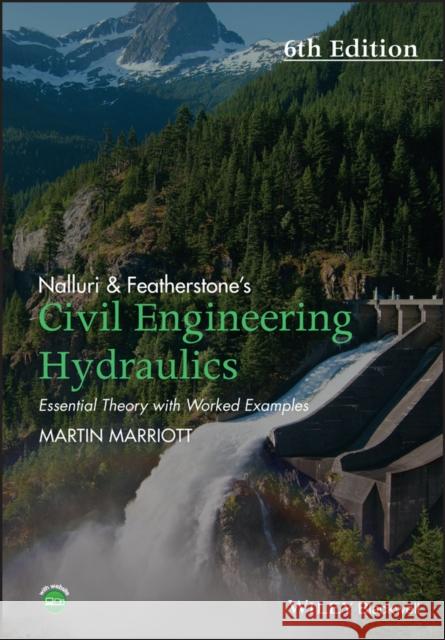
An update of a classic textbook covering a core subject taught on most civil engineering courses. Civil Engineering Hydraulics, 6th edition contains substantial worked example sections with an online solutions manual. This classic text provides a succinct introduction to the theory of civil engineering hydraulics, together with a large number of worked examples and exercise problems. Each chapter contains theory sections and worked examples, followed by a list of recommended reading and references. There are further problems as a useful resource for students to tackle, and exercises to enable students to assess their understanding. The numerical answers to these are at the back of the book, and solutions are available to download from the book s companion website.
Preface to Sixth Edition x
About the Authors xiii
Symbols xiv
1 Properties of Fluids 1
1.1 Introduction 1
1.2 Engineering units 1
1.3 Mass density and specific weight 1
1.4 Relative density 2
1.5 Viscosity of fluids 2
1.6 Compressibility and elasticity of fluids 2
1.7 Vapour pressure of liquids 2
1.8 Surface tension and capillarity 3
Worked examples 3
References and recommended reading 5
Problems 5
2 Fluid Statics 6
2.1 Introduction 6
2.2 Pascal s law 6
2.3 Pressure variation with depth in a static incompressible fluid 7
2.4 Pressure measurement 8
2.5 Hydrostatic thrust on plane surfaces 10
2.6 Pressure diagrams 13
2.7 Hydrostatic thrust on curved surfaces 14
2.8 Hydrostatic buoyant thrust 16
2.9 Stability of floating bodies 16
2.10 Determination of metacentre 17
2.11 Periodic time of rolling (or oscillation) of a floating body 19
2.12 Liquid ballast and the effective metacentric height 19
2.13 Relative equilibrium 21
Worked examples 23
References and recommended reading 40
Problems 40
3 Fluid Flow Concepts and Measurements 45
3.1 Kinematics of fluids 45
3.2 Steady and unsteady flows 46
3.3 Uniform and non–uniform flows 46
3.4 Rotational and irrotational flows 47
3.5 One–, two– and three–dimensional flows 47
3.6 Streamtube and continuity equation 47
3.7 Accelerations of fluid particles 48
3.8 Two kinds of fluid flow 49
3.9 Dynamics of fluid flow 50
3.10 Energy equation for an ideal fluid flow 50
3.11 Modified energy equation for real fluid flows 52
3.12 Separation and cavitation in fluid flow 53
3.13 Impulse momentum equation 54
3.14 Energy losses in sudden transitions 55
3.15 Flow measurement through pipes 56
3.16 Flow measurement through orifices and mouthpieces 58
3.17 Flow measurement in channels 62
Worked examples 67
References and recommended reading 83
Problems 83
4 Flow of Incompressible Fluids in Pipelines 87
4.1 Resistance in circular pipelines flowing full 87
4.2 Resistance to flow in non–circular sections 92
4.3 Local losses 92
Worked examples 93
References and recommended reading 113
Problems 113
5 Pipe Network Analysis 116
5.1 Introduction 116
5.2 The head balance method ( loop method) 117
5.3 The quantity balance method ( nodal method) 118
5.4 The gradient method 120
Worked examples 122
References and recommended reading 139
Problems 140
6 Pump Pipeline System Analysis and Design 145
6.1 Introduction 145
6.2 Hydraulic gradient in pump pipeline systems 146
6.3 Multiple pump systems 147
6.4 Variable–speed pump operation 149
6.5 Suction lift limitations 149
Worked examples 150
References and recommended reading 164
Problems 164
7 Boundary Layers on Flat Plates and in Ducts 167
7.1 Introduction 167
7.2 The laminar boundary layer 167
7.3 The turbulent boundary layer 168
7.4 Combined drag due to both laminar and turbulent boundary layers 169
7.5 The displacement thickness 169
7.6 Boundary layers in turbulent pipe flow 170
7.7 The laminar sub–layer 172
Worked examples 174
References and recommended reading 181
Problems 181
8 Steady Flow in Open Channels 183
8.1 Introduction 183
8.2 Uniform flow resistance 184
8.3 Channels of composite roughness 185
8.4 Channels of compound section 186
8.5 Channel design 187
8.6 Uniform flow in part–full circular pipes 190
8.7 Steady, rapidly varied channel flow energy principles 191
8.8 The momentum equation and the hydraulic jump 192
8.9 Steady gradually varied open channel flow 194
8.10 Computations of gradually varied flow 195
8.11 The direct step method 195
8.12 The standard step method 196
8.13 Canal delivery problems 197
8.14 Culvert flow 198
8.15 Spatially varied flow in open channels 199
Worked examples 201
References and recommended reading 237
Problems 237
9 Dimensional Analysis, Similitude and Hydraulic Models 242
9.1 Introduction 242
9.2 Dimensional analysis 243
9.3 Physical significance of non–dimensional groups 243
9.4 The Buckingham theorem 244
9.5 Similitude and model studies 244
Worked examples 245
References and recommended reading 257
Problems 258
10 Ideal Fluid Flow and Curvilinear Flow 260
10.1 Ideal fluid flow 260
10.2 Streamlines, the stream function 260
10.3 Relationship between discharge and stream function 261
10.4 Circulation and the velocity potential function 262
10.5 Stream functions for basic flow patterns 262
10.6 Combinations of basic flow patterns 264
10.7 Pressure at points in the flow field 264
10.8 The use of flow nets and numerical methods 265
10.9 Curvilinear flow of real fluids 268
10.10 Free and forced vortices 269
Worked examples 269
References and recommended reading 280
Problems 280
11 Gradually Varied Unsteady Flow from Reservoirs 283
11.1 Discharge between reservoirs under varying head 283
11.2 Unsteady flow over a spillway 285
11.3 Flow establishment 286
Worked examples 287
References and recommended reading 296
Problems 296
12 Mass Oscillations and Pressure Transients in Pipelines 298
12.1 Mass oscillation in pipe systems surge chamber operation 298
12.2 Solution neglecting tunnel friction and throttle losses for sudden discharge stoppage 299
12.3 Solution including tunnel and surge chamber losses for sudden discharge stoppage 300
12.4 Finite difference methods in the solution of the surge chamber equations 301
12.5 Pressure transients in pipelines (waterhammer) 302
12.6 The basic differential equations of waterhammer 304
12.7 Solutions of the waterhammer equations 305
12.8 The Allievi equations 305
12.9 Alternative formulation 308
Worked examples 309
References and recomended reading 315
Problems 315
13 Unsteady Flow in Channels 316
13.1 Introduction 316
13.2 Gradually varied unsteady flow 316
13.3 Surges in open channels 317
13.4 The upstream positive surge 318
13.5 The downstream positive surge 319
13.6 Negative surge waves 320
13.7 The dam break 322
Worked examples 323
References and recommended reading 326
Problems 326
14 Uniform Flow in Loose–Boundary Channels 327
14.1 Introduction 327
14.2 Flow regimes 327
14.3 Incipient (threshold) motion 327
14.4 Resistance to flow in alluvial (loose–bed) channels 329
14.5 Velocity distributions in loose–boundary channels 331
14.6 Sediment transport 331
14.7 Bed load transport 332
14.8 Suspended load transport 334
14.9 Total load transport 337
14.10 Regime channel design 338
14.11 Rigid–bed channels with sediment transport 342
Worked examples 344
References and recommended reading 358
Problems 359
15 Hydraulic Structures 361
15.1 Introduction 361
15.2 Spillways 361
15.3 Energy dissipators and downstream scour protection 366
Worked examples 369
References and recommended reading 379
Problems 380
16 Environmental Hydraulics and Engineering Hydrology 382
16.1 Introduction 382
16.2 Analysis of gauged river flow data 382
16.3 River Thames discharge data 384
16.4 Flood alleviation, sustainability and environmental channels 385
16.5 Project appraisal 386
Worked examples 387
References and recommended reading 394
Problems 395
17 Introduction to Coastal Engineering
17.1 Introduction
17.2 Waves and wave theories
17.3 Wave processes
17.4 Wave set–down and set–up
17.5 Wave impact, run–up and overtopping
17.6 Tides, surges and mean sea level
17.7 Solitary and tsunami waves
Worked examples
References and recommended reading
Problems
Answers 397
Index 401
Hydraulics underpins many topics in the water and environmental area of civil engineering. Water engineers work to ensure that we have a sustainable water supply, developing ever more efficient means of collecting, storing and distributing water for domestic, industrial and irrigation purposes. They also deal with drainage, sewerage, flood alleviation and coastal engineering.
This well–established textbook covers a core subject taught on most civil engineering courses. Expanded and revised by a syllabus expert who draws on wide experience in professional practice and university teaching of hydraulics, the new edition includes a new chapter on coastal engineering and has been updated to reflect current practice and course requirements.
Civil Engineering Hydraulics, 6th edition contains substantial worked example sections with an online solutions manual. A strength of the book has always been in its presentation these exercises, distinguishing it from other books on hydraulics and enabling students to test their understanding of the theory and of the methods of analysis and design.
This classic text provides a succinct introduction to the theory of civil engineering hydraulics, together with a large number of worked examples and exercise problems. Each chapter contains theory sections and worked examples, followed by a list of recommended reading and references. There are further problems as a useful resource for students to tackle, and exercises to enable students to assess their understanding. The numerical answers to these are at the back of the book, and solutions are available to download from the publisher s website: www.wiley.com/go/marriott.
Civil Engineering Hydraulics will be invaluable throughout a student′s course from initial principles to more advanced applications. By focussing on the problems most commonly encountered in hydraulic engineering, it will also be welcomed by practising engineers as a concise reference.
1997-2026 DolnySlask.com Agencja Internetowa











